Data Tiles
Part of the Decision-Driven Enterprise Framework

How to Identify the Decisions That Matter

Make the few decisions that drive value visible, named, owned and measurable.

DATA TILES GUIDE·7 min read·For CEO, COO, Business Executive, CDO·Decision Driven
Why this matters

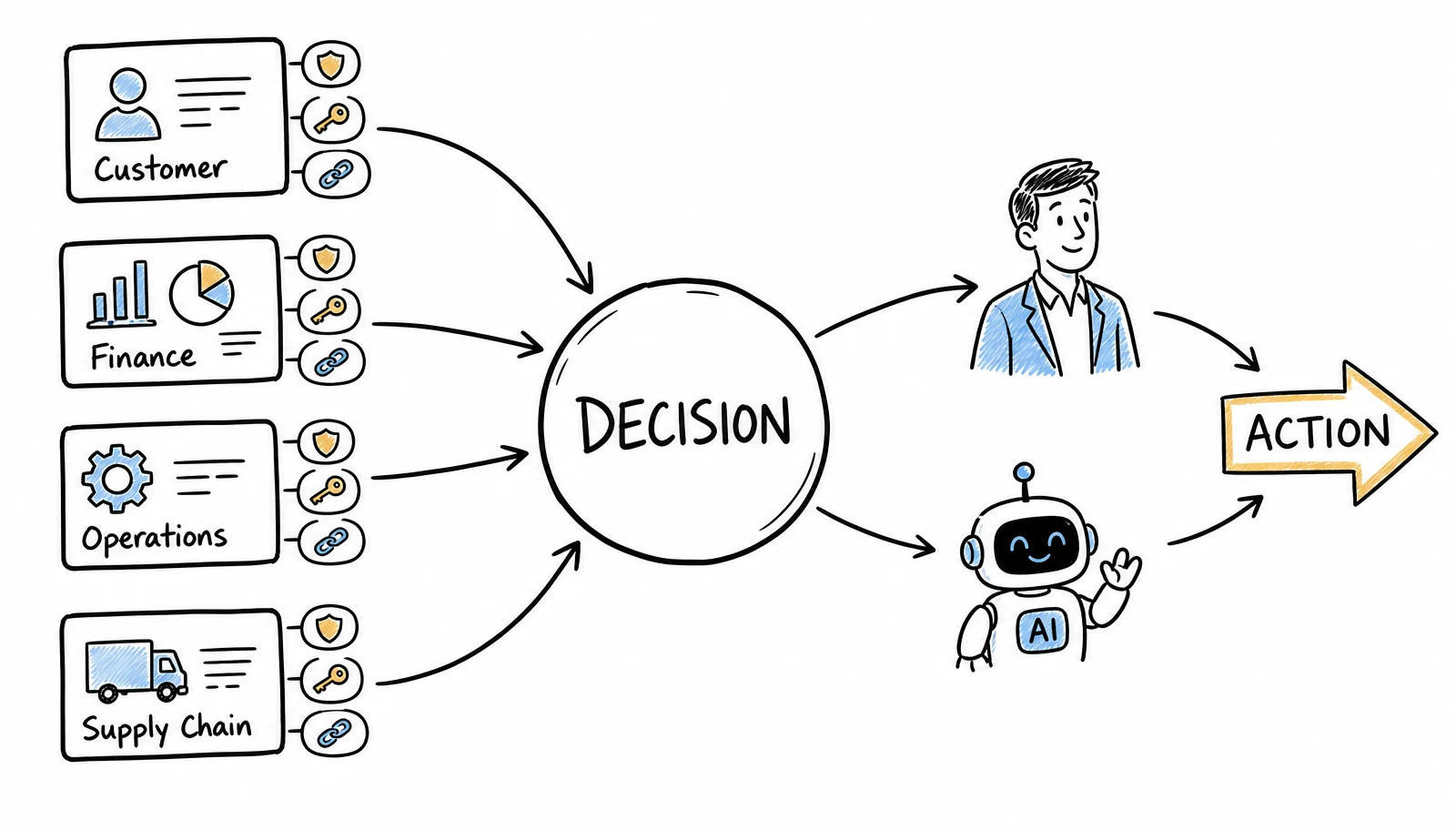
Organizations measure what they have always measured: activity, throughput and dashboards. The decisions that actually move the business sit underneath those metrics, often unnamed and unsupported. Until the decisions are visible, every data, governance and AI investment is aimed at the wrong target.

The challenge
  • · Decisions are implicit, not documented.
  • · No single owner can list the ten decisions that drive their P&L.
  • · Investment goes to dashboards that describe history, not decisions that shape the future.
  • · AI gets layered on top of a system with no decision to improve.
What good looks like
  • A short, ranked inventory of recurring decisions that drive value, risk and customer outcomes.
  • Each decision has a named owner, a frequency, an outcome measure and a current support level.
  • The inventory is shared across the executive team and revisited quarterly.
The Data Tiles framework
  1. Stage 1

    Surface

    Surface the decisions hiding inside processes and dashboards.

    What to do

    Run a structured workshop with line-of-business leaders to list recurring decisions.

    Where it gets stuck

    Decisions get described as activities or reports.

    How Latttice helps

    Latttice links surfaced decisions to the data products that should support them.

    How Lenz helps

    Lenz captures decision context for downstream AI.

  2. Stage 2

    Prioritize

    Rank by value, frequency, risk and reversibility.

    What to do

    Score each decision on a simple matrix and pick the top ten.

    Where it gets stuck

    Everyone wants their own decision at the top.

  3. Stage 3

    Own

    Assign a single accountable business owner to each priority decision.

    What to do

    Document the owner, the outcome measure and the support gap.

    Where it gets stuck

    Ownership defaults to a committee.

  4. Stage 4

    Instrument

    Measure the decision quality and outcomes over time.

    What to do

    Set a baseline. Track outcomes against intent.

    Where it gets stuck

    No system of record for decisions.

    How Lenz helps

    Lenz instruments decisions made with AI support.

Practical roadmap
First 30 days
  • · Run the surfacing workshop with the executive team.
  • · Produce the first draft decision inventory.
  • · Identify the top ten priority decisions.
Next 60 days
  • · Assign business owners and outcome measures.
  • · Document the current support gap for each decision.
  • · Pick the first three decisions to instrument.
Next 90 days
  • · Stand up trusted data products behind the first three decisions.
  • · Begin tracking decision quality over time.
  • · Make the decision inventory a standing executive review item.
Prioritize
  • · Decisions repeated weekly or monthly with material P&L impact.
  • · Decisions with regulatory or customer-trust exposure.
  • · Decisions that AI could augment safely.
Avoid
  • · Conflating reports with decisions.
  • · Boiling the ocean with a 200-item inventory.
  • · Letting committees take ownership.
Common mistakes
  • · Skipping straight to dashboards or AI without naming the decisions.
  • · Allowing the inventory to live in a deck no one revisits.
  • · Measuring activity instead of decision quality.
How Data Tiles helps

We facilitate the executive workshop, structure the inventory, and translate the priority decisions into trusted data products and a governance posture that supports them.

How Latttice enables this
StageChallengeCapabilityBusiness outcome
DiscoverTeams cannot find or trust the data behind the priority decisions.Latttice publishes data products with business meaning, ownership and trust signals attached.Faster reuse, less duplication, fewer escalations.
BuildBuilding the priority decisions repeatably without replatforming.Latttice industrializes data product build on top of the existing stack.Lower cost to build and operate, faster time to value.
GovernGovernance lags behind delivery.Latttice attaches quality, lineage, ownership and policy signals to every data product.Active governance without a manual review bottleneck.
OperateOwnership defaults to IT after launch.Latttice gives business owners the controls they need to take real accountability.Sustained business ownership and trust over time.
How Lenz enables this
AI requirementCapabilityGovernance benefitBusiness outcome
Explainability for priority decisionsLenz captures decision context and explains the reasoning behind every AI-supported action.Auditable, defensible decisions.Confidence to deploy AI on real decisions.
Policy enforcement at runtimeLenz applies governance signals from Latttice as policy at the point of decision.Active enforcement, not after-the-fact review.Risk is managed in the moment, not the audit.
Accountability for AI decisionsLenz attaches the named human owner and the decision instrumentation to every AI action.Clear ownership of AI outcomes.AI is adoptable by the business, not just the lab.
Executive checklist
  • We have a written inventory of the decisions that matter.
  • Each priority decision has a named business owner.
  • Each decision has an outcome measure.
  • The inventory is reviewed at executive level quarterly.

Want help applying this guide?

We help executives sequence the work, prove value on a priority decision and scale with Latttice and Lenz where it matters.