
Data, Reclaimed
What It Looks Like When You're Close to the Customer

The View From the Customer Side
Business leaders have data, but rarely fast enough for it to matter. Cameron Price's conclusion to The Death and Rebirth of Data (Part 5) sets out, strategically, why data drifted away from the business and what it takes to bring it back. What he describes in theory, I see play out in real conversations every day. This isn't a technology story. It's the friction between holding information and being able to act on it. Here's what those data problems look like from the customer side: the trust gaps, the experience failures, and the ownership shifts that turn data from obstacle into momentum.
When Theory Meets Reality
Cameron's strategic shift is not abstract from where I sit. It is the difference between teams that move and teams that stay stuck. I spend my days with business leaders, customer-facing managers, and the teams in the messy middle between having data and using it. That gap is felt every day, in delayed decisions, frustrated conversations, and opportunities that quietly slip away.
When data works, it doesn't feel like data. It feels like clarity.
Friction No One Talks About
Data problems rarely announce themselves as technology failures. They show up as friction. The three-day turnaround for a simple question. The meeting rescheduled because the numbers aren't ready. The gut decision made without data because waiting for it would have meant missing the window entirely.
One customer put it plainly: by the time the answer arrives, the question has changed. That's not just a data problem. It's a trust problem, a speed problem, an experience problem.
Trust
Ensure data ethics and governance so people believe what they're looking at.
Speed
Optimize pipelines and latency so answers arrive while the question still matters.
Experience
Focus on user-centered design so insight meets people in their flow of work.
Industry research consistently echoes this: Dataversity reports that roughly 60% of business intelligence initiatives fail to deliver measurable value when organizations prioritize tools and implementation over decision outcomes.
The Three-Day Wait
Simple questions take days because data sits in silos and depends on multiple hand-offs to extract meaning.
The Changed Question
By the time the answer arrives, the business context has moved on and the team is asking something different.
The Gut Decision
Teams make calls without data because waiting would mean missing critical windows of opportunity.
Trust Is Built on Understanding, Not Dashboards
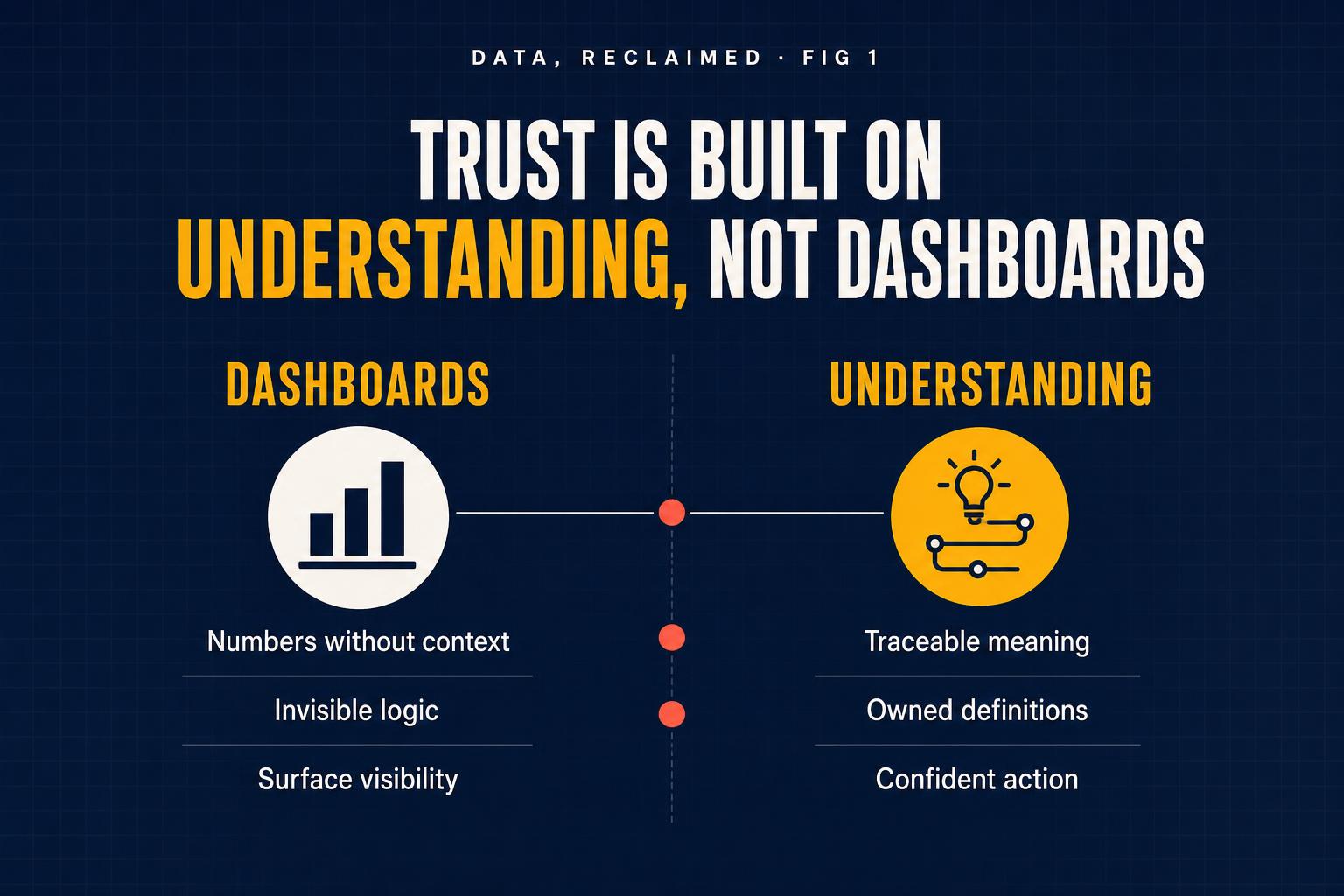
The trust gap is rarely about whether the data is accurate. It is about whether people understand what they're looking at well enough to act on it. The phrase I hear most often is some version of: "I don't trust these numbers because I don't know where they came from." Not because the source is unreliable, but because the path from raw data to insight is invisible. When you can't trace the logic, you can't trust the conclusion.
Trust comes from ownership of meaning. When the business defines which metrics matter, how they are calculated, and why they are relevant right now, those numbers begin to carry weight. They become real. They become actionable.
Dashboards don't build trust. Understanding does.
Data as an Experience, Not a Deliverable
Data isn't a thing you deliver. It's an experience you create. When someone asks for data, what they're really asking for is the ability to make a decision. They want confidence, context, and a sense of what happens next. Handing over a spreadsheet or a dashboard is only useful if the experience of engaging with it gets them closer to action.
Ease of Discovery
Can they find what they need without hunting through tabs or asking someone else?
Clarity of Context
Do they understand what they are looking at and why it matters right now?
Speed to Action
Can they move from insight to decision without waiting for interpretation?
The best data experiences don't feel like you're using data at all. They feel like you're doing your job, and the insight is just there when you need it. Seamless. Contextual. Human.
Why Ownership Changes Everything
Ownership of data does not mean turning everyone into an analyst. It means the business controls the meaning, not just the access. When IT or analytics teams own the definitions, they're making assumptions about what matters. Those assumptions are often close, sometimes spot-on, but rarely perfect. The gap between "close enough" and "exactly right" is where trust quietly erodes.
When the business owns the definitions, something shifts. People stop questioning the numbers and start using them. They don't need to verify with someone else, because they defined what "customer retention" or "conversion rate" means in the first place. That ownership creates accountability. It creates speed. It creates momentum.
Gartner predicts that by 2027, 80% of data and analytics governance initiatives will fail unless they are directly aligned to tangible business outcomes. Modern data management literature defines a data product as a domain-owned asset designed to deliver measurable business value, with embedded quality, governance, and semantics.
Business Defines Metrics
Teams decide what matters and how it should be measured, grounded in real business context.
Data Teams Enable
Technical teams build the infrastructure that makes those definitions accessible and reliable.
Trust Compounds
When people own the meaning, they trust the numbers and act faster with confidence.
Simplification, From the Customer Side
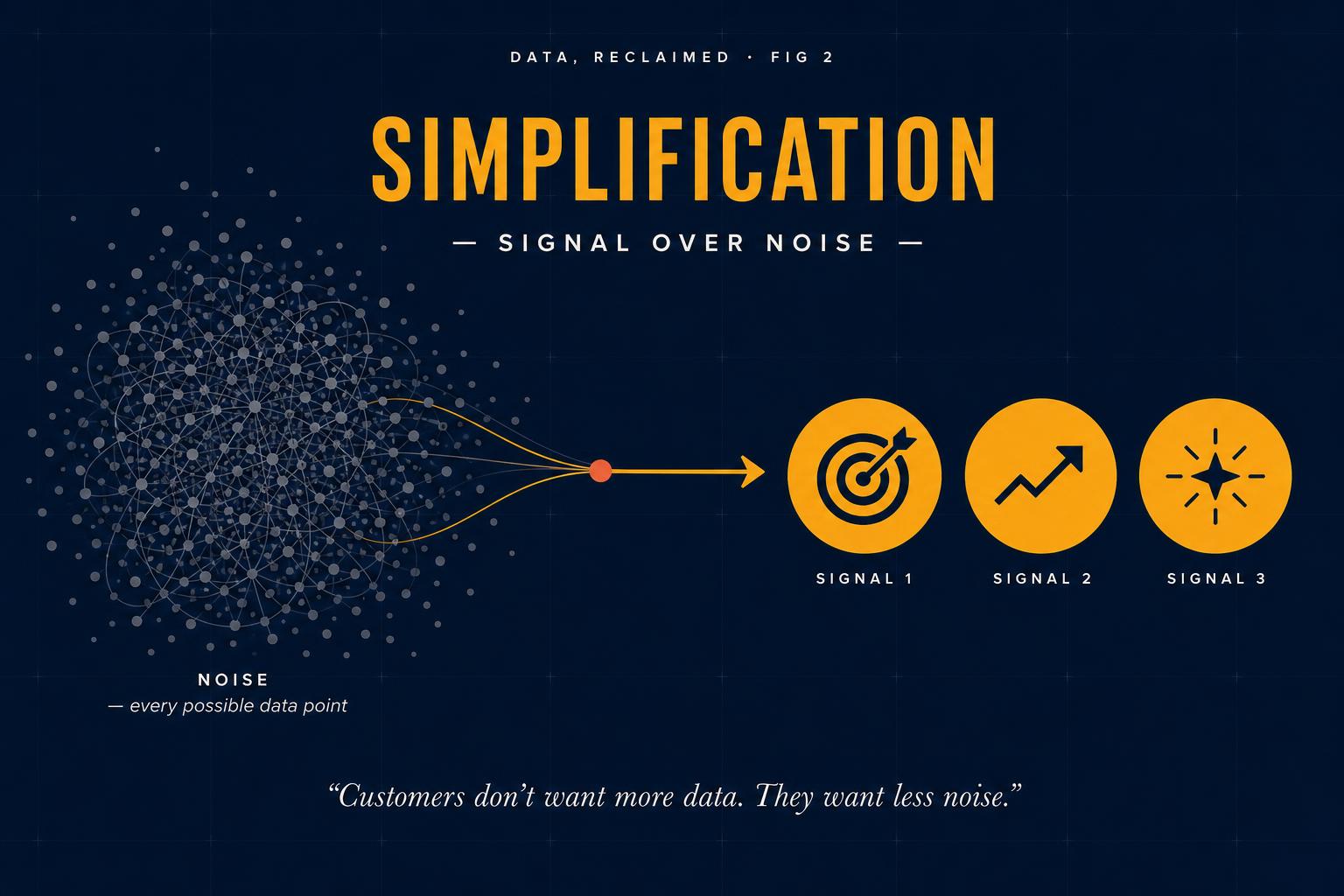
Simplification is not about dumbing things down. It is about removing everything that does not serve the decision in front of you. The biggest accelerator I see in customer success is when teams stop trying to provide every possible data point and start focusing on the three metrics that actually drive action. Not because the rest isn't valuable, but because cognitive load is real, and clarity beats comprehensiveness every time.
Customers don't want more data. They want less noise. They want the signal to be obvious. They want to look at something and know immediately whether things are going well, and what to do if they're not.
Customers don't want more data. They want less noise.
Where AI Helps, and Where It Doesn't
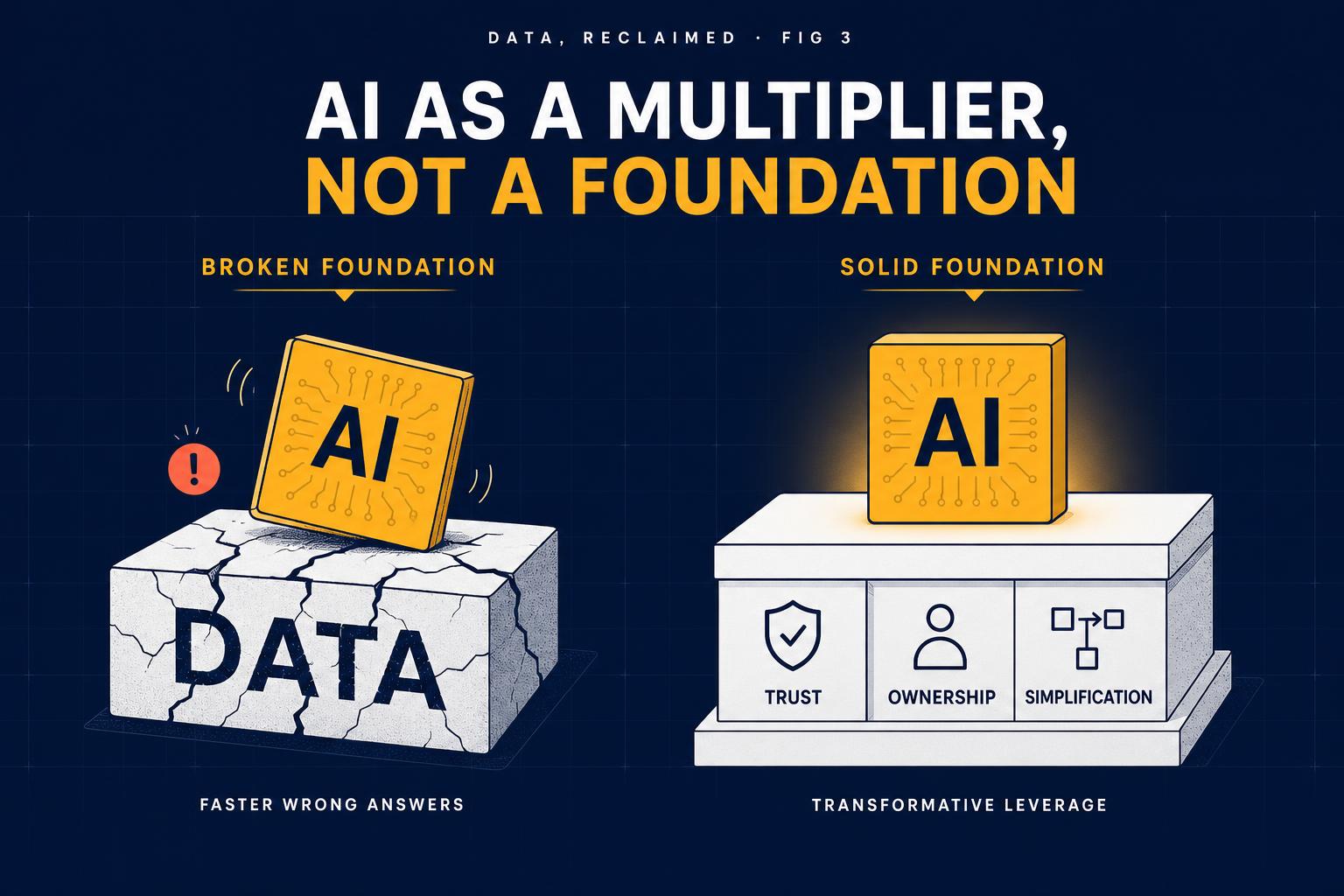
AI is a multiplier, not a foundation. If your data experience is broken, AI will only make it faster to get the wrong answer. I'm watching organizations rush to layer AI-powered analytics, chatbots, and predictive tools on top of data environments that people don't trust or understand. The result is impressive demos and underwhelming adoption.
AI Excels At
Pattern recognition across massive datasets, surfacing anomalies, accelerating analysis, automating repetitive transformations.
AI Struggles With
Understanding business context without clear definitions, building trust on questionable data, replacing ownership and accountability.
AI On Solid Ground
When data is trusted, owned and simplified, AI makes good systems faster, smarter, and more proactive.
AI as a multiplier of good systems is transformative. AI as a bandaid for broken ones is expensive theater.
Research from the Center for Business Analytics at Melbourne Business School highlights that more than 80% of analytics and AI projects fail due to poor alignment between data, people, and business context. Studies on AI adoption consistently show that the majority of failures stem from poor data readiness, unclear ownership, and lack of context, not model capability.
This is where Latttice quietly works. Not by taking control away from teams, but by giving it back. The business owns meaning and intent. Engineers can hand data over without losing trust or control. Leaders gain confidence that AI is no longer experimental but grounded in trusted, governed data. And governance itself stops being a blocker. It becomes active, embedded into how data is created, shared, and used. From a customer success perspective, this is what progress feels like: clarity without friction, confidence without delay, and AI that finally has something solid to stand on.
What Success Looks Like
When data is working, you can feel it. Meetings get shorter because people arrive with answers, not questions. Decisions happen faster because the context is already there. Teams stop second-guessing numbers and start debating strategy. That is the shift: from validating to acting, from reporting what happened to shaping what happens next.
Faster Decision Cycles
Time from question to action drops sharply once data trust is established.
Higher Engagement
Self-service adoption rises when business users own the metric definitions.
Improved Confidence
Leaders express greater trust in insights when they understand the underlying logic.
Success doesn't look like perfect dashboards or flawless pipelines. It looks like momentum. A team moving forward with confidence, using data as a tool rather than wrestling with it as an obstacle.
A Mindset Shift, Not a Technology Shift
Cameron talks about the rebirth of data as a return: to purpose, to business ownership, to human experience. That rebirth is already happening in pockets. In conversations. In teams who've decided they're done with the old way and ready to build something better. It isn't a technology shift; it's a mindset shift.
From Technology to Experience
Move from tool-centered thinking to prioritizing the user's interaction and ease of access to insight.
From Dashboards to Trust
Move beyond static reports to a foundation for shared understanding and confident decision-making.
From Comprehensiveness to Simplification
Show only what matters most so people can decide faster and with more impact.
From Delegation to Ownership
Empower people to manage and understand their data, fostering accountability and a deeper connection to business outcomes.
The data was always there. What's being reclaimed is the relationship between people and insight: between question and answer, between having information and actually being able to use it. That's the rebirth. And it's worth building toward.
Join a Data Conversation
Lili Marsh

Lili Marsh leads customer and partnerships at Data Tiles, working with business teams to translate data ambition into operational reality. She writes and speaks on customer-centered data, ownership, and the cultural shifts that turn data from obstacle into momentum.
Further Reading
- Dataversity (2025). "Why 60% of BI Initiatives Fail (and How Enterprises Can Avoid It)."
- Gartner, Inc. (28 February 2024). "Gartner Predicts 80% of Data & Analytics Governance Initiatives Will Fail by 2027."
- Center for Business Analytics, Melbourne Business School (2024). "Why Do Analytics and AI Projects Fail?"
- Wikipedia Contributors (2025). "Data Product."
- Ethyca Research (2025). "Why 80% of AI Projects Fail: Data Readiness for the Speed of AI."