Latttice: The Data Product Workbench for Collibra
Activating Governance Where Decisions Are Made

Executive Summary
This collaboration is grounded in a shared conviction. Both Collibra and Data Tiles recognize that data products are the structural foundation of modern governance. Collibra approaches this from the governance perspective, providing the enterprise framework for ownership, classification, lineage, glossary, and policy enforcement. Latttice operates as the Data Product Workbench within that framework, enabling decision-makers to create governed, trusted data products that are defined by governance rules and built close to the point of decision.
The market often confuses documentation with activation. Many enterprises believe they are building data products because they catalog assets, assign ownership, and define policies. Yet in most cases, the operational model has not changed. Engineering still controls pipelines. Activation still depends on technical delivery cycles. What exists is a documented data product, not an executable one. Governance is described, but not activated at creation.
A real data product must be built by the teams who use the data and understand what it should reflect. When the people closest to the decision shape the product within governance boundaries, trust becomes structural rather than procedural. If data is moved away from the decision and mediated exclusively through pipelines, it becomes distant and difficult to trust, regardless of how comprehensive governance documentation may be.
Latttice closes that gap. It enables business-owned, zero-code data products to be created directly within governance boundaries defined by Collibra. Governance rules are activated during the build. Engineers remain undisturbed because Latttice connects to data where it resides without disrupting infrastructure. The result is trustworthy data products, faster AI activation, structural compliance, and decisions that can occur as soon as the data is available.
This document also addresses two critical extensions of the data product model that are often treated as separate concerns but are in fact integral to it. Data contracts make governance enforceable at the interface between producer and consumer, ensuring that what a data product commits to deliver is formally defined and versioned. Data observability ensures that governance does not expire at deployment, it monitors freshness, completeness, schema stability, and distribution drift continuously, so that the trust embedded at creation holds across the full operational life of the data product.
Governance does not need more documentation. It needs activation at the moment of creation, close to where decisions are made.
The Collaboration and the Imperative
The collaboration with Collibra is important for a simple reason. They recognize that data products are the future, and so do we.
If you lead governance, you have probably noticed the tone of conversations changing. Not because governance suddenly became fashionable, but because AI made it unavoidable. AI initiatives have shifted governance from good practice to board-level dependency. Leaders are no longer asking, "Do we have policies?" They are asking, "Can we move fast without creating risk?" That question is what is putting data products at the center of modern governance strategies.
Collibra has consistently articulated that trusted AI depends on unified governance for both data and AI assets, emphasizing visibility, lineage, quality, ownership, and policy enforcement as prerequisites for scaling reliable and compliant AI across the enterprise. That direction mirrors what the broader analyst community has been reinforcing.
Gartner
Gartner has repeatedly stated that AI-ready data, governed, trusted, and operationally accessible, is the limiting factor in AI success. In recent research communications, Gartner predicts that through 2026 a significant percentage of AI projects will be abandoned due to the lack of properly governed data foundations.
McKinsey
McKinsey's global AI research echoes this finding, observing that while experimentation with AI is accelerating, sustained enterprise value remains constrained by data availability, governance integration, and operating model friction.
The industry message is converging.
AI does not fail because models are weak. It fails because data products are not ready.
Yet there is a quiet reality governance leaders are facing. Even when governance foundations are strong, ownership defined, stewardship assigned, classifications implemented, lineage documented, there remains a gap between governance intention and operational execution. Forrester has described this distinction clearly, noting that governance maturity cannot stop at documentation. Enforceable policy must extend into the operational layer where data is consumed. Many enterprises have invested heavily in governance frameworks and platforms, but the path from definition to decision remains elongated and engineering dependent.
The typical lifecycle still follows a familiar sequence. The business defines the need. Engineering builds the asset. Governance validates compliance. Access is provisioned. Deployment follows. It is structured and disciplined, yet often too slow for the pace of AI. More importantly, it separates ownership from creation. When engineering builds the product, even if governance documentation names the domain as owner, the product still feels delivered by IT rather than built by the business.
This is where the misconception begins.
Documented vs. Real Data Product
Many organizations now claim to 'have a data product team.' But in practice, what often exists is a team responsible for documenting data products. Definitions are written. Metadata is curated. Lineage is visualized. Governance controls are described. The asset appears in the catalog and is labeled a data product. But the operational model remains unchanged. The domain cannot directly create or evolve the physical data product. Engineering still owns the pipelines. Activation still depends on technical cycles. What has been created is a governed description of a data asset, not a real, executable data product.
A documented asset is not a real data product.
A true data product must be consumable, governed, reusable, and directly aligned to business outcomes.
Sanjeev Mohan — Data Products for Dummies
As Sanjeev Mohan emphasizes in Data Products for Dummies, product thinking requires clear ownership and accountability that extends beyond metadata. Documentation alone does not produce business agility. A catalog entry is not a product if the domain cannot shape it.
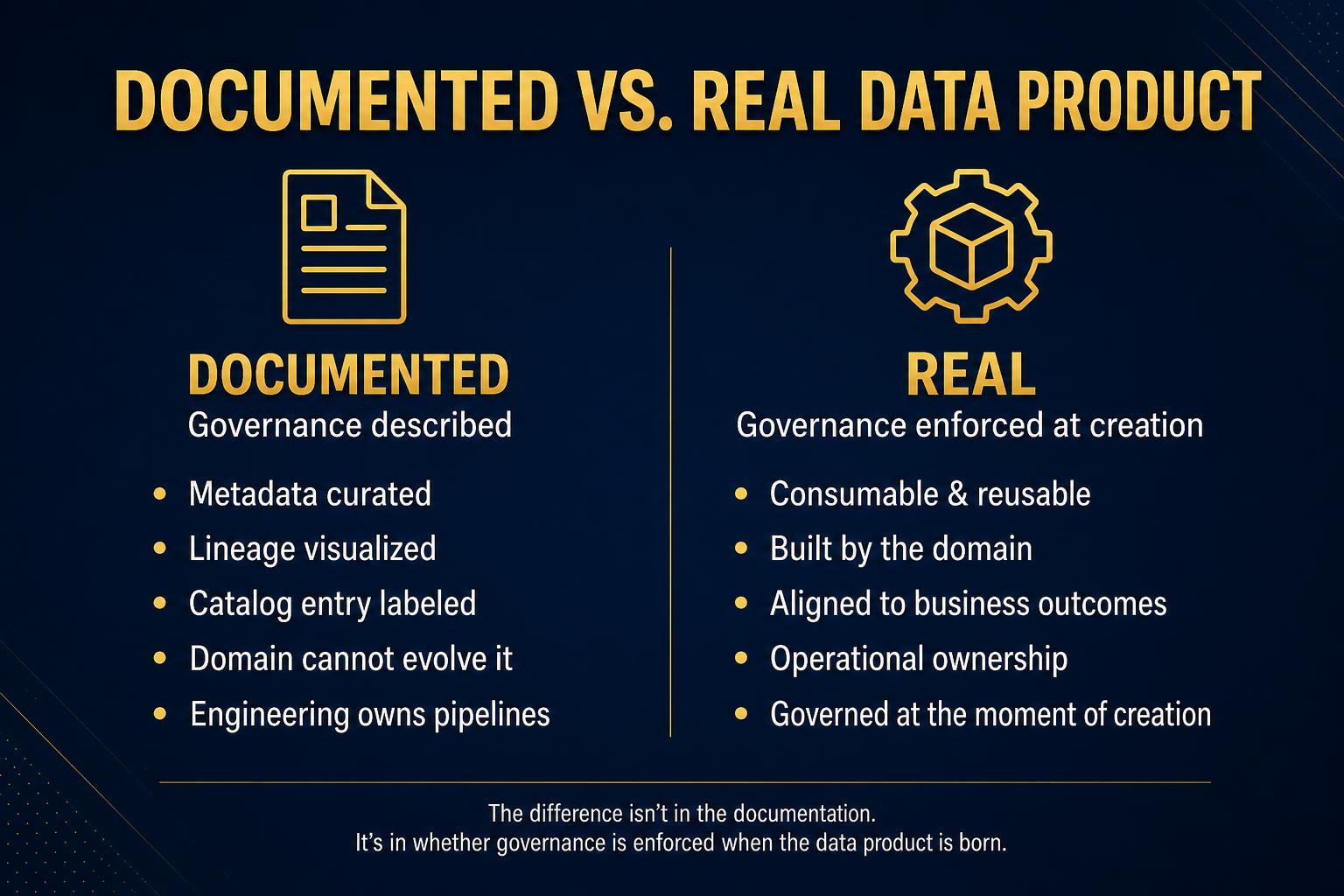
Documented Data Product
Metadata curated. Lineage visualized. Governance described. Asset labeled in the catalog. But the domain cannot create or evolve it. Engineering still owns the pipelines.
Real Data Product
Consumable, governed, reusable, and aligned to business outcomes. Built by the domain. Ownership extends beyond metadata into operational execution.
Pipeline-First vs. Product-First
At the same time, many assume that governing data products requires defining the pipeline first. The pipeline-first mindset has dominated data architecture for decades. Ingestion is engineered. Transformations are coded. Orchestration is built. Only then does the business receive the asset. This model inherently moves the data away from the decision. Ownership remains technical because creation remains technical.
IDC — Data Strategy Research
IDC has noted in its data strategy research that enterprises often struggle to translate governance investments into measurable outcomes because execution remains centralized and detached from domain context.
Forrester — Governance Maturity Research
Forrester similarly observes that governance initiatives stall when operational ownership does not sit with the business users closest to value creation.
A Data Product Workbench changes the sequence.
The domain defines the product inside established governance boundaries. Governance rules are activated during creation. The platform compiles what is required behind the scenes. The business does not need to engineer plumbing in order to own the outcome.
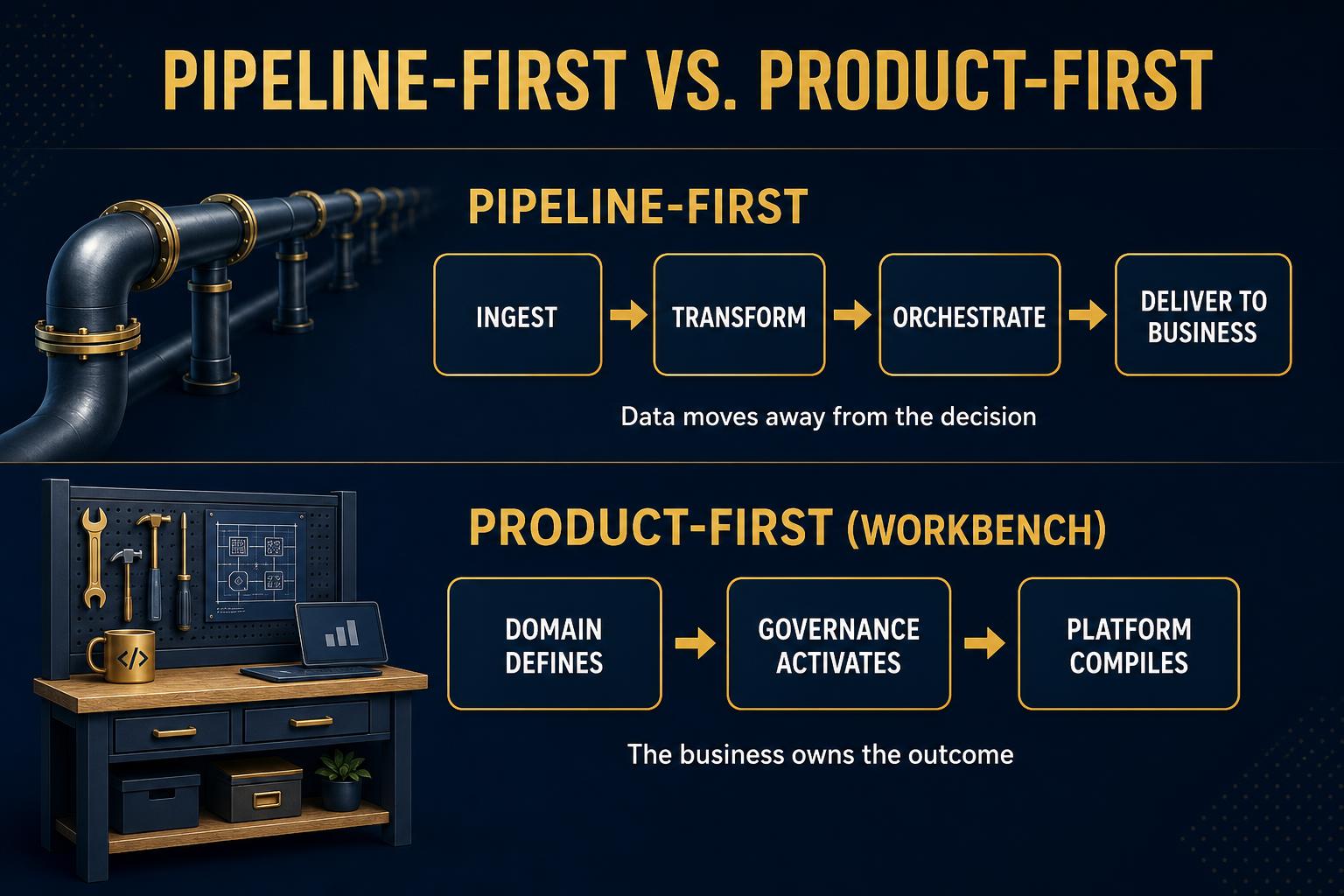
This is the distinction that defines Latttice.
Built Where Decisions Are Made
Latttice exists as the Data Product Workbench for Collibra. Collibra establishes the governance system of record, ownership, classification, glossary, lineage, and policy. Latttice activates that framework at the moment a data product is built. Business-owned, zero-code data products can be created directly by the teams who use the data and understand what it should reflect. Those closest to the decision know the nuance of the metrics. They understand the context. They recognize what belongs in a calculation and what does not. When those decision-makers are builders, and governance rules are embedded during build, the resulting data products are trustworthy.
If you move the data away from the decision, it becomes untrustworthy, no matter how comprehensive the governance documentation may be. But when the decision-makers are the creators, and governance is activated during the creation process, trust becomes structural.
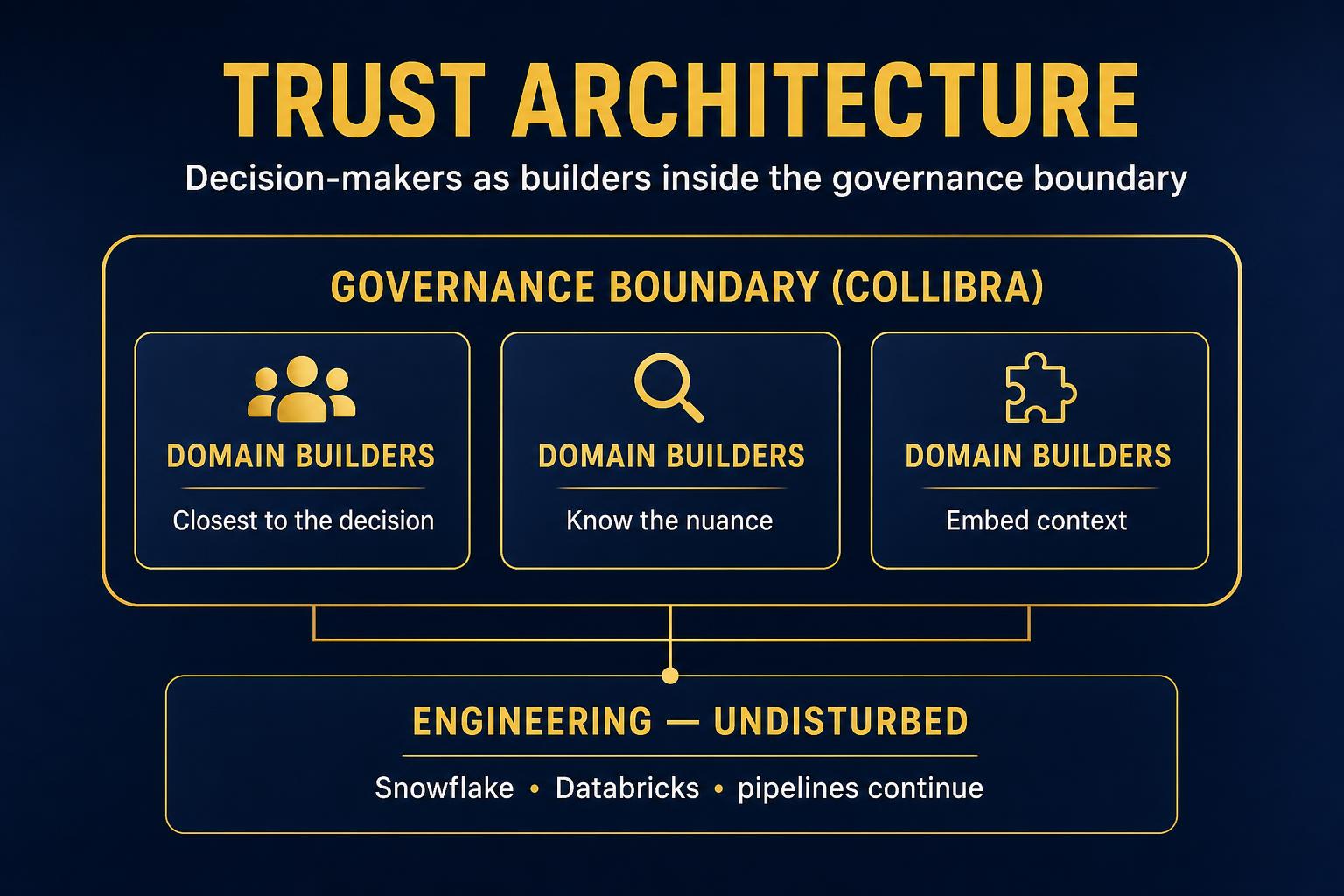
Importantly, this does not disrupt engineering. Latttice connects to data where it resides, in Snowflake, Databricks, and other environments, without redesigning pipelines or interfering with platform architecture. Engineers continue building foundational infrastructure. The workbench sits above that layer, enabling domains to create governed data products without introducing friction into engineering workflows. The business gains ownership. Governance gains operational enforcement. Engineering remains uninterrupted.
And decisions can take place as soon as the data is available.
Contracts, Observability, and Operational Trust
Data Contracts: Governance at the Interface
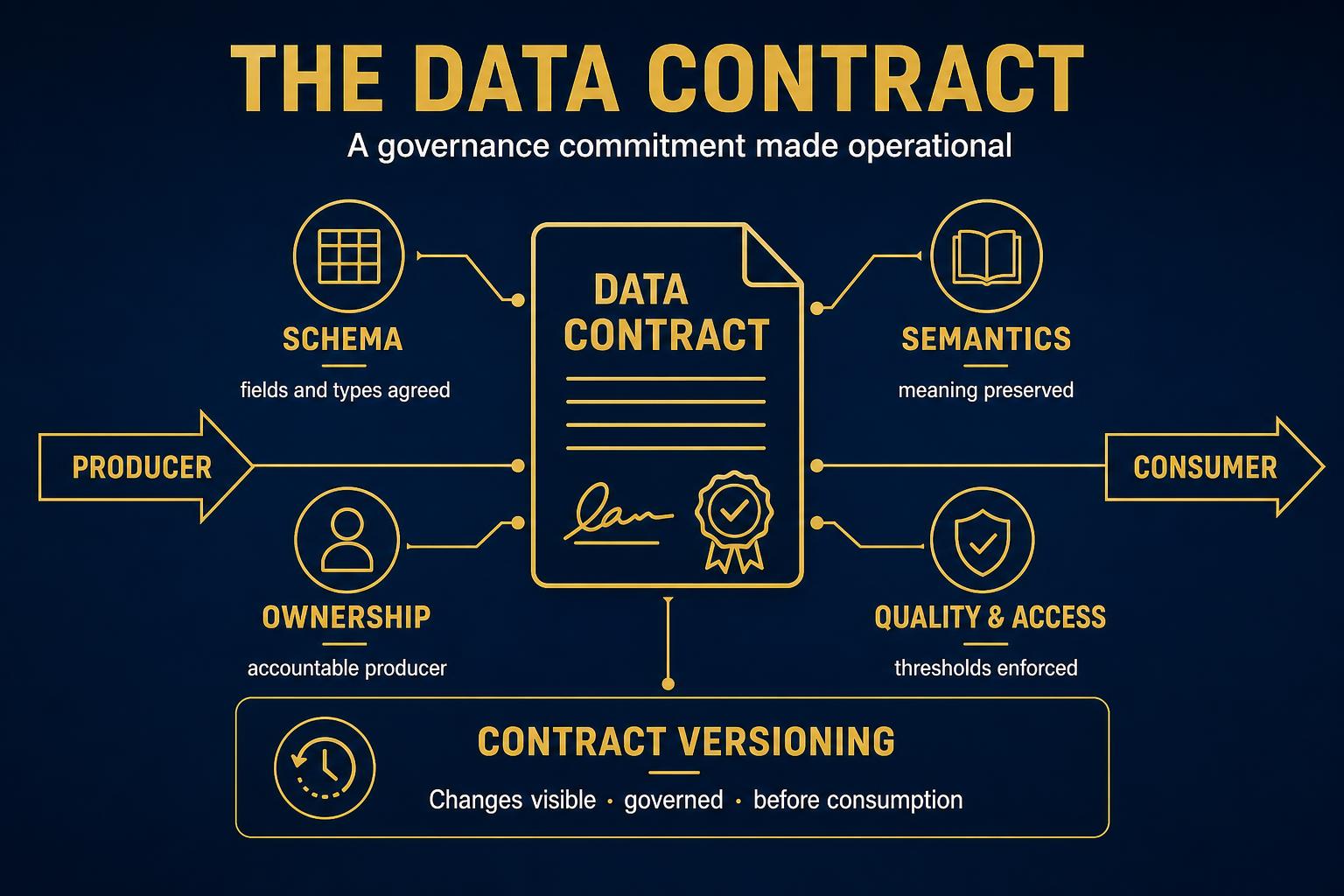
A data product without a contract is a promise without terms. Data contracts define the formal agreement between a data product and its consumers. They specify what the product contains, what it guarantees, how it behaves, and what happens when it does not. Without contracts, governance remains aspirational. With them, it becomes enforceable at the interface between producer and consumer.
In the context of Latttice and Collibra, data contracts are not a separate layer bolted on after the fact. They are embedded in the product definition itself. When a domain builds a data product in the Latttice Workbench, the governance boundaries set by Collibra, ownership, classification, access policy, and quality thresholds, become the terms of the contract. The consumer knows what they are receiving. The producer is accountable for what they have committed to deliver.
This matters for AI in particular. AI models consume data at scale and at speed. If the data product changes shape, drops fields, or shifts semantics without notice, the model degrades silently. A data contract makes that change visible and governed. It creates a formal checkpoint between the data product and the AI system consuming it, ensuring that governance does not stop at the catalog but extends into the consumption layer.
A data contract is not a technical artifact. It is a governance commitment made operational.
Data Observability: Governance That Stays On
Governance at creation is necessary. Governance after creation is what makes it durable. Data observability is the operational layer that monitors whether a data product continues to behave as it was built to behave. It tracks freshness, completeness, schema stability, volume consistency, and governance drift. Without observability, a data product can degrade silently between the moment it was governed and the moment it is consumed.
In a Latttice and Collibra environment, observability is not a separate monitoring tool. It is the continuation of governance into the operational lifecycle of the product. The quality thresholds defined during creation become the benchmarks against which the product is continuously measured. When a product drifts outside those thresholds, the governance system is notified. Ownership is clear. The domain responsible for the product is the domain responsible for the resolution.
This is particularly important for AI. A model trained on a data product that has drifted is a model trained on broken data. Observability closes the loop between governance intention and operational reality. It ensures that the trust embedded at creation is not eroded by time, volume, or upstream change. Governance does not expire at deployment. It continues for as long as the product is in use.
The Complete Data Product Lifecycle
A data product is not complete at the moment of creation. It is complete when it can be trusted across its entire operational life. That requires three things working together:
Governance at creation, Contracts at the interface, and Observability in operation.
Collibra provides the governance foundation. Latttice activates it at creation. Data contracts make the governance commitment explicit to consumers. Observability ensures that commitment holds over time. Together, these four elements form a closed loop.
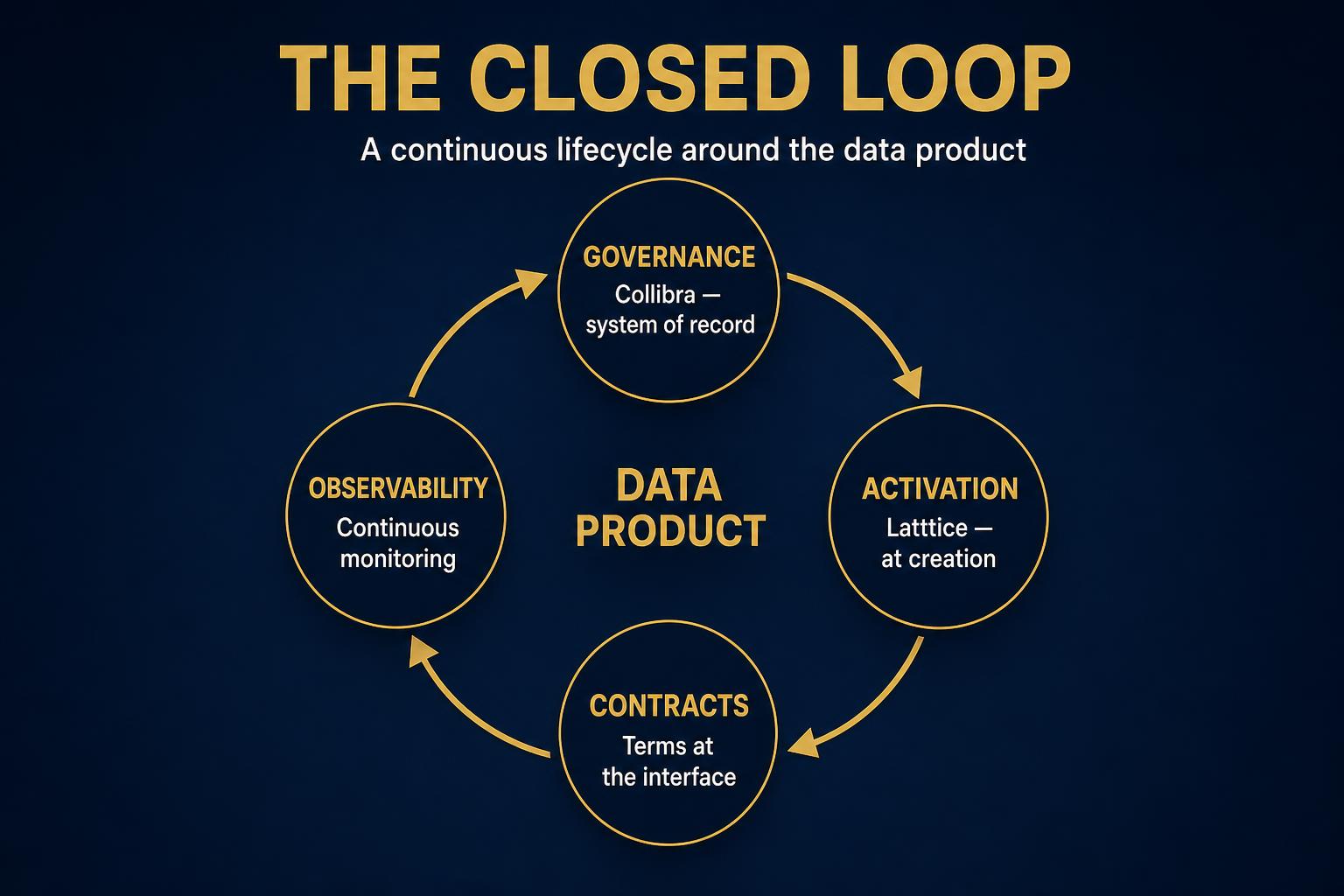
Governance is not a phase. It is a continuous property of the data product.
Watch the Latttice Workbench Demo
To see how this collaboration works in practice, watch our latest demonstration below. It shows Latttice operating as the Data Product Workbench for Collibra and how governance definitions move directly into business-built data products, closer to where decisions are made. Explore Latttice for Collibra to see the complete workbench experience.
Collibra defines the governance framework. Latttice activates it. Domains build real, business-owned data products within those boundaries. The lifecycle compresses. Ownership becomes practical. Governance moves closer to the decision.
Cameron Price.

Cameron Price is a senior data industry practitioner with deep experience in data strategy, enterprise data programs, executive leadership, and advisory, as well as the development of data-focused software products. He champions business data access and enablement, with a primary focus on business-built data products, a philosophy reflected in his work and in the creation of Latttice.
References
- Gartner. Research communications on AI-ready data and AI project abandonment projections, 2024–2025.
- McKinsey & Company. The State of AI global surveys highlighting data readiness and governance integration as barriers to scaling AI impact.
- Forrester Research. Governance maturity and operational enforcement research emphasizing embedded policy controls at the point of data use.
- IDC. Data strategy and data governance research noting the gap between governance investment and measurable business outcomes when execution remains centralized.
- Basel Committee on Banking Supervision. Principles for Effective Risk Data Aggregation and Risk Reporting.
- Mohan, Sanjeev. Data Products for Dummies. Wiley.
- Atlan / Data Contract Community. Data contracts as a mechanism for enforcing governance at the producer-consumer interface, including schema versioning, SLA definition, and change communication protocols.
- Monte Carlo Data / Acceldata / Bigeye. Data observability research and practitioner frameworks covering freshness, completeness, volume, schema, and distribution monitoring as operational extensions of data governance.