Why data products, active governance, and AI factories are becoming the new operating model for business outcomes.
For years, organizations have invested in becoming data-driven. They have built platforms, warehouses, lakehouses, catalogs, dashboards, governance frameworks, and analytics capabilities. Yet many still face the same challenge: data remains too far away from the decisions it is meant to improve.
The next era of data and AI will not be defined by how much data an organization stores, governs, or catalogs. It will be defined by how quickly, safely, and repeatedly trusted data improves decisions.
CP
By Cameron Price
CEO & Founder, Data Tiles
Figure 1
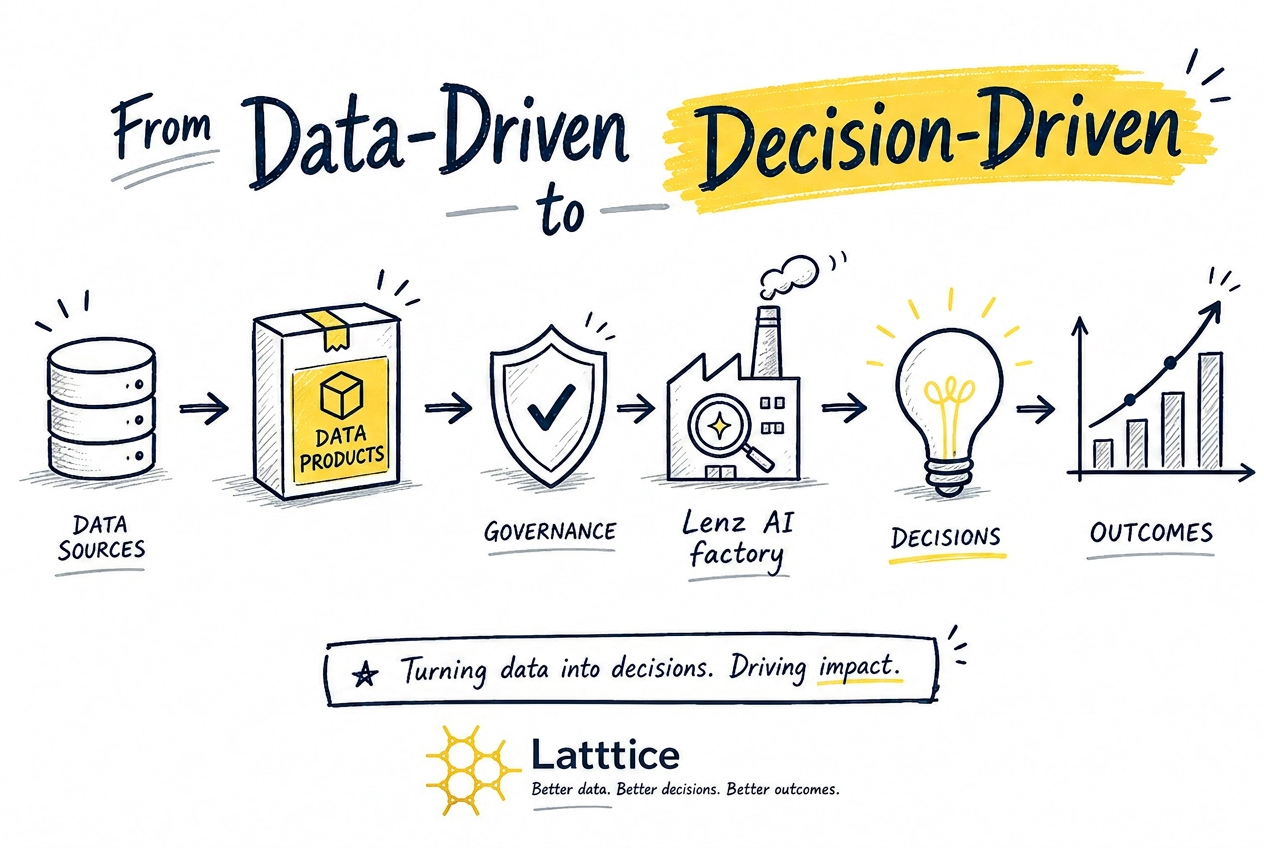
From data availability to decision impact
Fig 1.The shift is not simply about making more data available. It is about making trusted, governed, fit-for-purpose data usable at the point where business decisions are made.
The goal was never being data-driven. It was better decisions.
For many years, the data industry has been focused on helping organizations become data-driven. That was an important step. It encouraged organizations to invest in platforms, warehouses, lakehouses, catalogs, dashboards, governance frameworks, and analytics capabilities. It helped bring data into the language of business leadership.
But being data-driven was never meant to be the destination.
The real goal was always better decisions.
At Data Tiles, our mission has always been simple: Enabling Better Decisions. That mission has shaped how we think about data, AI, governance, business ownership, and the future of enterprise platforms. We believe the next era of data will not be defined by how much data an organization stores, centralizes, catalogs, or governs in theory. It will be defined by how effectively trusted data improves decisions, automates processes, reduces risk, supports AI, and changes business outcomes.
This is why I believe the industry is now moving from being data-driven to becoming decision-driven. That distinction matters.
Core Idea
A data-driven organization makes data available. A decision-driven organization ensures the right data, context, controls, and intelligence are available at the point where decisions are made.
That is a very different operating model. It changes the role of the CDAO. It changes the relationship between business and technology. It changes how governance works. It changes how data products are defined. It changes what AI needs from the data estate. Most importantly, it changes how organizations measure success.
Success will no longer be measured by how much data has been centralized, cataloged, or pushed into dashboards. It will be measured by whether data improves the decisions that matter most. That is the future we are building toward at Data Tiles.
Join a Data Conversation, Cameron Price
Executive Summary
A new operating model for trusted decisions.
Organizations have invested enormous time, money, and energy into becoming data-driven. They have built sophisticated platforms. They have centralized data in warehouses and lakehouses. They have implemented governance programs, catalog tools, and analytics stacks. They have hired data engineers, analysts, scientists, and governance leaders. And yet, in board rooms and executive committees, the same questions persist.
Why does it still take so long to act on data?
Why is the data we trust the most often the data we use the least?
Why does AI not feel ready to scale?
This gap between data availability and decision impact has become more urgent because of AI. Generative AI, agentic AI, automation, copilots, and intelligent workflows are increasing the demand for trusted, contextual, governed, fit-for-purpose data. The implication is clear. AI is not simply creating demand for more data. It is creating demand for a new operating model. That operating model is decision-driven.
In a decision-driven organization, data strategy begins with the business decision or outcome that needs to improve. The organization then works backward to identify the data, context, ownership, governance, quality expectations, consumption patterns, and AI capabilities required to support that decision.
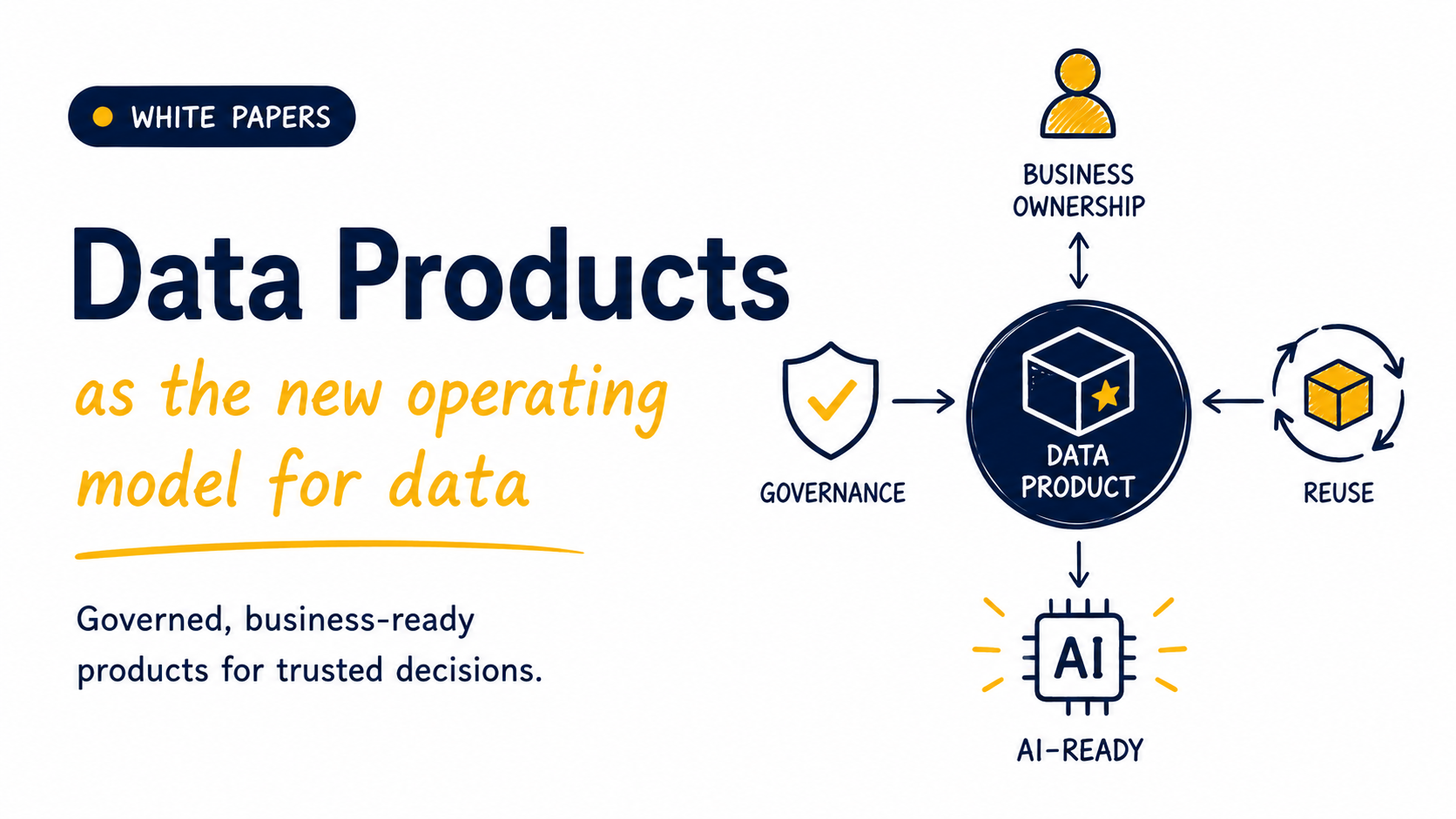
This is where data products become critical. A true data product is not simply a table, pipeline, semantic model, dashboard, or curated dataset. It is a governed, business-ready product with purpose, ownership, context, policies, lineage, quality expectations, usage intent, and consumption pathways. It is designed around a decision or outcome, not merely around a source system.
This white paper argues that data products are the core operating mechanisms of the decision-driven enterprise. It also explains why active governance must be embedded at the point of creation and consumption, not documented after the fact.
Finally, this paper introduces the relationship between Latttice and Lenz. Latttice provides the governed data product foundation, enabling business teams to create trusted, fit-for-purpose data products without code. Lenz extends that foundation into the AI factory, helping organizations build AI agents and intelligent workflows from trusted data products, business context, and active governance. Together, they support the future Data Tiles is building toward: business-focused, decision-driven, outcome-led data and AI platforms for organizations demanding more today, not tomorrow.
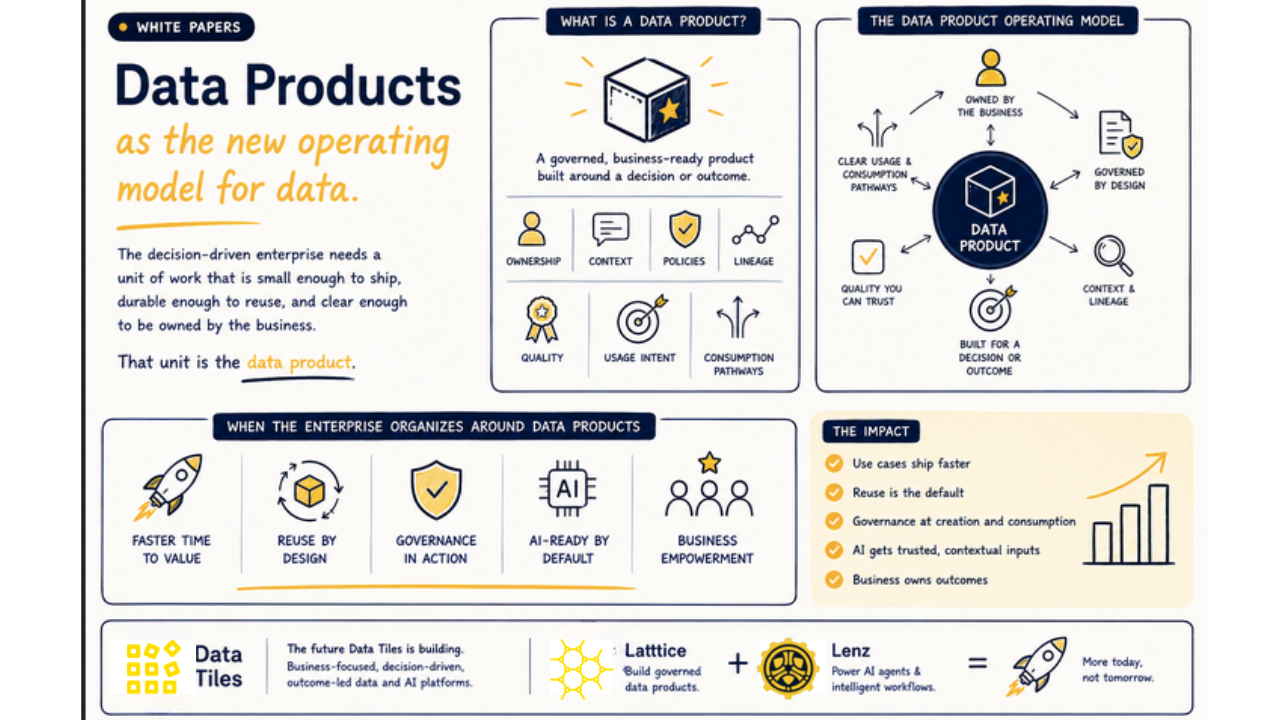
Fig 2.Data products as the new operating model for data.
Chapter 1
The limits of being data-driven.
Organizations have invested enormous time, money, and energy into becoming data-driven. They have built sophisticated platforms. They have centralized data in warehouses and lakehouses. They have implemented governance programs, catalog tools, and analytics stacks. They have hired data engineers, analysts, scientists, and governance leaders. And yet, in board rooms and executive committees, the same questions persist. Why does it still take so long to act on data? Why is the data we trust the most often the data we use the least? Why does AI not feel ready to scale?
The honest answer is that being data-driven was always a means, not an end. It was a useful organizing principle, but it set a low bar. Making data available is not the same as making it useful. Pushing information into a dashboard is not the same as improving a decision. Cataloging assets is not the same as putting them to work. The limits of the data-driven era are now visible, and they are the reason the next era looks fundamentally different.
Chapter 2
The rise of the decision-driven enterprise.
The decision-driven enterprise does not abandon the work of the data-driven era. It builds on it. The difference is the starting point. Instead of asking, what data do we have and how can we make it more available, leaders ask a more disciplined question. What decision do we need to improve, and what would it take to improve it consistently?
That single shift reorders almost everything. Investment cases are scoped around outcomes rather than platform features. Data product roadmaps become extensions of business strategy rather than backlogs owned by technology. Governance moves from a compliance reporting function to an embedded enabler of safer, faster decisions. AI stops being an experimentation budget and starts being a way of increasing the speed and quality of decisions across the enterprise.
FIGURE 3
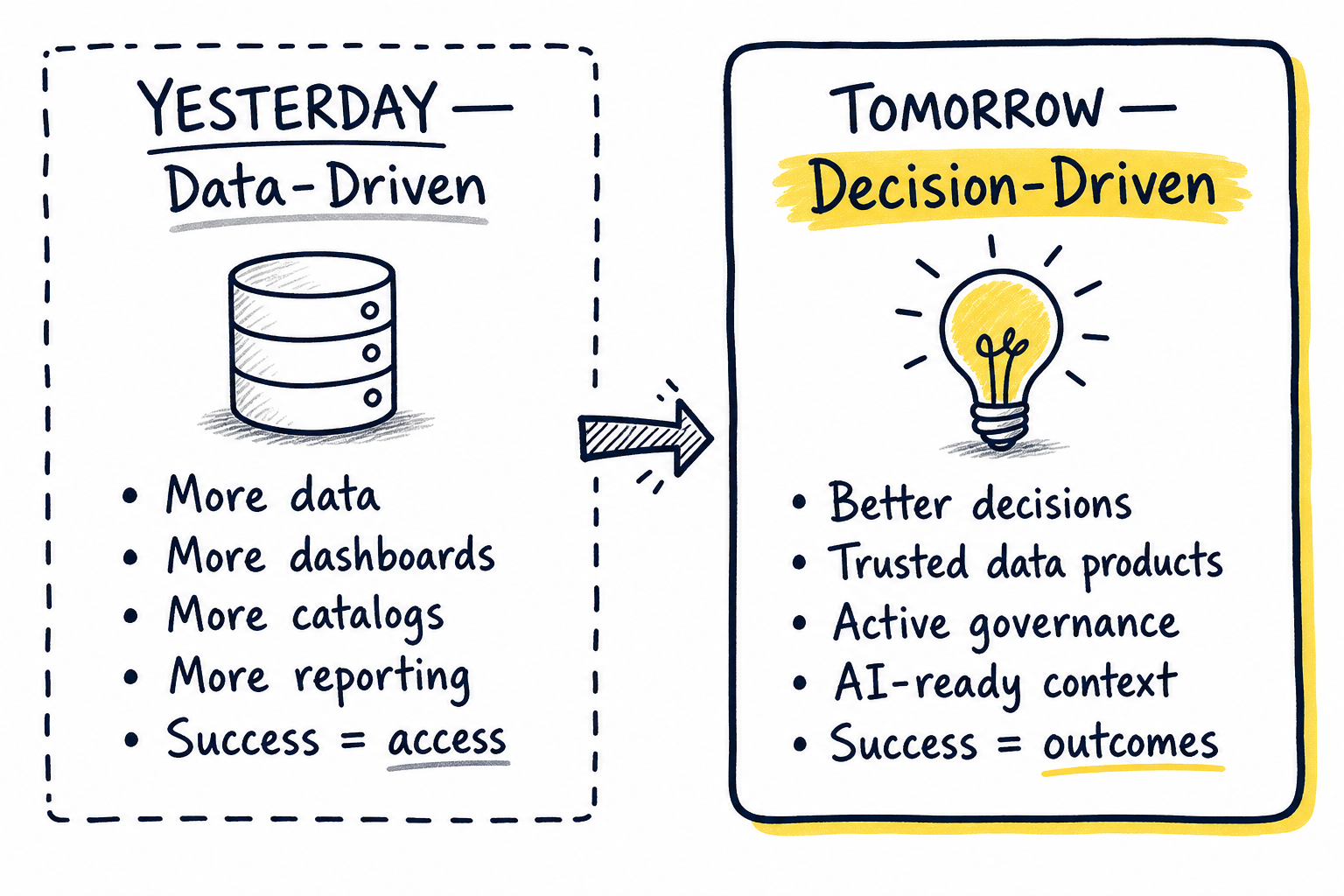
From Data-Driven to Decision-Driven
The decision-driven enterprise does not abandon data strategy. It changes the measure of success from data availability to decision improvement.
Fig 3.From data-driven to decision-driven.
Chapter 3
Why AI makes this urgent.
For the past decade, organizations could afford to treat the gap between data and decisions as an inconvenience. AI has changed that. The same data estates that powered yesterday's dashboards are now expected to power copilots, agents, automated workflows, and grounded language models. The cost of poor context is rising fast. An AI assistant that reaches into ungoverned data does not produce mildly wrong answers. It produces confident wrong answers at scale.
The pressure on data and analytics leaders is also rising. Boards and CEOs are demanding AI value on timelines that do not match the way data work has traditionally been planned. The expectation is no longer that data teams will eventually surface insight. It is that trusted, governed, contextual data will be available whenever an agent, model, or workflow needs it.
These numbers do not describe a niche scenario. They describe an operating environment in which decision-grade data has to flow into agents and applications as a default. That is impossible without a new operating model for data.
Chapter 4
Data products as the new operating model for data.
The decision-driven enterprise needs a unit of work that is small enough to ship, durable enough to reuse, and clear enough to be owned by the business. That unit is the data product. A data product is not a table. It is not a pipeline. It is not a semantic layer or a dashboard. It is a governed, business-ready product built around a decision or outcome, with explicit ownership, context, policies, lineage, quality expectations, usage intent, and consumption pathways.
When the enterprise organizes around data products in this way, the difference is felt immediately. New use cases are no longer negotiated platform by platform. Reuse becomes the default rather than the exception. Governance moves from documentation written after the fact to controls applied at the moment of creation and consumption. AI gains a curated supply of trusted, contextual inputs.
Fig 4.Data products as the new operating model for data.
FIGURE 5
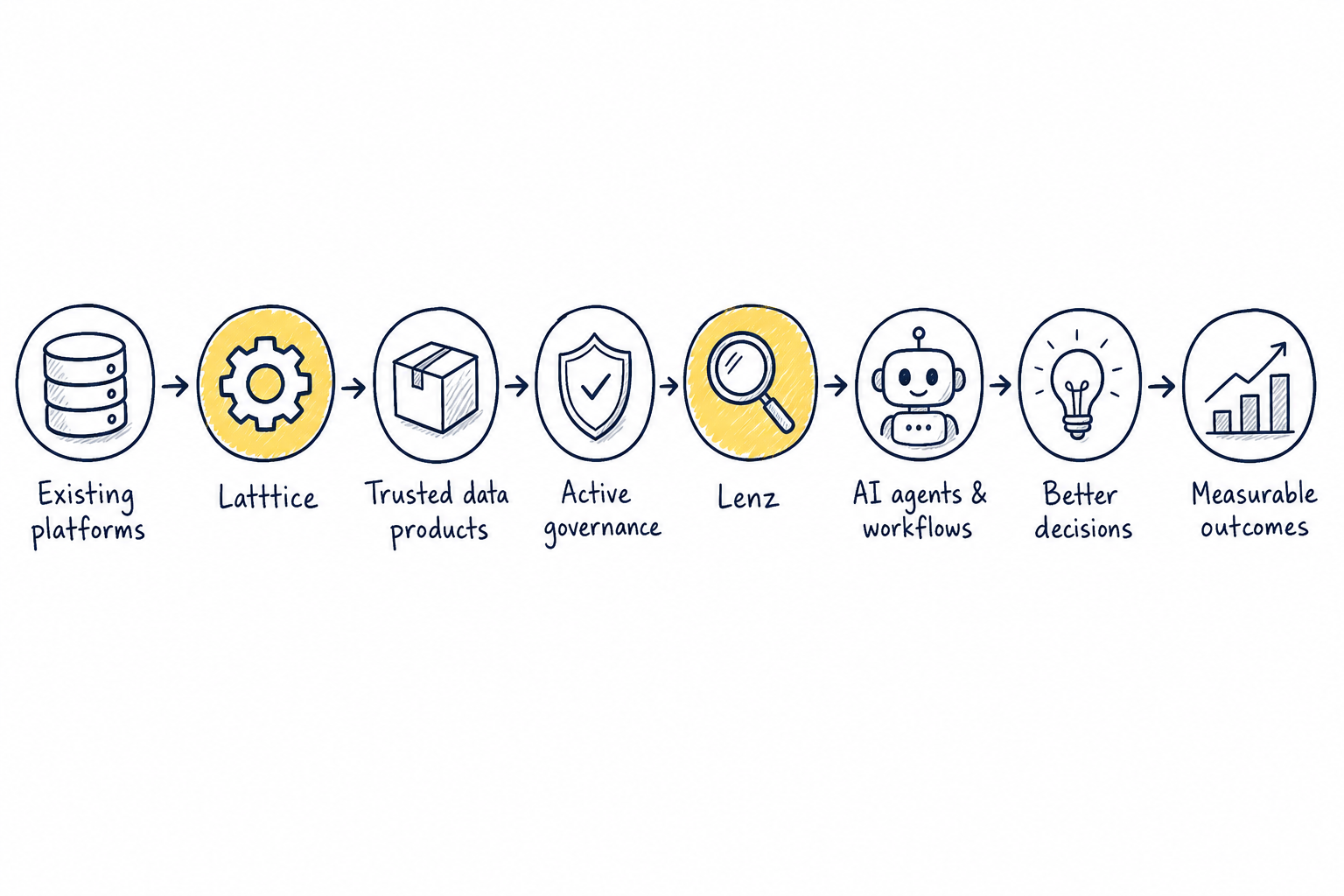
The Decision Supply Chain
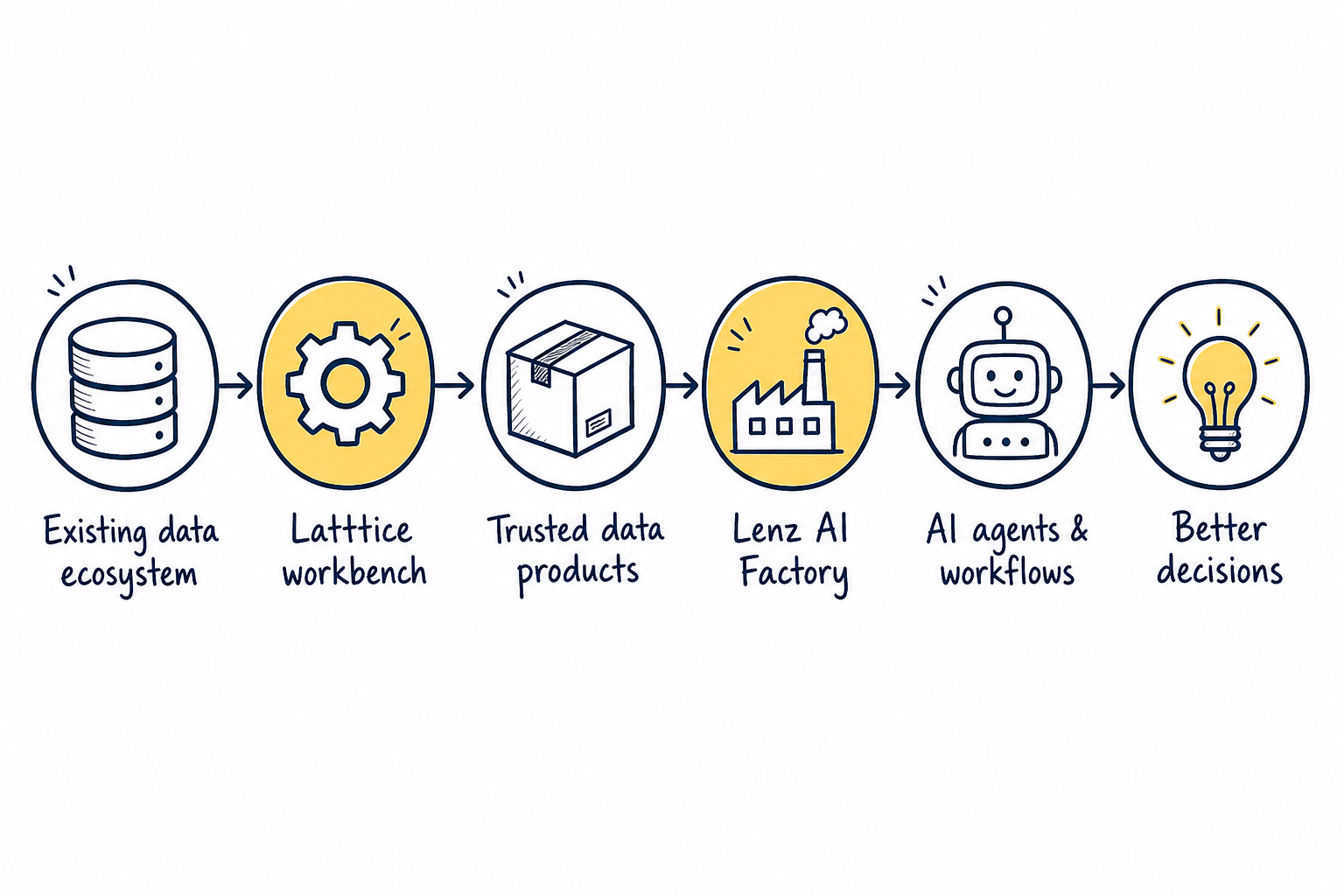
Existing platforms continue to handle infrastructure, ETL, policies, pipelines, processing, and storage. Latttice helps business teams create trusted data products. Lenz turns those products into AI-powered decision capability.
Fig 5.The decision supply chain connects existing data investments to the point where business value is created.
Chapter 5
Business ownership becomes the critical success factor.
The single biggest predictor of whether a data product will actually improve a decision is whether the business owns it. Not sponsors it. Not signs off on it. Owns it. That ownership covers the meaning of the data, the context in which it should be used, the decisions it is intended to support, and the standards by which its value will be judged.
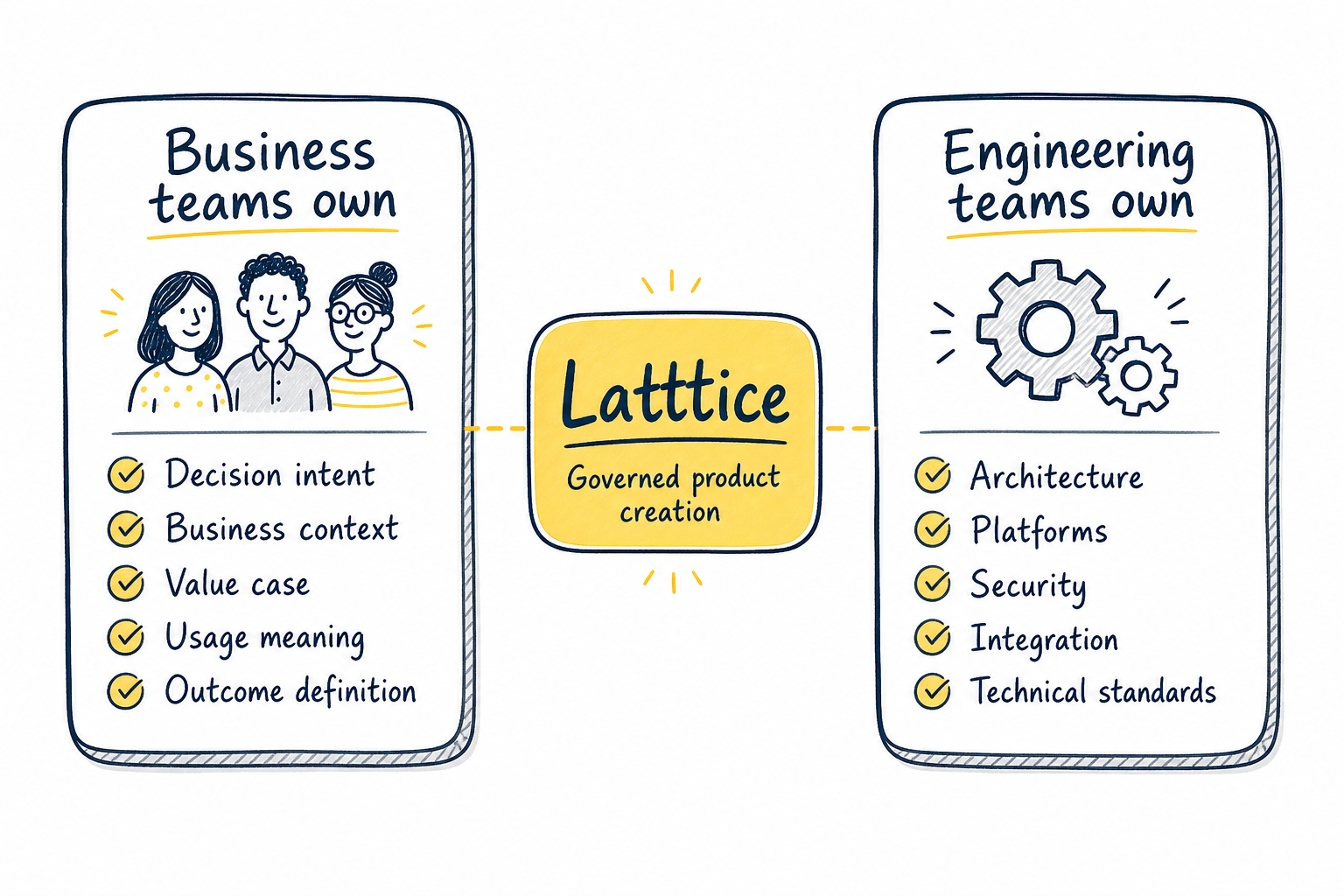
This is also where most organizations stumble. They have asked engineering and analytics teams to translate fragmented business intent into durable data products. The translation cost is high, the result is often brittle, and the feedback loop between consumption and improvement is too slow. The decision-driven operating model resolves this by giving business teams the tools to shape and own data products directly, while engineering retains responsibility for the platforms, integration, and standards that keep the estate safe and scalable.
FIGURE 6
Business and Engineering in Sync
Business teams should not have to become engineers. Engineers should not have to interpret every business decision. The right operating model lets both teams work in sync.
Fig 6.Business and engineering teams working in sync.
Chapter 6
Active governance at the point of decision.
Governance has historically been a backstop. It documented what existed, defined who was accountable, and added controls during audits. In an AI-driven world, that is not enough. Governance has to be active. It has to be present at the moment a data product is designed, at the moment it is published, and at the moment a person or agent consumes it.
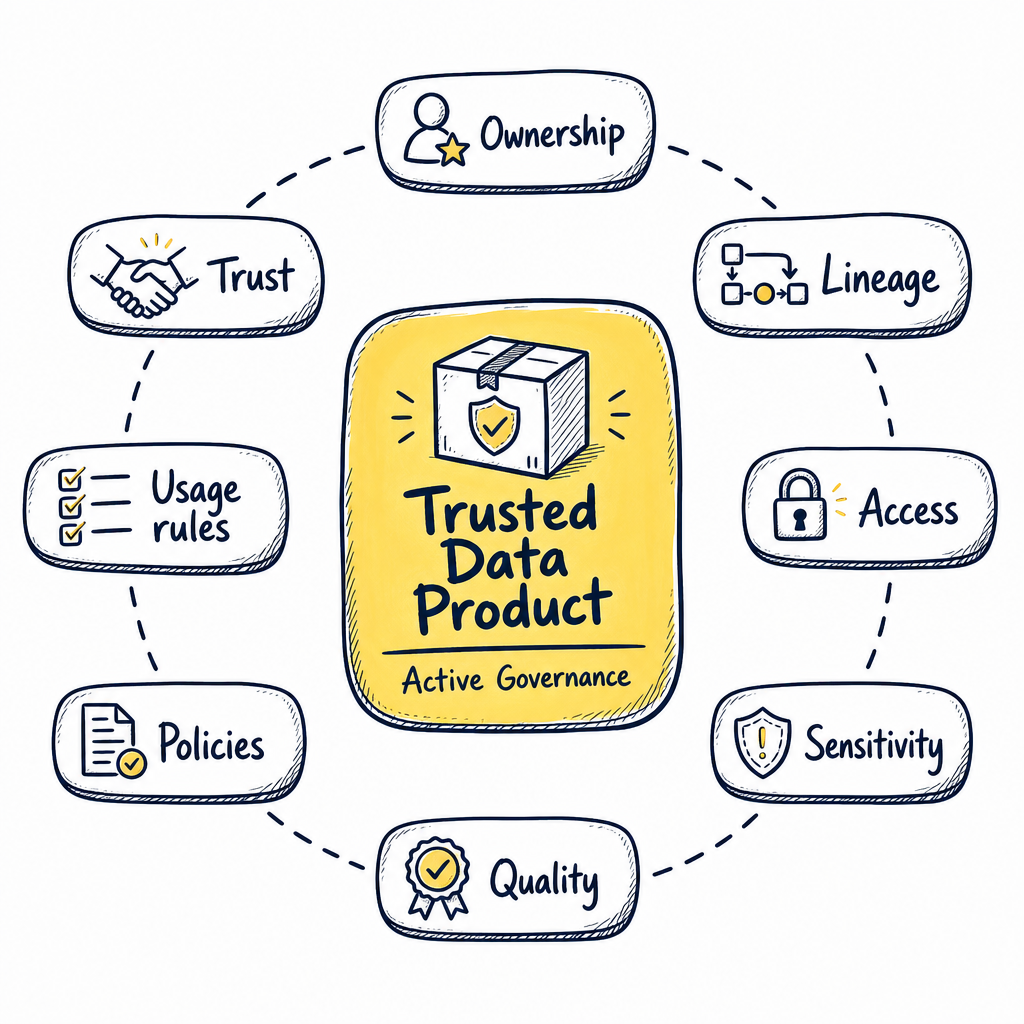
Active governance does not slow the business down. It does the opposite. When ownership, lineage, sensitivity, quality expectations, and usage rules are embedded into the product itself, the conversation with stakeholders changes. Business teams can move forward with confidence. Risk and compliance teams can see the posture of every product. AI teams can ground models in data they can defend.
FIGURE 7
Active Governance at the Point of Decision
Active governance means policies and controls are embedded into how data products are created, shared, and consumed. Governance moves from documentation to operational trust.
Fig 7.Active governance at the point of decision.
Chapter 7
From data products to AI-ready decisions.
Trusted data products are a precondition for trustworthy AI. When an AI agent is grounded in a governed data product, it inherits the ownership, context, lineage, and quality expectations that come with it. The agent can explain where its inputs came from. The human in the loop can see what assumptions the agent is operating under. The organization can change a policy in one place and see the change propagate.
Without that foundation, AI ends up acting on the digital equivalent of folklore. Numbers without provenance. Definitions without owners. Context without controls. Decision-driven organizations refuse to let AI run on that footing.
Chapter 8
From data products to the AI factory.
The natural progression from a portfolio of trusted data products is an AI factory. An AI factory is the place where business problems are translated into AI capability with the same discipline, repeatability, and governance that the best manufacturing organizations apply to physical products. It is where agents and intelligent workflows are designed, governed, measured, and improved, drawing on the data products produced elsewhere in the enterprise.
This is the relationship between Latttice and Lenz. Latttice is the Data Product Workbench. It is where business teams shape, govern, and publish trusted data products. Lenz is the AI Factory. It is where those products become AI agents and intelligent workflows grounded in business context, governance, and measurable outcomes.
FIGURE 8
Latttice + Lenz AI Factory
Latttice creates the trusted data product foundation. Lenz turns that foundation into AI-powered workflows and agents that operate with business context and governance.
Fig 8.Latttice and Lenz working together as the decision-driven AI factory.
Chapter 9
The new role of the CDAO.
The Chief Data and Analytics Officer is being asked to do something new. The mandate is no longer to centralize data, prove value through dashboards, or oversee a portfolio of analytics projects. The mandate is to build the operating model that lets the business improve decisions at scale, safely, with AI in the loop.
That changes the day. It changes the team. It changes the conversations the CDAO has with the board. The most effective CDAOs we work with are spending less time defending the data estate and more time helping business leaders frame the decisions they need to improve. They are sponsoring the creation of trusted data products around those decisions. They are insisting on active governance from day one. And they are building the AI factory that turns trusted products into agents and workflows.
Chapter 10
What leaders should do now.
The first move is rarely a technology decision. It is a discipline decision. Pick the decisions that matter most to the next twelve months of business performance. Be specific. Then ask, for each of those decisions, what data, context, ownership, and governance would have to be in place for the decision to improve consistently? That conversation often reveals more than any architecture review.
From there, the next moves follow naturally. Establish business ownership for the products that will support those decisions. Make governance active rather than documentary. Pilot the AI capability against decisions that already have a trusted data product behind them. Measure success in terms of decisions improved, not dashboards published.
Chapter 11
The decision-driven framework.
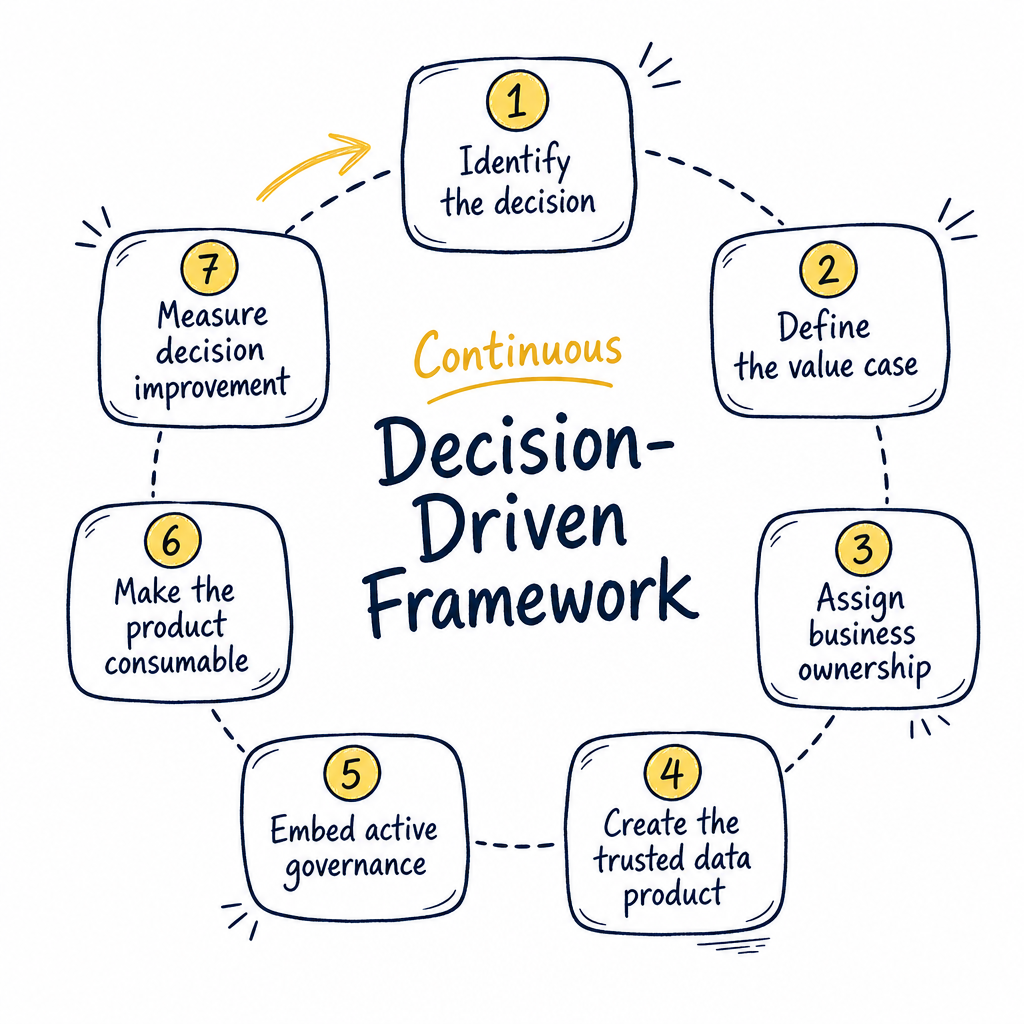
The decision-driven framework is a simple sequence that any organization can adopt. It begins with the decision, not the dataset. It works backward from business value to data product creation, governance, consumption, and measurable outcome improvement. The seven stages can be applied to a single decision, a domain, or the entire enterprise.
FIGURE 9
The Decision-Driven Framework
The decision-driven framework starts with the decision, not the dataset. It works backward from business value to data product creation, governance, consumption, and measurable outcome improvement.
Fig 9.The Data Tiles decision-driven framework.
Chapter 12
Where Data Tiles fits.
Data Tiles builds business-focused, decision-driven, outcome-led data and AI platforms for organizations demanding more from their data today, not tomorrow. Our work begins with the decisions our customers need to improve. From there, we help them design and deliver the trusted data products, active governance, and AI capability required to improve those decisions repeatedly.
Latttice is the Data Product Workbench. It lets business teams create trusted, governed, fit-for-purpose data products without code, building on the platforms organizations already own. Lenz is the AI Factory. It turns those products into AI agents and intelligent workflows that operate with business context, governance, and measurable outcomes. Together, they give decision-driven organizations a faster, safer path from data to decision.
Conclusion
The future is decision-driven.
The data-driven era has run its course as the headline ambition. It served a purpose. It taught organizations to invest in platforms, governance, and analytics capability. It put data on the executive agenda. But it never promised better decisions. It only promised more data.
The decision-driven era starts with a different promise. Improve the decisions that matter. Make them faster, safer, and more repeatable. Use data products, active governance, and AI factories as the operating model. Measure success by outcomes, not by availability. That is the future we are building toward at Data Tiles, and it is the future we believe will define the next decade of enterprise performance.
References
Sources and further reading.
A curated set of analyst research, industry perspectives, and Data Tiles writing informing the arguments in this paper.
01
Harvard Business Review (2026). Companies will not survive without AI-driven operating models.
02
Gartner (2024). Data and Analytics Operating Model and AI Technologies.
03
Gartner (2025). Agentic AI Predictions.
04
Thoughtworks. Introduction to Data Mesh.
05
Gartner (2026). Zero-Trust Data Governance Prediction.
06
Gartner (2025). CDAO Agenda Survey.
About the Author
Cameron Price
Founder & CEO, Data Tiles
Cameron Price is the Founder and CEO of Data Tiles. He writes and speaks on data product strategy, Active Data Governance, and how AI factories deliver value only when built on trusted, governed foundations. He created Latttice and Lenz to make decision-driven operating models operational at scale.
Interactive · Anonymous · 5 minutes
Decision-Driven Ability Assessment.
Gauge how ready your organization is to move from data availability to decision impact.
This assessment helps leaders understand whether their organization is still operating in a data-driven model or beginning to mature into a decision-driven enterprise. It assesses how well your organization connects data, governance, AI, business ownership, and measurable outcomes. No personal information is required.
Score each statement from 1 (Not in place) to 5 (Mature and repeatable).
Q1.Our organization can clearly identify the business decisions that matter most to performance.
Q2.Data initiatives are usually connected to a specific decision, process, or outcome.
Q3.Business teams can explain what decision a data product, dashboard, or AI use case is meant to improve.
Q4.Leaders measure whether data improves decision quality, speed, risk, or business value.
Answer 4 more questions to continue
Data Tiles · Enabling Better Decisions
The future of data is decision-driven.
Data only becomes valuable when it reaches the point of decision. Latttice helps organizations create trusted, governed data products around the decisions that matter. Lenz extends that foundation into the AI factory, where agents and intelligent workflows can operate from trusted data, business context, and active governance.