For more than two decades, organizations have invested heavily in data platforms, warehouses, lakes, lakehouses, governance programs, dashboards, and analytics teams. Yet many business leaders still ask the same basic question:
Why does it still take so long to get trusted data into the hands of the people making decisions?
The answer is not simply technology. It is translation. The modern enterprise has built extraordinary technical capability, but the people closest to the business problem are often still too far away from the data required to solve it. At the same time, the teams responsible for engineering, governing, and securing data are expected to interpret fast-moving business needs without always understanding the commercial context behind them.
This is the divide the Data Catalyst is designed to close.
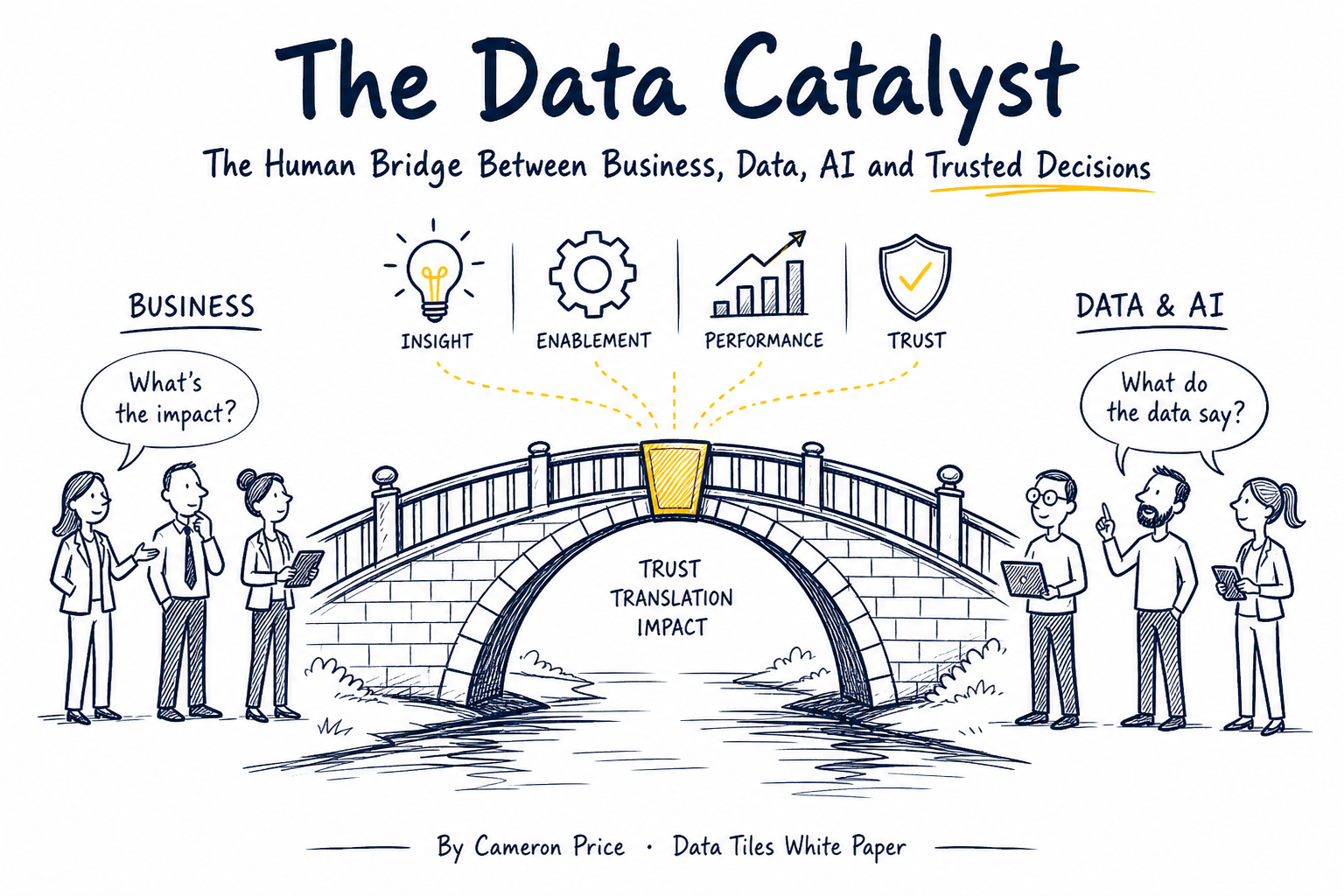
The Data Catalyst is a role I have championed because the future of data will not be won by technology alone. It will be won by people who can connect technical capability to business purpose. People who can translate complexity into action. People who can help organizations move from data availability to data usefulness, from analytics activity to decision impact, and from AI ambition to measurable business value.
AI will automate more work. Zero-code tools will change who can build. Data products will shift ownership closer to the business. Governance will move from documentation to operational control. These shifts do not remove the need for human judgment. They make it more important.
The organizations that succeed in the next decade will not simply have better platforms. They will have better bridges. The Data Catalyst is one of those bridges.
Executive Summary
A new role for a new operating model.
A fundamental realignment is underway across data, analytics, and AI. Generative AI is accelerating automation, changing workforce expectations, and forcing organizations to rethink how work is designed. At the same time, data and analytics leaders are being asked to deliver measurable value faster. Many organizations now have more tools, more platforms, more automation, and more data than ever before, but still struggle to connect those investments to trusted decisions.
This creates a new enterprise requirement. Organizations need people who can operate between business strategy, data capability, AI adoption, governance, and measurable outcomes. They need individuals who understand enough of the technology to ask the right questions, enough of the business to identify the right problems, and enough of the culture to bring people with them. That role is the Data Catalyst.
The Data Catalyst is not just another analyst. Nor is it a replacement for the data engineer, data steward, product owner, or business leader. It is an enabling role that helps these functions work in sync. The Data Catalyst translates business need into data action, accelerates trusted data product creation, strengthens data literacy, supports governance in practice, and helps ensure that AI and analytics initiatives remain tied to business value.
In an AI-driven operating model, the Data Catalyst becomes essential because the bottleneck is shifting from access to alignment. AI increases the cost of poor context. Data democratization without guardrails creates chaos. Business teams need to own more of the data product lifecycle. Data professionals must evolve. The future belongs to those who can combine technical understanding, business empathy, communication, and AI collaboration.
Prologue
The Great Realignment.
The technology world is entering a new era. AI is not simply another wave of innovation. It is changing the structure of work itself. Across industries, automation is reshaping roles, responsibilities, and expectations. Tasks that once required technical specialists are increasingly being supported, accelerated, or partially automated by AI. Zero-code and AI-assisted development environments are changing who can build. Conversational interfaces are changing how people interact with systems. Data products are changing how organizations package, govern, and consume trusted information.
This does not mean the data profession is disappearing. It means it is evolving.
For data engineers, analysts, architects, and data-savvy business professionals, this creates both a challenge and an opportunity. The challenge is that technical work will continue to be automated. The opportunity is that business value will increasingly depend on people who can connect AI, data, governance, and commercial outcomes. That is the space where the Data Catalyst emerges.
“Your role will not disappear. It will evolve. The future belongs to those who can translate technical capability into business knowledge.”
— Cameron Price
Chapter 1
The Data Divide.
Most organizations do not suffer from a lack of data. They suffer from a lack of usable, trusted, contextual data at the moment a decision needs to be made. This distinction matters.
For years, enterprises have invested in platforms designed to centralize, process, govern, catalog, transform, and visualize data. These investments have created enormous technical capability. Yet business teams still frequently experience data as slow, fragmented, hard to access, difficult to understand, or disconnected from the decision they are trying to make.
The divide often appears in familiar ways.
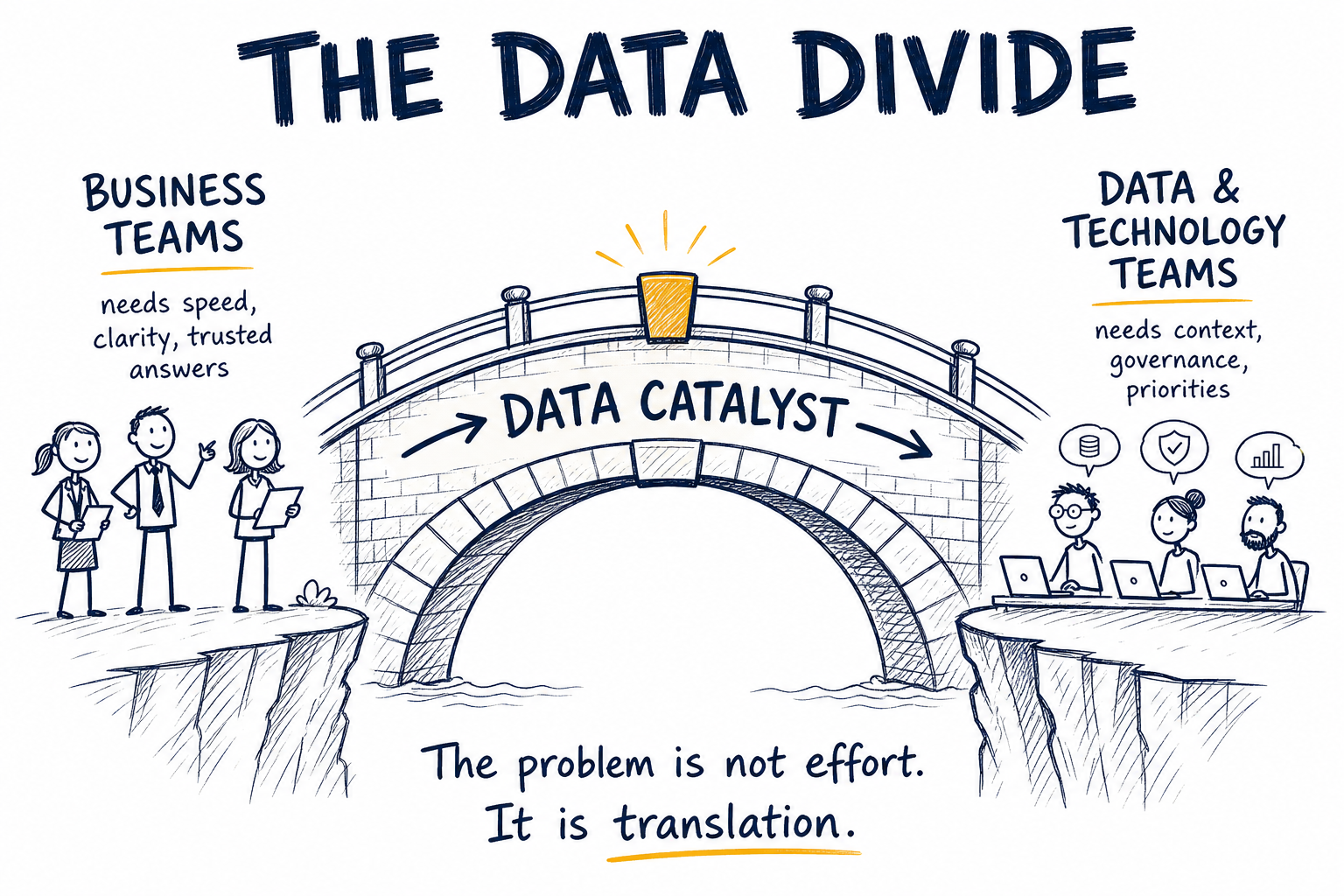
Business teams say the data takes too long, the dashboard does not answer the real question, the numbers do not match, or they do not know which data they can trust. Data and IT teams say the business keeps changing the requirement, does not understand the complexity, or wants self-service without accepting ownership. Both sides are usually right.
The problem is not a lack of effort. It is a lack of translation. Organizations have spent years optimizing the technical supply chain of data. They have not always invested enough in the human translation layer that connects business intent to data execution.
The Data Catalyst exists because these principles do not implement themselves. Someone has to help the business understand what ownership means. Someone has to help technical teams understand what the decision requires. Someone has to help governance move from policy to practice. Someone has to help turn data assets into trusted data products that people can actually use. That someone is the Data Catalyst.
FIGURE 1
The Data Divide
Fig 1.The problem is not effort. It is translation. The Data Catalyst connects both sides around the decision.
Chapter 2
Who Is the Data Catalyst?
A Data Catalyst is the human bridge between business need and data capability.
The role is not defined by a single job title. In many organizations, potential Data Catalysts already exist. They may be senior analysts, business operations leads, data-savvy managers, data stewards, product owners, transformation leads, or technically fluent business users who naturally connect teams, clarify requirements, and drive outcomes. What makes them different is not where they sit on the org chart. It is how they operate.
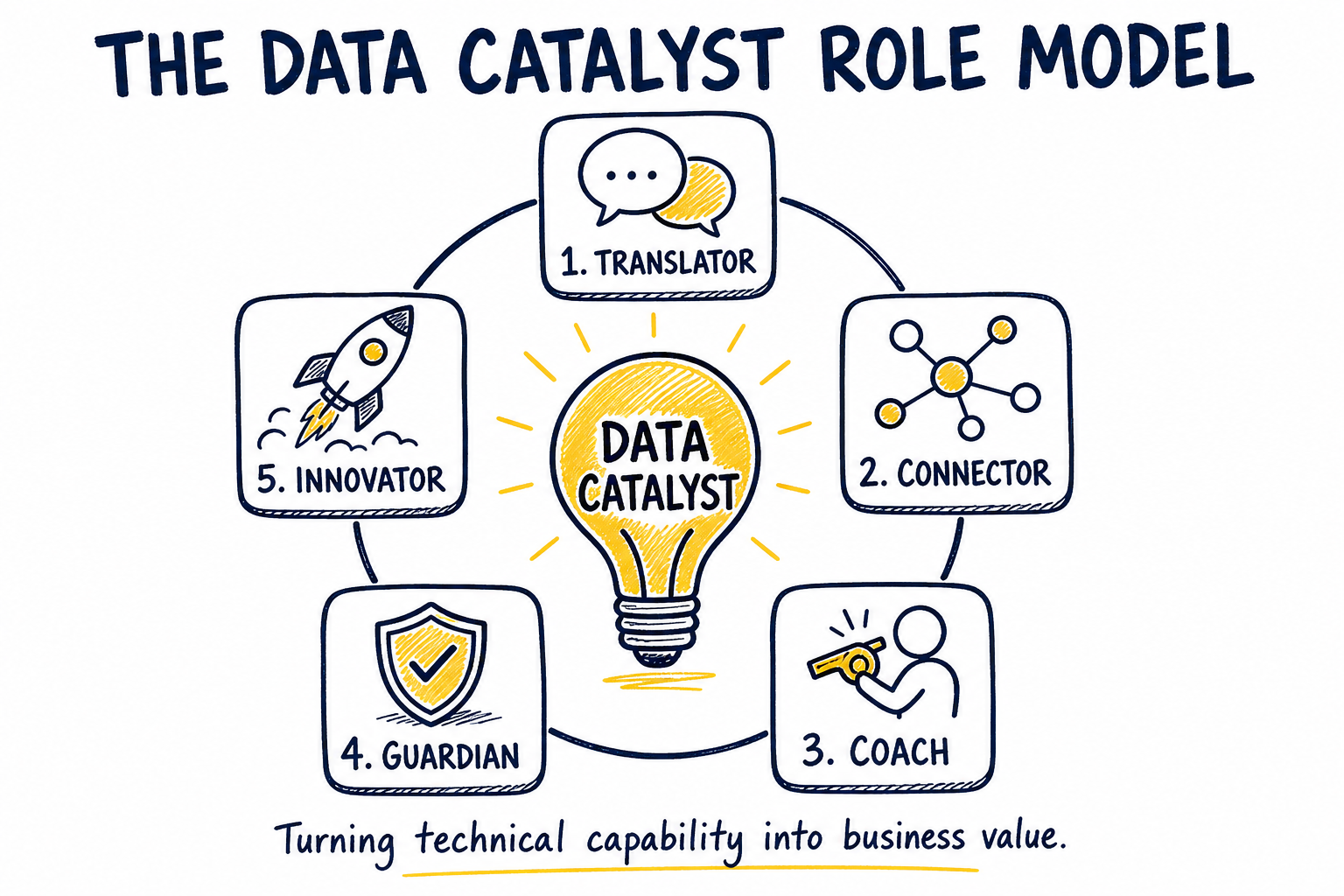
A Data Catalyst translates. They turn business questions into data requirements and technical constraints into business choices.
A Data Catalyst connects. They bring together business teams, data teams, governance teams, and technology platforms around a shared outcome.
A Data Catalyst enables. They help others use data with confidence rather than becoming the bottleneck for every request.
A Data Catalyst accelerates. They reduce friction between need, access, trust, and decision.
The Data Catalyst is not a dashboard builder with a better title. They are not a data engineer in disguise. They are not a governance administrator. They are not a project manager who schedules meetings but does not shape outcomes. They are a business-data translator with enough credibility to influence both sides.
Definition
The Data Catalyst is a strategic enablement role that connects business outcomes to trusted data products, ensuring that data, AI, and analytics initiatives deliver measurable value.
FIGURE 2
The Data Catalyst Role Model
Fig 2.The Data Catalyst turns technical capability into business value.
Chapter 3
Why Organizations Need Data Catalysts Now.
There are five reasons the Data Catalyst role is becoming urgent.
AI has raised the stakes. AI does not remove the need for trusted data. It increases it. Generative AI, agentic systems, and AI-assisted analytics all depend on context, quality, lineage, permissions, semantic meaning, and human oversight. Without these foundations, AI can produce faster confusion rather than better decisions.
The bottleneck has moved. The old bottleneck was access. The new bottleneck is alignment. Many organizations can now connect to data, move data, catalog data, visualize data, and automate parts of the data lifecycle. Yet they still struggle to answer the business question quickly and confidently.
Self-service without structure creates risk. Data democratization sounds attractive, but without governance it can create inconsistent definitions, duplicated dashboards, uncontrolled extracts, competing metrics, and fragmented decisions. The goal is not unlimited self-service. The goal is governed empowerment.
Data teams are overburdened. Many data teams are still trapped between strategic architecture work and endless business requests. They are expected to build pipelines, manage platforms, enforce governance, support analytics, interpret vague requirements, and deliver business-ready outputs. This is not sustainable.
The workforce is changing. Technical capability will remain important, but the differentiator will be the ability to apply it in context. The future data professional will not be judged only by what they can build. They will be judged by what they can help the organization understand, decide, and improve.
FIGURE 3
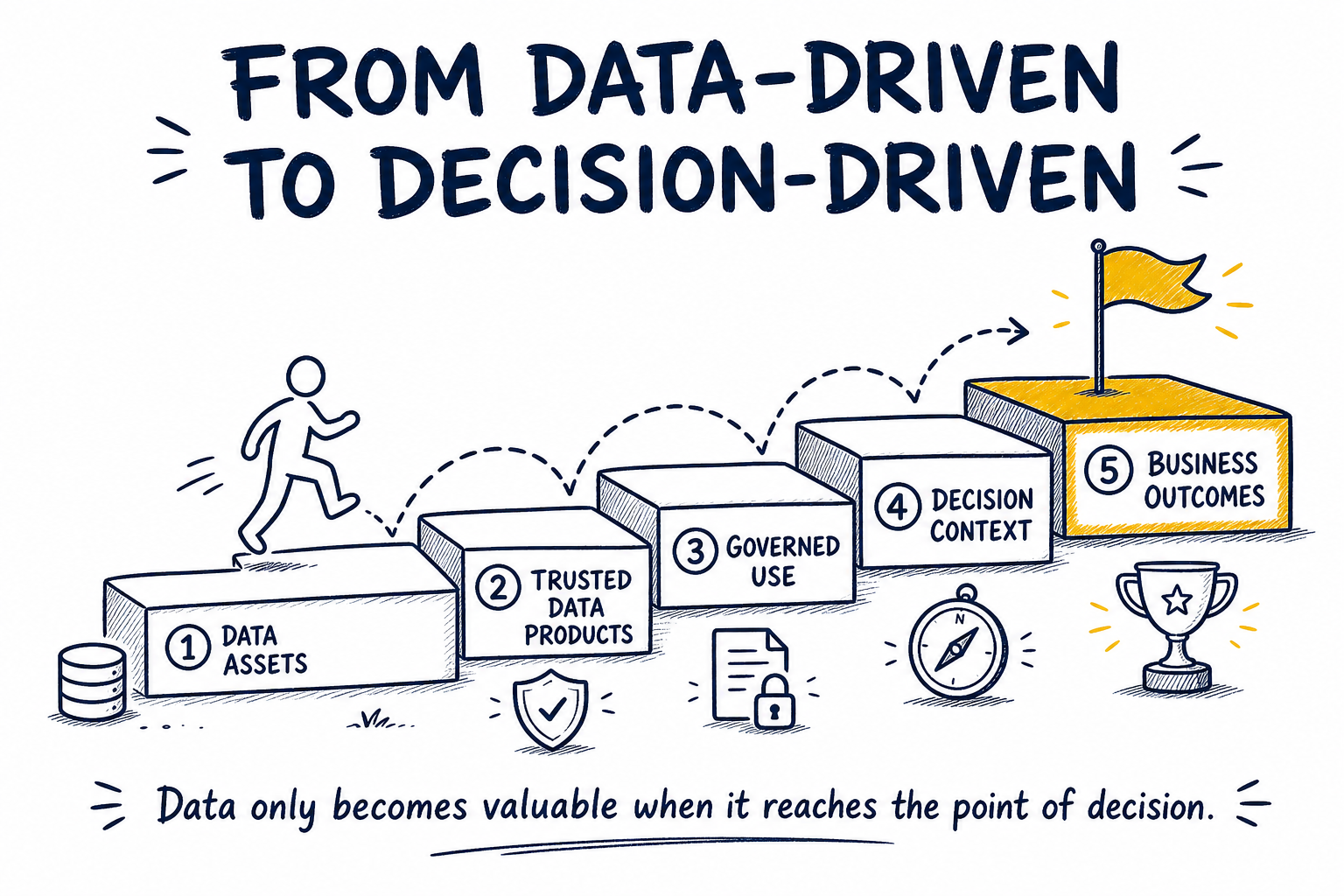
From Data-Driven to Decision-Driven
Fig 3.Data only becomes valuable when it reaches the point of decision.
Chapter 4
The Traditional Divide Is No Longer Fit for Purpose.
The traditional divide between business and technology was built for a slower era.
Business teams defined requirements. Technology teams built systems. Data teams prepared outputs. Reports were delivered. Dashboards were reviewed. Decisions followed. That model assumes stable requirements, clear handoffs, and enough time to wait. Modern business does not work that way.
Markets move faster. Customers generate more signals. Supply chains shift. Regulatory expectations increase. AI changes competitive dynamics. Executives expect faster answers. Domain teams need to act with greater autonomy. The traditional model struggles because it separates the people who understand the decision from the people who control the data.
This creates persistent problems: misaligned goals, slow time to insight, overloaded data engineers, siloed data and duplicated logic, and erosion of trust. The Data Catalyst addresses these issues by changing how the organization works around data. They do not simply speed up requests. They improve the quality of the request itself.
They help the business ask better questions. They help data teams understand the business context. They help governance teams embed controls into usage. They help technology teams support reuse rather than one-off delivery. This is why the Data Catalyst should be viewed as a strategic role, not an administrative one.
Chapter 5
The Skills and Mindset of a Data Catalyst.
The Data Catalyst combines five skill sets that are often separated across different roles.
The Data Catalyst is a translator. They translate between business language and data language. They understand that a business user does not really want a report. They want to know why sales margin has changed, which customers are at risk, where inventory is constrained, which campaign is working, or whether a regulatory threshold is being breached.
The Data Catalyst is an advocate. They advocate for evidence-based decision-making. They challenge assumptions, encourage curiosity, and help teams understand why trusted data matters.
The Data Catalyst is a coach. They build data confidence across the organization. They help business users understand how to ask better questions, interpret outputs, reuse trusted data products, and recognize when data is not fit for purpose.
The Data Catalyst is a guardian. They understand that empowerment without governance creates risk. They help ensure that data products are built with ownership, access control, lineage, quality, definitions, and accountability in mind.
The Data Catalyst is an innovator. They identify repeatable data products, spot opportunities for AI-assisted insight, encourage reuse, and help the organization move away from one-off reporting toward scalable decision assets.
Their value is measured not by the volume of analysis produced, but by the decisions improved.
Chapter 6
The Rise of the Knowledge Engineer.
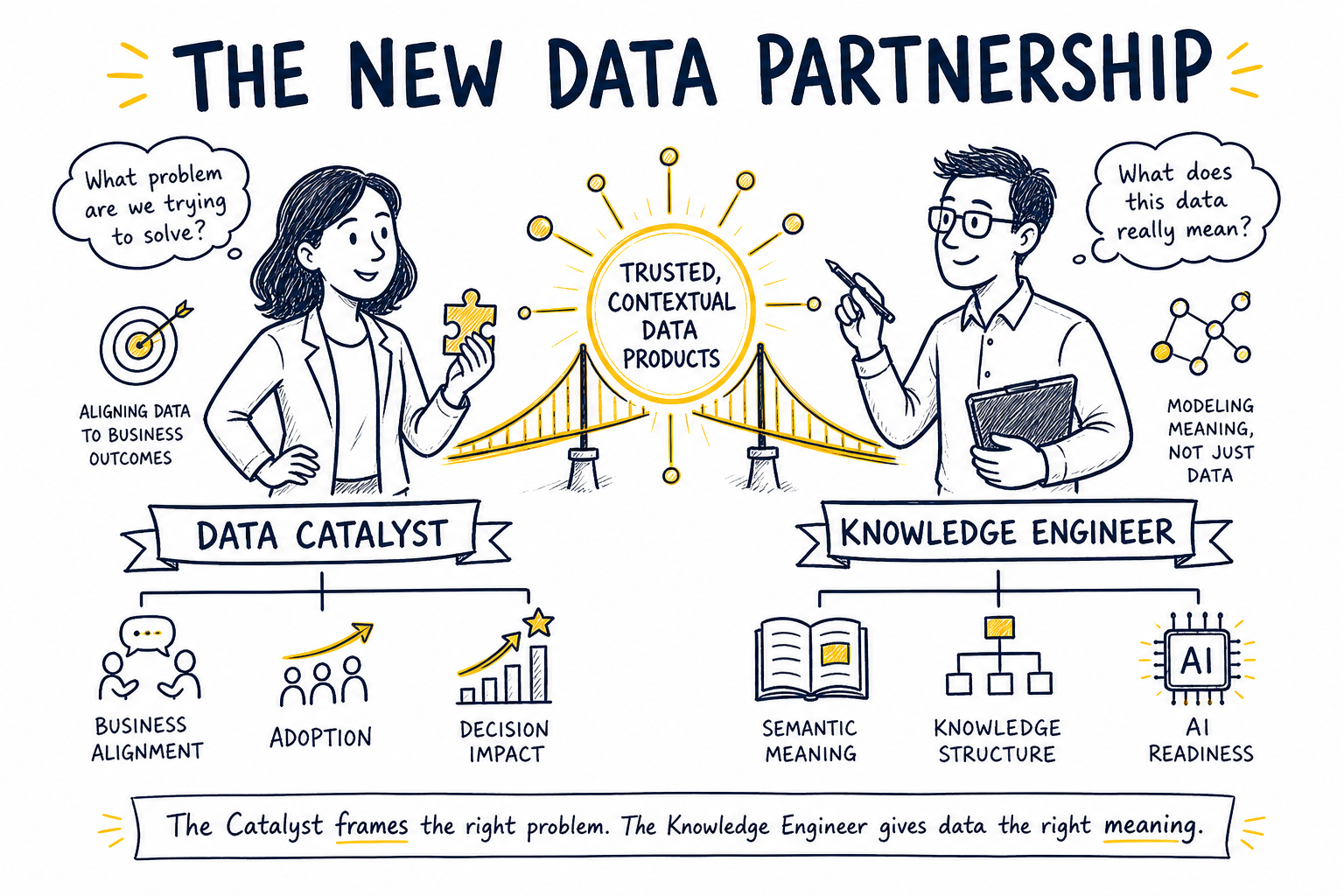
As organizations mature in data and AI, another role is emerging alongside the Data Catalyst: the Knowledge Engineer. The Data Catalyst focuses on business translation, adoption, decision alignment, and trusted usage. The Knowledge Engineer focuses on structuring meaning.
This distinction will matter more as AI becomes more embedded in enterprise workflows. AI systems do not only need data. They need context. They need relationships. They need definitions. They need semantic models. They need knowledge structures that help machines interpret business reality more accurately.
The Data Catalyst ensures the organization is solving the right problem. The Knowledge Engineer ensures the data and knowledge structures are fit for intelligent use. Together, they represent the next evolution of the data profession.
FIGURE 4
The New Data Partnership
Fig 4.The Catalyst ensures the organization solves the right problem. The Knowledge Engineer ensures the data carries the right meaning.
Chapter 7
Scenarios: Data Catalysts in Action.
Marketing Performance
A marketing team wants to understand why campaign conversion has dropped. Traditionally, this request would move through several handoffs. Marketing defines a requirement, data teams extract and prepare data, analytics teams build outputs, and stakeholders review dashboards weeks later. A Data Catalyst changes the flow. They help marketing clarify the business question, identify required data sources, align definitions for conversion and attribution, and work with the team to create a governed data product in Latttice. The result is not just a dashboard. It is a reusable campaign performance data product that can be shared, governed, and queried again.
Finance Forecasting
A finance team needs to build a rolling forecast using sensitive data. The challenge is not only access. It is control. A Data Catalyst works with finance, governance, and data teams to define who can see which data, which assumptions are approved, and how forecast inputs should be reused. Through Latttice, fine-grained access controls can support trusted use without exposing sensitive information unnecessarily.
Supply Chain Bottlenecks
An operations leader wants to understand late shipments across suppliers, warehouses, and transport partners. The data sits across multiple systems, and each domain uses slightly different terminology. A Data Catalyst identifies the decision that needs to be improved, aligns stakeholders on common definitions, and helps create a cross-domain data product that brings together the relevant information.
AI Readiness
An executive team wants to deploy AI agents into customer service, but the organization lacks confidence in the underlying knowledge base, customer data quality, and governance model. A Data Catalyst helps define the business value case, risk considerations, access requirements, and decision points. A Knowledge Engineer helps structure the underlying knowledge assets. Together, they create the foundation for AI that is useful, governed, and aligned to business outcomes.
Chapter 8
Technology as the Enabler: Latttice as the Bridge.
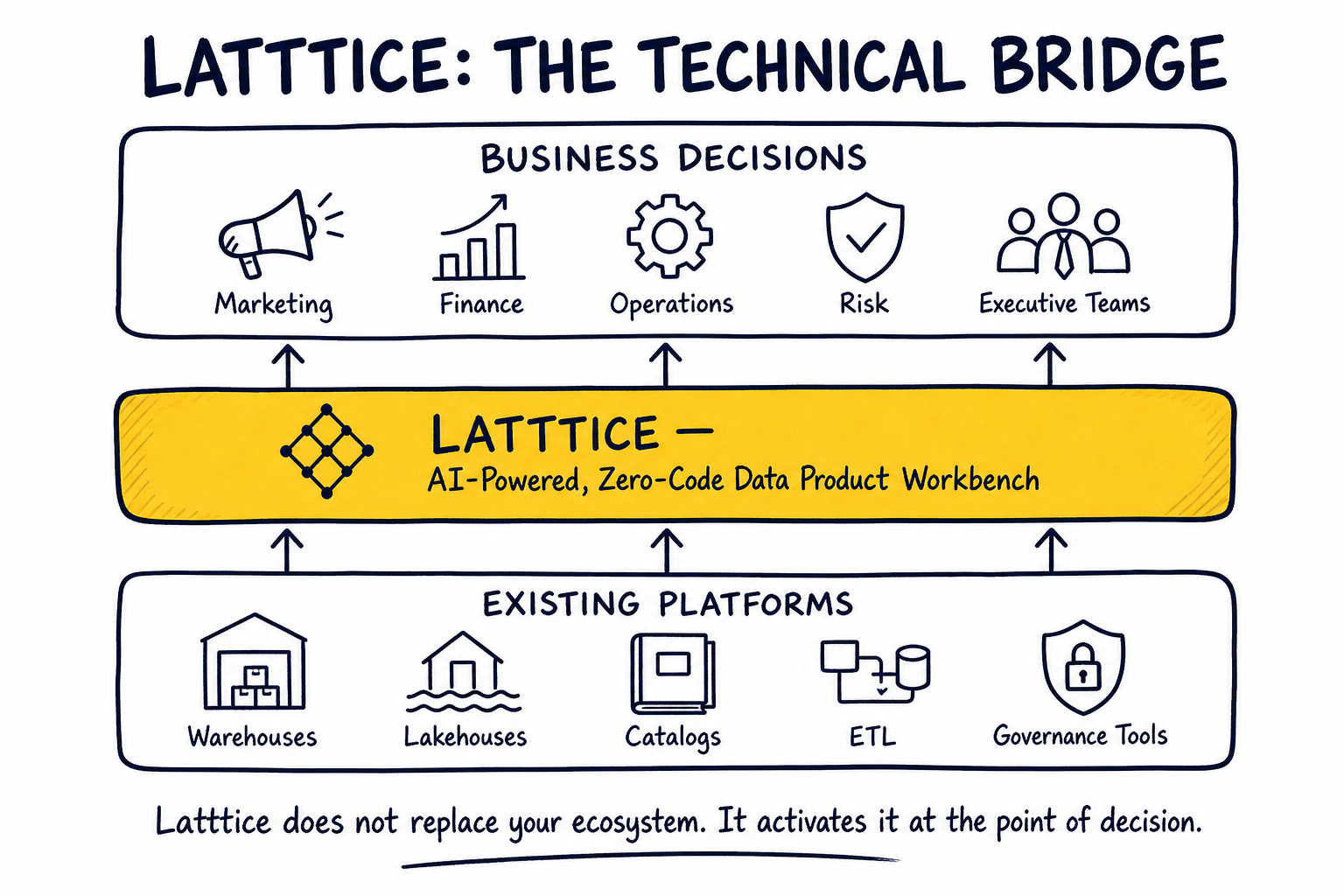
The Data Catalyst is the human bridge. Latttice is the technical bridge. The role and the platform are designed around the same belief: trusted data should reach the point of decision faster, with governance built in, and without forcing business teams into technical dependency for every data product they need.
Latttice enables business teams and domain owners to create, govern, share, and reuse trusted data products through an AI-powered, zero-code experience. It does not replace the existing data ecosystem. It works with it. Infrastructure platforms, ETL tools, policy engines, warehouses, lakehouses, catalogs, and processing layers all continue to play important roles. But those layers do not automatically create decision-ready business data products. They do not automatically preserve context. They do not automatically ensure that the business can access, understand, and use trusted data at speed. Latttice focuses on that final mile.
It gives the Data Catalyst the practical environment to turn business need into governed data product. Latttice supports zero-code data product creation, AI-assisted product build, fine-grained governance, structured and unstructured data access, a marketplace for reusable data products, lineage and quality visibility, and business ownership.
This is important because the future of data products cannot rely on slow, manual handoffs. Business teams need to work in sync with engineering teams. Data engineers need confidence that business-created data products remain governed and secure. Executives need confidence that data initiatives produce measurable outcomes. Governance teams need confidence that policies are operationalized, not bypassed. Latttice gives the Data Catalyst the mechanism to make this collaboration practical.
FIGURE 5
Latttice: The Technical Bridge
Fig 5.Latttice does not replace your ecosystem. It activates it at the point of decision.
Chapter 9
Building the Data Catalyst Role in Your Organization.
The Data Catalyst role should not begin as a large reorganization. It should begin as a focused operating model decision.
Identify natural Catalysts. Look for people who already bridge business and data conversations. They are often the people others go to when requirements are unclear, dashboards do not make sense, or teams are misaligned.
Give them authority. The Catalyst cannot succeed if they are treated as a messenger. They need permission to challenge unclear requirements, align stakeholders, influence data product priorities, and escalate barriers.
Equip them with the right platform. A Data Catalyst without enabling technology becomes another bottleneck. They need tools that allow business teams to create, govern, discover, and reuse data products safely.
Connect them to governance. The Catalyst should not bypass governance. Their role is to make governance usable.
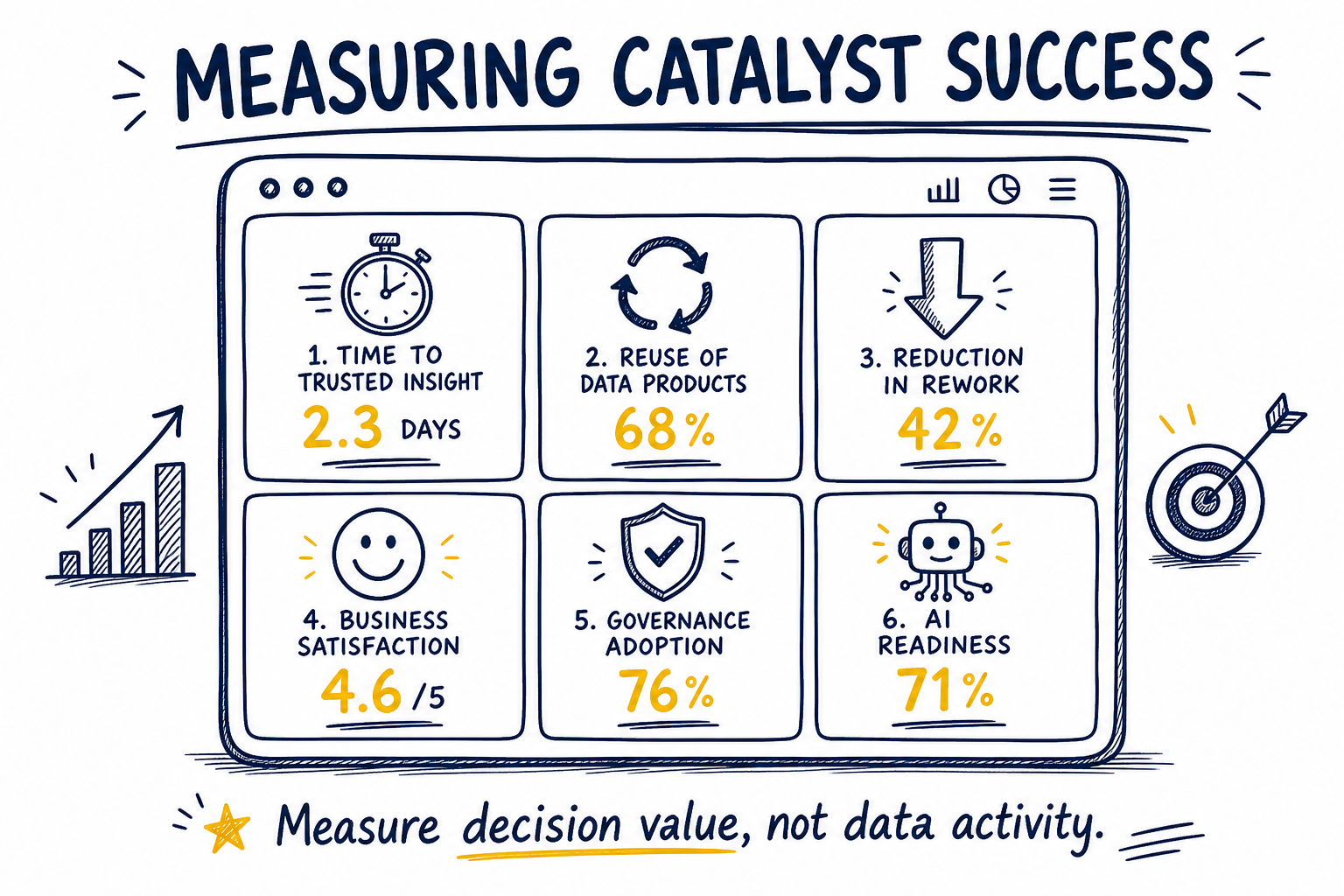
Measure business outcomes. Do not measure the Catalyst by the number of reports delivered. Measure time-to-insight, reuse of trusted data products, business satisfaction, reduction in rework, improvement in decision speed, and measurable value created.
Chapter 10
Pitfalls to Avoid.
The Data Catalyst role can fail if organizations misunderstand it.
Do not treat the Catalyst as a reporting resource. If the Catalyst becomes the person who builds every dashboard, the role loses strategic value.
Do not give responsibility without authority. A Catalyst cannot align teams if they have no mandate.
Do not ignore governance. Self-service without governance creates risk.
Do not overload one person. The Catalyst is a role pattern, not a superhero. Mature organizations will build networks of Catalysts across domains.
Do not measure activity instead of impact. If the organization measures outputs rather than business outcomes, the Catalyst will be pulled back into traditional reporting behavior.
“The goal is not more data activity. The goal is better decisions.”
Chapter 11
Measuring Success.
A Data Catalyst should be measured through outcomes that matter to executives and domain leaders.
Success should be measured by time to trusted insight. How quickly can a business team move from question to governed answer? It should be measured by reuse of trusted data products. Are teams discovering and reusing existing data products instead of rebuilding the same logic?
It should be measured by reduction in rework. Are requirements clearer? Are fewer dashboards being rebuilt? Are fewer definitions being debated? It should be measured by business satisfaction. Do stakeholders trust the data? Do they feel empowered? Are they making decisions faster?
It should be measured by governance adoption. Are governance controls being embedded into the way data is used, rather than handled separately? It should be measured by AI readiness. Are data products structured, governed, and contextual enough to support AI use cases?
And it should be measured by business value. Can the organization connect data products and Catalyst-led initiatives to revenue, cost reduction, risk reduction, productivity, or customer outcomes? This is where many data programs fall short. They measure delivery, but not decision value. The Data Catalyst changes the conversation.
FIGURE 6
Measuring Catalyst Success
Fig 6.Measure decision value, not data activity.
Chapter 12
The Future of the Data Professional.
The future data professional will not be defined only by technical specialization. They will be defined by their ability to create business value from data, AI, and human collaboration.
Some will become deeper technical specialists. Some will become Knowledge Engineers. Some will become AI governance leaders. Some will become data product architects. Some will become Data Catalysts. The common thread is this: the next generation of data professionals must understand that technical capability alone is no longer enough.
AI will write more code. Platforms will automate more pipelines. Business users will build more products. Governance will become more embedded. Agents will support more decisions. But human judgment will remain central.
The future belongs to those who can ask:
What decision are we trying to improve?
What data is trusted enough to support it?
What context must be preserved?
What governance must be applied?
Who needs access?
What outcome are we trying to measure?
How do we help people use this confidently?
That is the work of the Data Catalyst.
Conclusion
The Bridge Defines the Future.
The enterprise does not need more disconnected data activity. It needs better alignment between data, AI, governance, and business outcomes. The Data Catalyst is the role that makes this alignment practical.
It is a role born from the reality that technology alone cannot close the data divide. Platforms matter. AI matters. Governance matters. Data products matter. But without people who can connect them to business purpose, organizations will continue to struggle with slow delivery, poor trust, duplicated effort, and unclear ROI.
The Data Catalyst is not a temporary role. It is a signal of where the industry is heading.
From centralized control to governed empowerment.
From technical handoff to business ownership.
From dashboards to data products.
From data-driven activity to decision-driven performance.
From AI experimentation to AI value.
The future of data will be shaped by those who can bridge the gap.
“Empower your Data Catalyst. Give them the authority, platform, and mandate to turn data into decisions.”
— Cameron Price · Join a Data Conversation
Next Step
Empower your Data Catalyst with Latttice.
Latttice helps organizations bridge the gap between business teams and trusted data by enabling AI-powered, zero-code data product creation with governance built in. Data Catalysts can help domain teams create trusted data products faster, reuse governed data assets, access structured and unstructured data, apply fine-grained controls, preserve business context, and accelerate decision-making in sync with engineering and governance teams.
Latttice gives catalyst leaders a platform to turn this thinking into operational reality — bridging business and data teams around decisions, not dashboards.