
Part 3: From Knowing Data Exists to Using It
Making Governance Operational
Part 3 of the Series — Active Data Governance: From Knowing Data Exists to Using It.
From Knowing to Using: Making Governance Operational. In this installment, we move beyond theory and into operational practice, exploring the principles, structural changes, and design decisions that transform governance from a compliance function into a live operational capability.
The Gap Between Knowing and Using
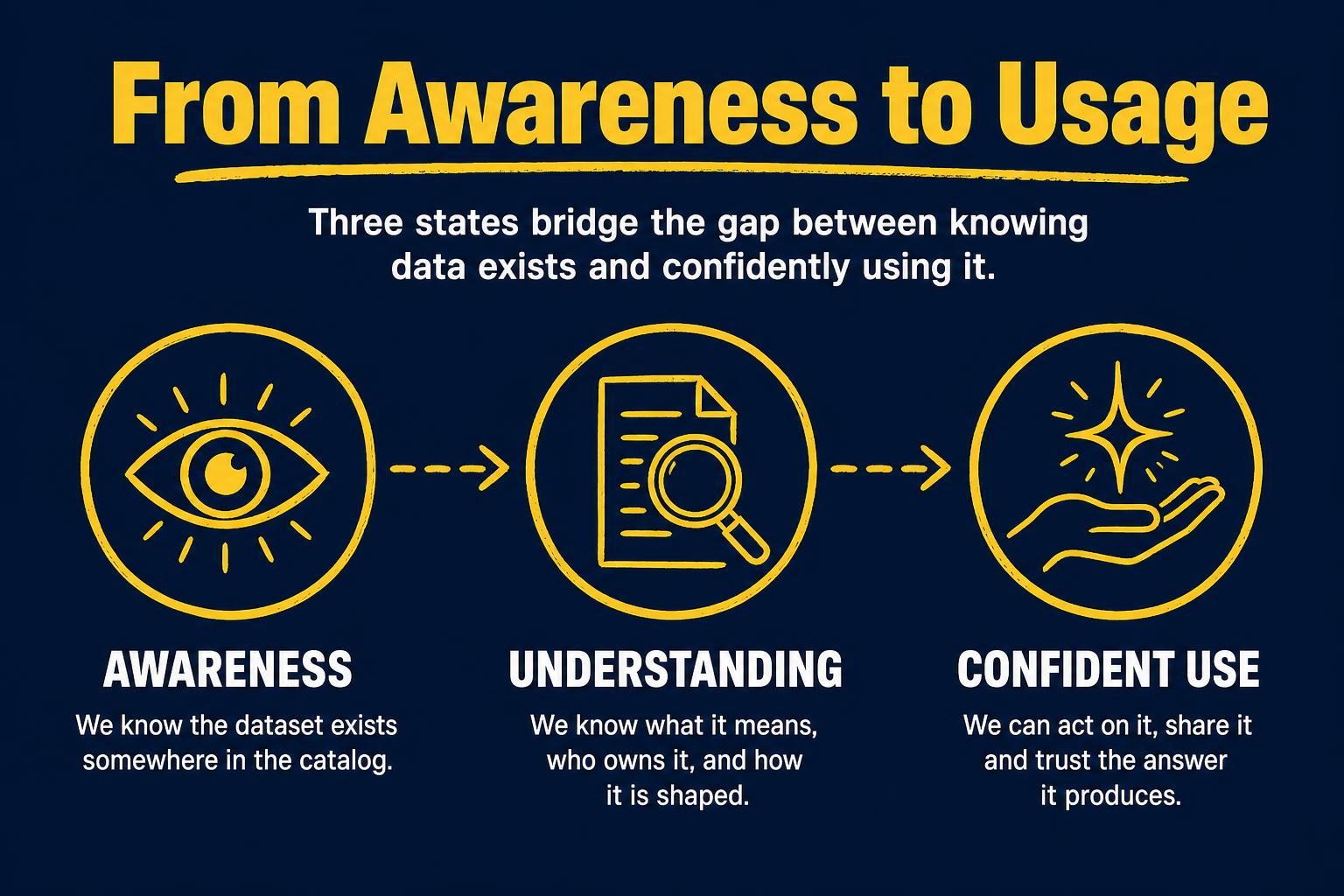
Most organizations have already invested heavily in data governance. They have catalogs, policies, classifications, ownership models, and compliance frameworks in place. They know where their data is, who owns it, and how it should be used. And yet, when it comes to actually using that data to make decisions, hesitation remains. Access is delayed, confidence is inconsistent, and governance is often perceived as a barrier rather than an enabler.
This is the gap that Active Data Governance addresses. It is not about redefining governance, but about making it operational. Traditional governance has focused on documentation and oversight, creating awareness without ensuring usability. Active Data Governance shifts this model by embedding governance directly into the moment data is used, where value and risk exist simultaneously. This allows organizations to move from static control to dynamic, context-aware enforcement, without slowing down decision-making.
Research from Gartner, McKinsey and Company, and Forrester consistently highlights that organizations struggle not because they lack governance frameworks, but because those frameworks are not integrated into operational workflows. The result is a persistent disconnect between knowing data exists and trusting it enough to use it.
This article outlines the practical principles required to close that gap. It argues that governance must move from being a project to becoming an operating capability, from being centrally interpreted to automatically executed, and from being applied to technical artifacts to being aligned with business-facing data products. When implemented correctly, governance becomes invisible until it matters, scalable across both human and machine consumption, and capable of enabling rather than restricting decision-making.
From Awareness to Action
In the first two parts of this series, we reframed the governance challenge in a way that reflects what many organizations are already experiencing. In Part 1, we explored how governance has historically stopped at awareness, creating visibility without confidence. Organizations know their data exists, but they do not trust it enough to act on it. In Part 2, we introduced Active Data Governance as the shift from documentation to execution, moving governance into the flow of how data is actually used.
The critical question now is not theoretical. It is operational.
How do organizations make this real in environments that are already complex, distributed, and under pressure to deliver faster outcomes?
The answer is not another layer of process or another centralized program. It is a change in how governance is designed and applied, embedding governance into the natural lifecycle of data usage, ensuring that it operates at the exact point where decisions are made, rather than before or after that moment.
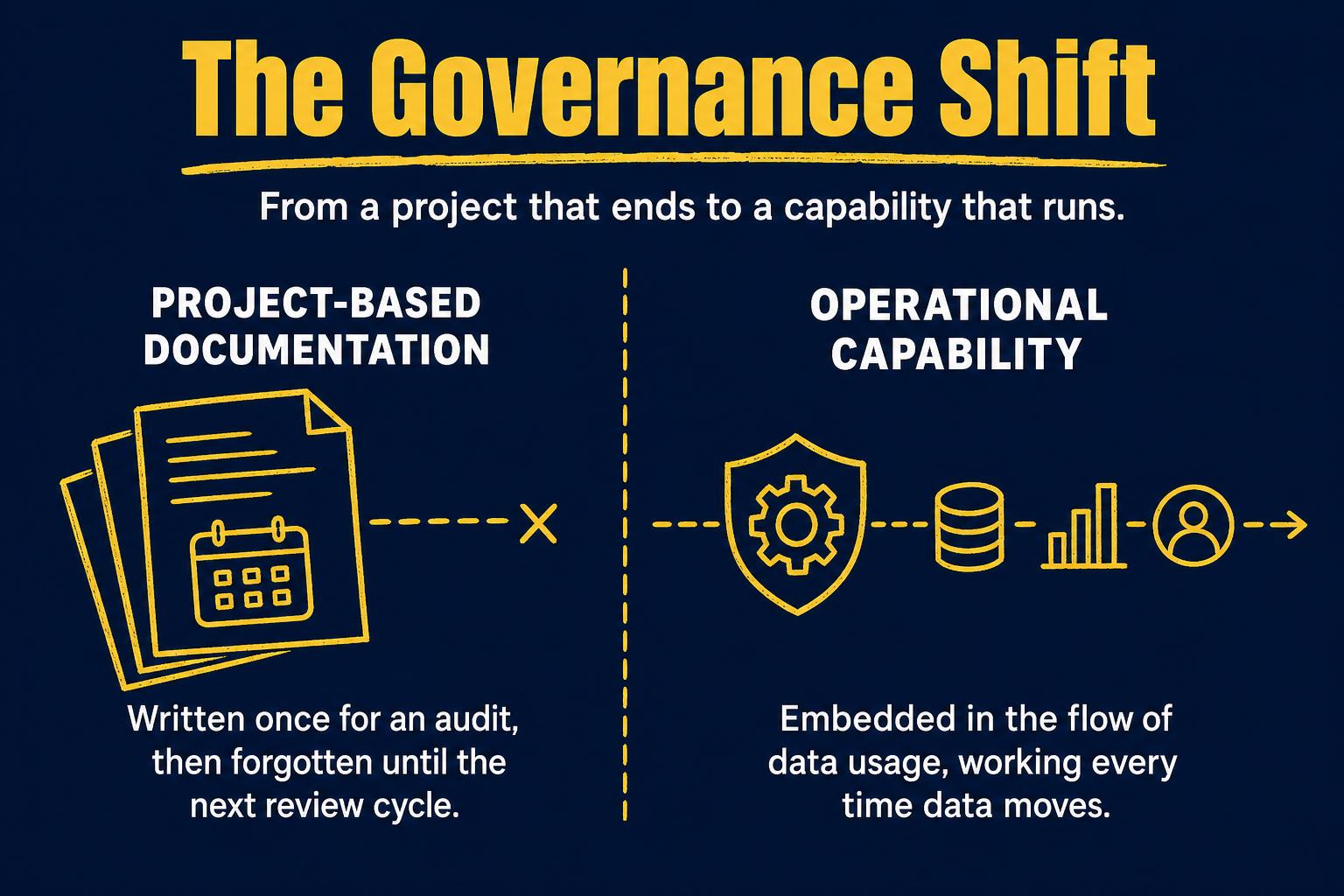
Stop Treating Governance as a Project
One of the most common failure points in governance initiatives is the assumption that governance can be "delivered" as a project. This approach typically results in large-scale transformation efforts that focus on building frameworks, defining policies, and implementing tools over extended periods of time. While these efforts often produce comprehensive documentation, they rarely change how data is actually used within the organization.
Evidence from Gartner suggests that a significant proportion of governance programs fail to achieve adoption beyond initial implementation phases. This is not due to a lack of capability, but due to a lack of integration into daily workflows. Governance becomes something that exists alongside operations, rather than within them.
Active Data Governance reframes this entirely. It is not a destination that can be reached and completed. It is an operating capability that evolves continuously. It prioritizes relevance over completeness, ensuring that governance is always aligned with how data is being used, rather than how it was originally designed to be controlled.
Governance Must Exist at the Point of Use
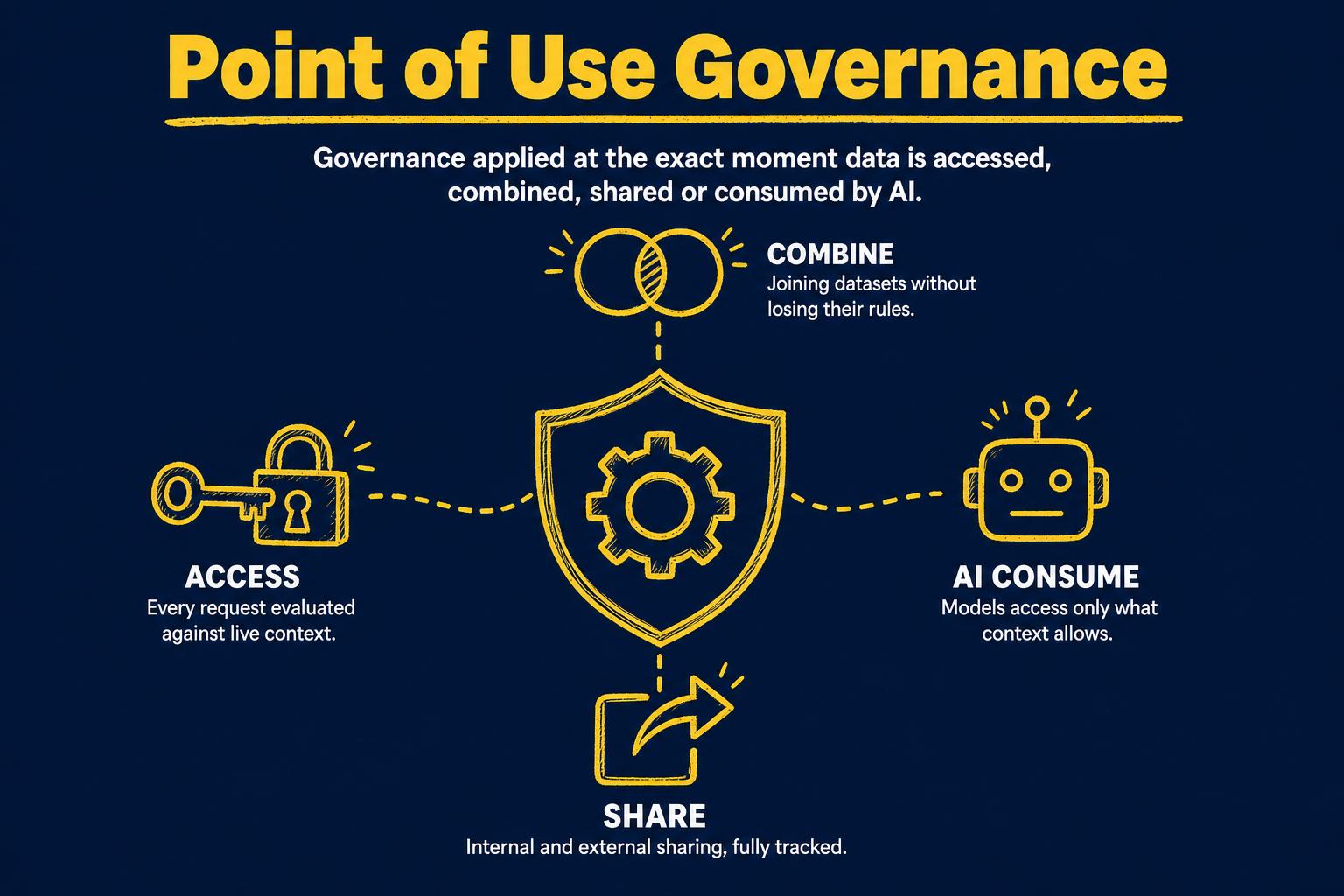
The most important shift in Active Data Governance is where governance is applied. Traditional models place governance either upstream, within data engineering pipelines, or downstream, within audit and compliance processes. In both cases, governance is removed from the moment where data is actually used to make decisions. This separation is increasingly problematic in modern data environments.
According to McKinsey and Company, organizations that enable real-time, data-driven decision-making are significantly more likely to outperform their peers. However, these same organizations identify governance as a key constraint on speed, particularly when access and approval processes introduce delays.
Governance must therefore operate at the point of use. It must be present when queries are executed, when datasets are combined, when insights are shared, and when data is consumed by AI systems or automated processes.
This is the moment where risk and value intersect, and where governance has the greatest impact. When governance is not present in this moment, it becomes advisory rather than operational. It may inform decisions, but it does not shape them. The distinction between these two states is the difference between governance that is tolerated and governance that is trusted.
Separating Definition from Execution
Governance intent is set by humans. Enforcement is handled by systems. This separation eliminates variability and removes the bottleneck of manual interpretation at scale.
A core principle of making governance operational is the separation of definition from execution. Organizations still require policies, classifications, glossaries, and ownership models. These elements provide the structure and intent of governance. However, the enforcement of these elements should not rely on manual interpretation at the point of use.
Research from Deloitte and Forrester highlights that manual governance processes introduce inconsistency and delay, particularly in large, distributed environments. When humans are responsible for both defining and enforcing governance, the result is variability in how rules are applied and increased risk of non-compliance.
Active Data Governance addresses this by allowing humans to define governance intent while systems handle execution, ensuring consistency and scale.
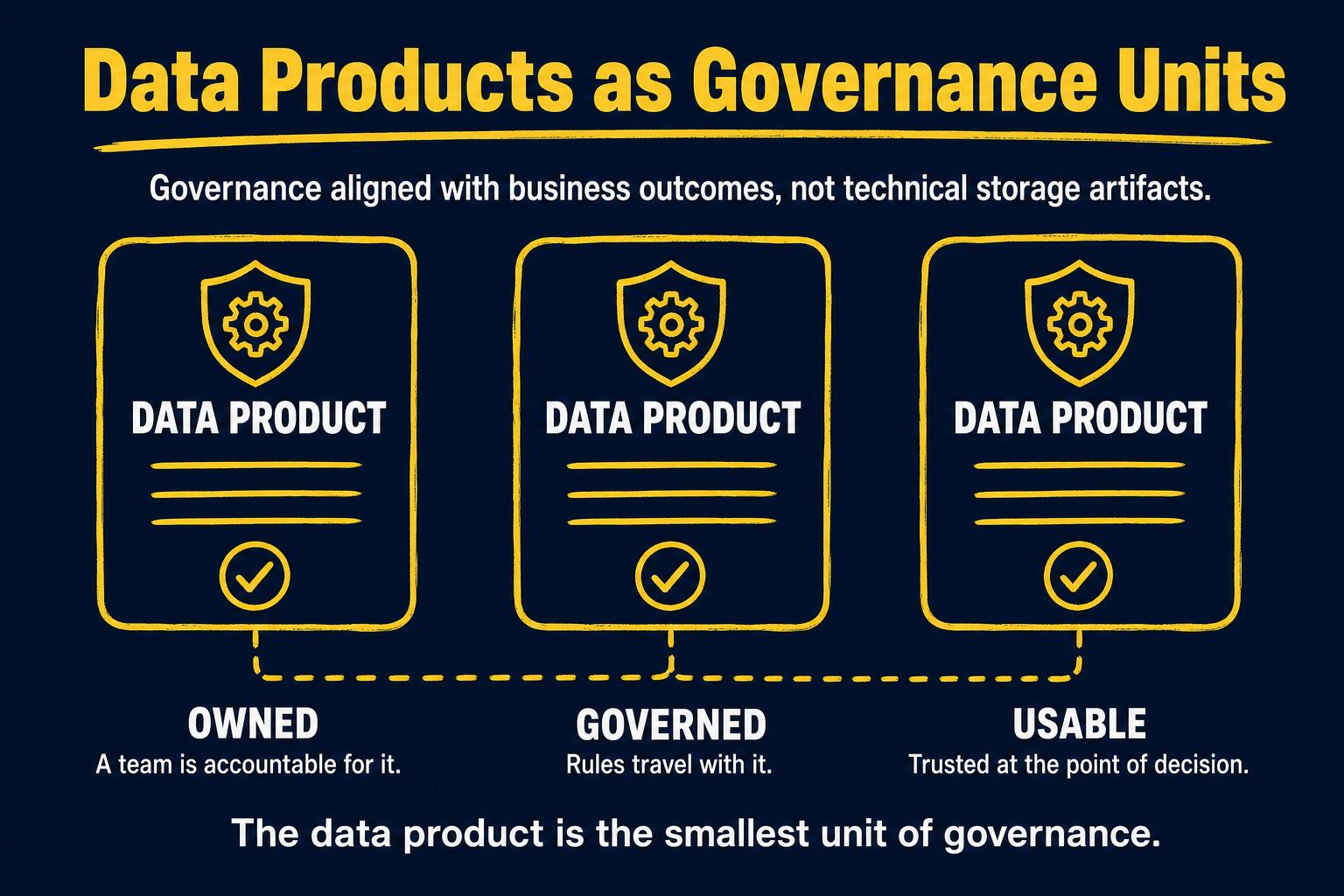
Data Products as the Unit of Governance
Another critical shift is the move away from governing technical artifacts toward governing data products. Tables, files, and schemas were never designed to carry business meaning. They represent how data is stored, not how it is used. Applying governance at this level creates a persistent disconnect between the rules that exist and the outcomes that matter to the business.
The concept of data as a product, introduced by Zhamak Dehghani, provides a more appropriate unit for governance. Data products are defined by their purpose, their consumers, and their expected usage. They have clear ownership and accountability, making them a natural focal point for governance. Studies from BARC (Business Application Research Center) and Thoughtworks indicate that organizations adopting data product approaches see improved trust and reuse of data, because governance is aligned with how the business actually interacts with data, rather than how data is structured technically.
By governing data products, organizations can ensure that governance is directly tied to outcomes rather than infrastructure, making it both more meaningful to business users and more enforceable in practice.
Making Governance Invisible Until It Matters
One of the defining characteristics of effective governance is that it does not unnecessarily interrupt workflows. Traditional governance often introduces friction through approval processes, access requests, and manual checks. This creates resistance among users and limits adoption across the organization.
According to Forrester, user experience is a critical factor in governance success. When governance is perceived as restrictive, users are more likely to bypass it, increasing risk rather than reducing it.
Active Data Governance takes a different approach. It is designed to be invisible during valid usage, allowing users to access and use data without interruption. When restrictions are necessary, governance provides clear, contextual explanations, ensuring that users understand why certain actions are limited and what alternatives exist.
This approach shifts governance from being perceived as a mechanism of control to being experienced as a foundation of confidence. Users trust that the data they are working with is governed appropriately, without needing to engage directly with governance processes to validate that trust.
Designing for Humans and Machines
The modern data landscape includes not only human users but also machines. BI tools, APIs, automation workflows, and AI systems all interact with data continuously. This introduces new challenges for governance, particularly in ensuring consistency and scalability across forms of consumption that operate at speed and volume far beyond what manual processes can manage.
Research from MIT Technology Review and IDC highlights that the rapid adoption of AI is outpacing governance capabilities, creating significant risks in areas such as data privacy, bias, and regulatory compliance. Active Data Governance addresses this by encoding governance intent in a way that can be enforced by machines, ensuring that governance is applied consistently across all forms of data consumption, whether human or automated.
Human Intent
Business and governance leaders define policies, classifications, and ownership rules that reflect organizational priorities and regulatory requirements.
Machine Execution
Systems enforce governance at scale, in real time, across every data interaction — BI queries, API calls, AI pipelines, and automated workflows.
Continuous Oversight
Human oversight remains essential for defining, monitoring, and refining governance rules as business context, regulation, and data usage evolve.
Starting Where It Matters Most
Implementing Active Data Governance does not require a complete overhaul of existing systems. Organizations that attempt full-scale transformation simultaneously often find themselves paralysed by complexity before demonstrating any meaningful value. Instead, a targeted approach focused on the highest-impact areas enables momentum and builds internal confidence.
Cross-Domain Data Usage
Where ownership and context intersect across teams and platforms, creating ambiguity about accountability and appropriate use.
Regulated and Sensitive Data
Where risk is highest and the consequences of inconsistent governance are most immediately felt by the organization and its stakeholders.
AI and Automation Use Cases
Where scale amplifies consequences, making consistent, machine-enforced governance a prerequisite for responsible deployment.
High-Value Decision Workflows
Where delays in access are most visible and where the cost of governance friction is most directly felt by business leadership.
By focusing initial efforts on these areas, organizations can demonstrate immediate and measurable value, building the internal momentum required for broader adoption without requiring enterprise-wide transformation as a precondition for progress.
What Changes When Governance Becomes Operational
When governance is embedded into the flow of data usage, the impact is significant and felt across multiple dimensions of the organization. Business users gain the confidence to make decisions without waiting for approval from data teams or compliance functions. Data teams are no longer required to act as enforcement layers, allowing them to focus on enabling capabilities rather than managing access requests and resolving ambiguity.
Risk becomes continuous rather than episodic, with governance applied in real time rather than through periodic audits that assess what happened after the fact. Trust becomes reusable, embedded into every interaction with data rather than being re-established for each new use case. Most importantly, data begins to move at the speed of the organization, rather than at the speed of its governance processes.
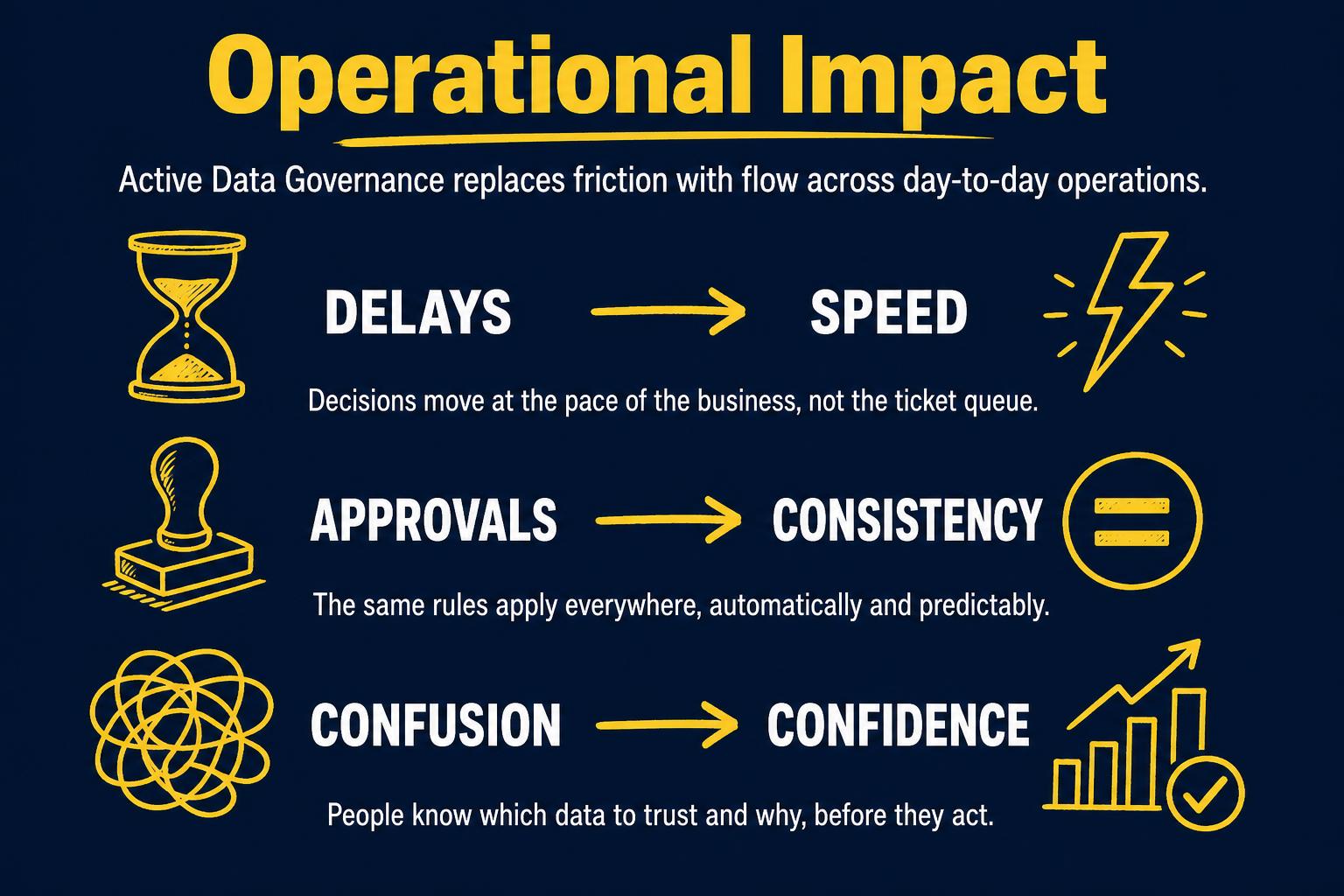
Active Data Governance represents a fundamental shift in how governance is understood and applied. It is not about increasing control, but about applying control more effectively, moving governance from static rules to dynamic intent, from oversight to enablement, and from awareness to action.
From Awareness to Action
Active Data Governance represents a fundamental shift in how governance is understood and applied within an organization. It is not about increasing control, but about applying control more effectively and at the right moment. It moves governance from static rules to dynamic intent, from oversight to enablement, and from awareness to action.
This shift allows organizations to move beyond simply knowing that data exists, toward trusting that data enough to use it confidently and consistently across every team, tool, and decision-making context. The organizations that make this shift will not just be better governed. They will be more competitive, more responsive, and more capable of delivering on the promise of data as a strategic asset.
Restoring the Connection
Data governance was never intended to be a reporting function. Its purpose has always been to make data usable, safe, and valuable across the organization. Over time, it became focused on documentation and compliance, losing its connection to operational outcomes and the business decisions it was designed to support.
Active Data Governance restores that connection. It embeds governance directly into how data works, ensuring that it supports rather than constrains decision-making at every level of the organization. When governance becomes operational, it is no longer something organizations struggle to implement, justify, or sustain. It becomes something they rely on to drive outcomes, enable growth, and manage risk with confidence.
The journey from knowing to using is not a technical problem. It is a governance design problem. And the organizations that solve it will define what data-driven leadership looks like for the next decade.
Five Principles of Active Data Governance
Active Data Governance is not a single technology, framework, or governance program. It is a shift in how organizations think about trust, access, accountability, and decision-making at scale. These five principles summarize the operational foundations required to move governance from static oversight into a live capability embedded directly into the flow of data usage.
From Awareness to Usage
Governance must bridge the gap between knowing data exists and trusting it enough to use it in live decision workflows.
From Project to Capability
Governance is not a destination to be delivered. It is an operating capability that must evolve continuously alongside the business.
At the Point of Use
Governance must be present at the exact moment data is accessed, combined, shared, or consumed, not before or after.
Products, Not Artifacts
Govern data products aligned with business purpose and consumer context, not tables, files, or schemas.
Intent Defined. Enforcement Automated.
Humans define governance intent. Systems enforce it consistently, at scale, in real time, across every form of data consumption.
The organizations that succeed with governance will not necessarily be those with the most policies, the largest governance teams, or the most complex frameworks. They will be the organizations that make governance operational — embedded directly into how data is accessed, trusted, shared, and used every day. Because ultimately, governance only creates value when it enables better decisions, faster, with confidence.
Cameron Price.

Cameron Price is a senior data practitioner and the creator of Latttice. In this Part 3 — the final installment of the Active Data Governance series — he turns the conversation from theory to practice, setting out how organizations move governance from documentation to live execution at the point of decision.
Data Conversation with Cameron Price
The Governance Gap — why most programs stop at awareness and what that costs the enterprise
What Active Data Governance Actually Means — the shift from documentation to execution
Enabling Active Data Governance — from concept to practice, and from knowing data exists to confidently using it at scale (You are here)
Is Your Governance Operational?
Take this 5-question assessment to see where your organization sits on the journey from governance as documentation to governance as an operating capability.
Making Governance Operational
5 questions · ~2 minutes · Based on the principles in this article
Start a conversation with Cameron Price
Cameron often engages on LinkedIn. If you would rather continue the conversation there, reach out directly.
Take the series with you — and keep the conversation going.
Download the full 3-part Active Data Governance series, or reach out directly to explore how Latttice — the Data Product Workbench — makes Active Governance operational in your environment.
The full 3-part series, in one PDF
All three articles by Cameron Price — from the governance gap, to what Active Data Governance actually means, to enabling it at scale. Designed for executives and data leaders. No email required.
Connect with John Goode
John Goode, Chief Revenue Officer at Data Tiles, works with organizations exploring trusted data products, Active Data Governance, AI readiness, and faster business decision-making. Share a little about your environment or challenges, and John will connect personally.
Governance That Works Where You Work
The organizations that will lead the next decade of data-driven enterprise are not those with the most comprehensive governance frameworks. They are those that have made governance operational, invisible when it should be, and unmistakable when it matters.
Active Data Governance. From knowing to using.
References (discoverable)
This article is grounded in Cameron Price's practitioner-led experience across enterprise data environments and the development of Latttice. The following organizations and authors are referenced to validate and support the direction outlined, reflecting broader industry alignment on governance challenges, data strategy, and AI risk trends.
Gartner
Data governance and analytics maturity research.
McKinsey and Company
Data-driven enterprise and decision intelligence studies.
Forrester
Governance adoption and data strategy insights.
Deloitte
Data governance operating models.
BARC
Business Application Research Center — Data product and analytics research.
Thoughtworks
Technology Radar and data mesh evolution.
MIT Technology Review
AI governance and risk trends.
IDC
AI adoption and governance gap analysis.
Zhamak Dehghani
Data Mesh and data product thinking.
Cameron Price’s three-part series traces how governance moves from knowing what data you have to actively shaping how it is used. AI raises the stakes: models act on whatever context they are given, so trust has to travel with the data itself. Governed data products are how that context is packaged, meaning ownership, quality and policy attached at the point of decision, not documented somewhere else. Read the parts in order, or start with the synthesis.
- Part 1From Knowing to UsingRead
- Part 2What Active MeansRead
- Part 3Governance in the MomentYou are here
- SynthesisStarts With the DecisionRead