
AI Needs Purple People
Competitive Advantage Is Built, Not Bought
By Cameron Price, Founder & CEO, Data Tiles · Estimated read time: 8 minutes
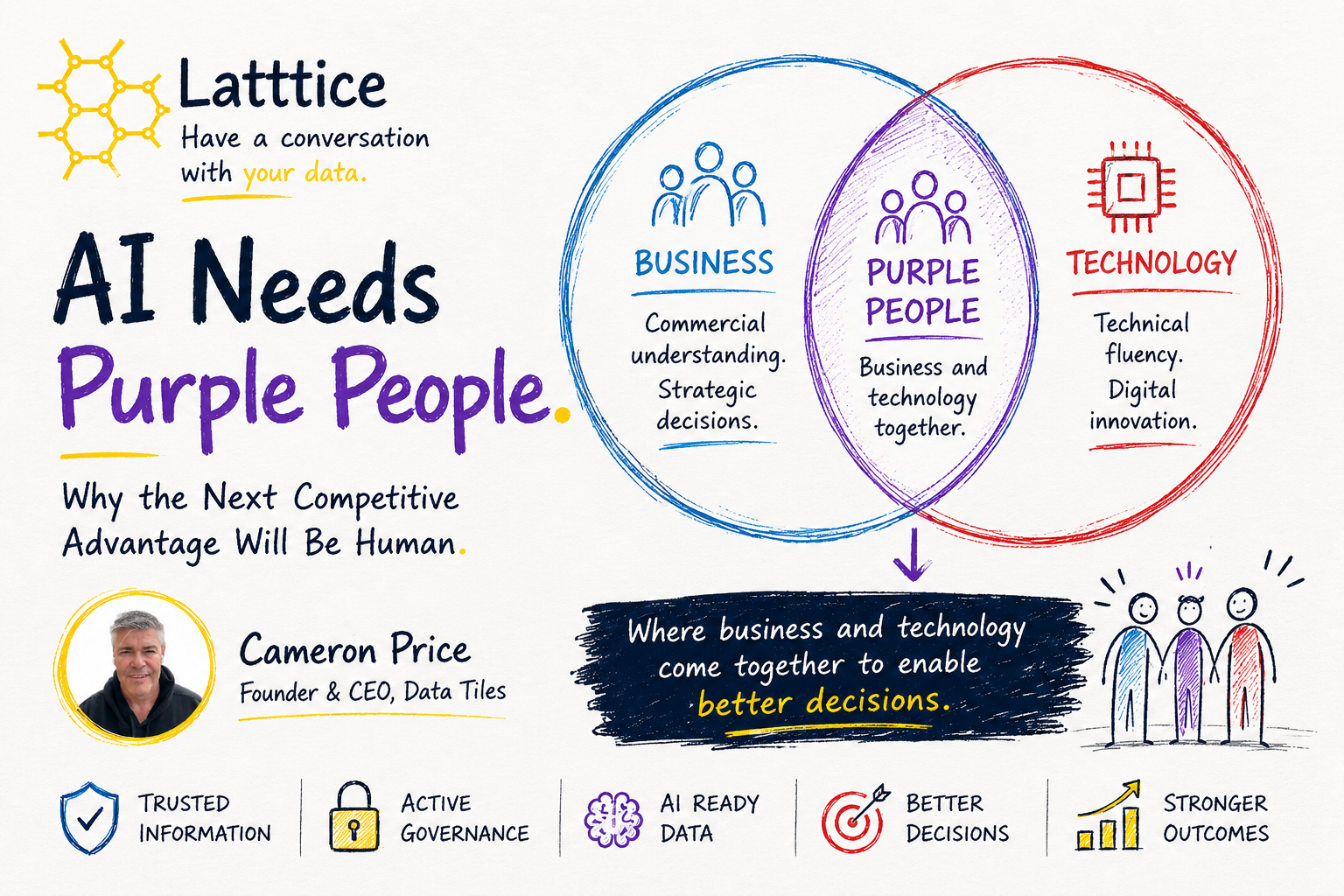
"Technology availability isn't the issue. Organizational capability is. That's why AI needs Purple People."— Cameron Price, Founder & CEO, Data Tiles
The Human Layer of AI Advantage
Artificial intelligence has rapidly become one of the defining strategic priorities for organizations across every industry. Leaders are investing in models, platforms, agents, and copilots, and expecting those investments to translate into measurable competitive advantage. Yet in most enterprises, the barrier is not the availability of AI. It is the organizational capability required to use it well.
This article introduces the concept of Purple People. They are the individuals who bridge business understanding, trusted information, governance, and technology, enabling artificial intelligence to operate within real business context rather than in isolation. They are not a new profession or another specialist discipline. They represent an organizational capability that becomes increasingly valuable as AI becomes more deeply embedded in everyday decision making.
What follows is a practitioner's argument for why the next era of competitive advantage will not be won on the strength of the AI model. It will be won on the strength of the organization that surrounds it.
A Familiar Pattern, A New Frontier
Every major technology shift eventually reaches the same point. The technology becomes widely available. The organizations that outperform others are rarely those with exclusive access to the technology. They are the organizations that develop the capability to use it better.
AI is following the same pattern. The challenge is not that AI lacks intelligence. The challenge is that many organizations have not yet developed the human and organizational capability required to ensure that intelligence operates within trusted business context.
Why Purple People Are Purple
Every major technology shift eventually reaches the same point. The technology becomes widely available. Electricity did. The internet did. Cloud computing did. Artificial intelligence will too. The organizations that outperform others are rarely those with exclusive access to the technology. They are the organizations that develop the capability to use it better.
That is where Purple People1 come in.
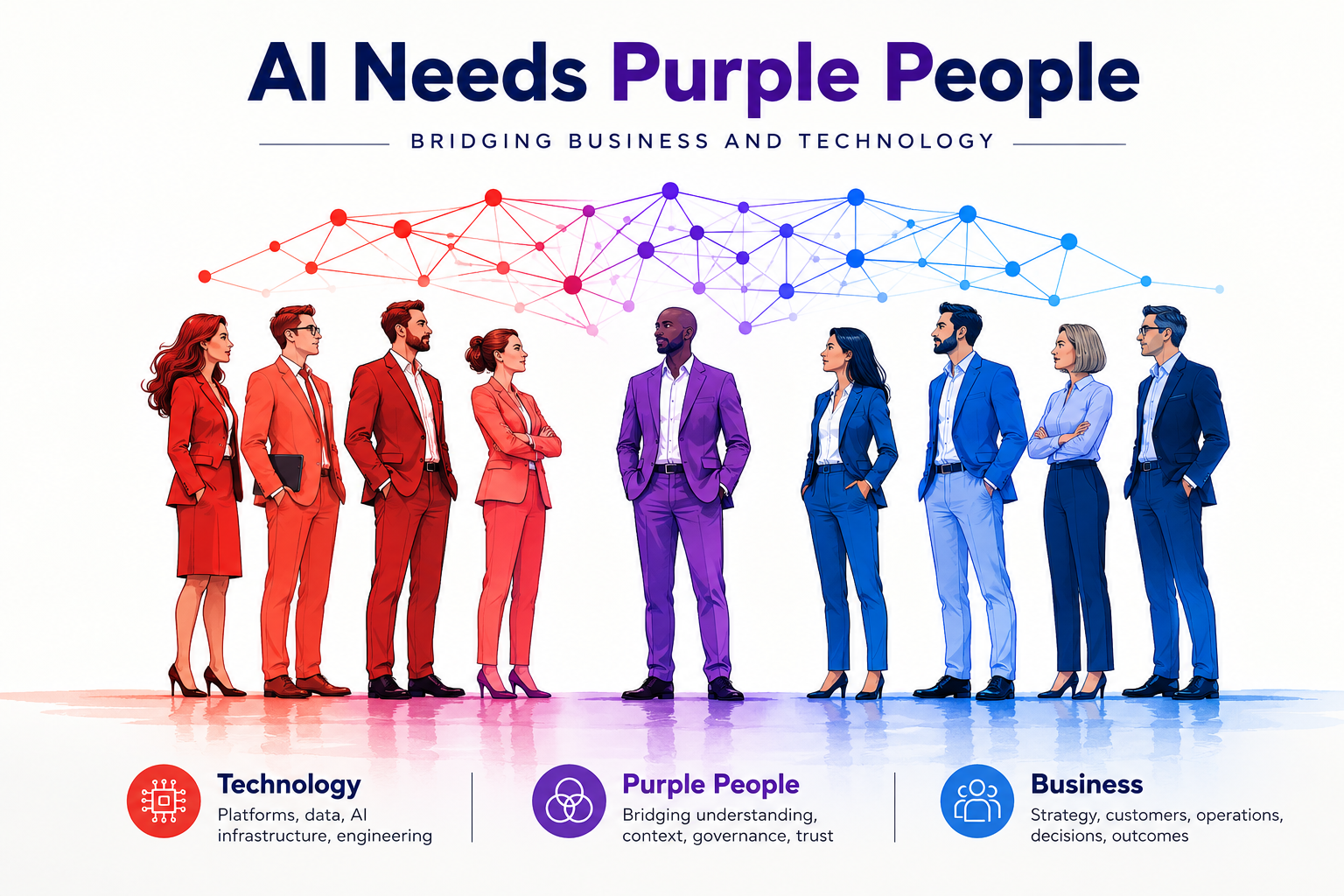
Throughout my career, I have watched organizations divide themselves into two worlds. On one side are business teams. They understand customers, operations, commercial priorities, and the decisions that ultimately determine success. On the other side are technology teams. They understand platforms, architecture, engineering, data, security, governance, and increasingly, artificial intelligence.
Both groups are essential, and neither can succeed alone.
If we think of technology people as red and business people as blue, something important happens when those worlds genuinely come together. Red and blue become purple.
That is why I call them Purple People.
The term Purple People has appeared previously within the business and technology community. During a Business Rules Forum experts panel on emerging trends in decisioning, James Taylor attributed the expression to Brian Stucky, describing Purple People as individuals who operate at the intersection of business and IT and can think effectively from both perspectives. This article builds on that earlier idea and extends it for the AI era, where Purple People must also connect business strategy, trusted information, active governance, intelligent systems, human judgment, and better decisions.
Purple People are not simply technical people who know a little about business. Nor are they business leaders who have learned enough technology to participate in technical discussions. They are individuals who naturally bridge both worlds. They understand how the business creates value, and they understand enough about technology, trusted information, governance, and AI to connect that value to practical execution.
Perhaps most importantly, they help each side understand the other.
They translate business objectives into technical outcomes. They translate technical possibilities into business opportunities. They reduce misunderstanding, shorten feedback loops, and help ensure that decisions remain connected to trusted information rather than assumptions or disconnected reports.
As artificial intelligence becomes embedded in everyday work, this capability becomes even more valuable.
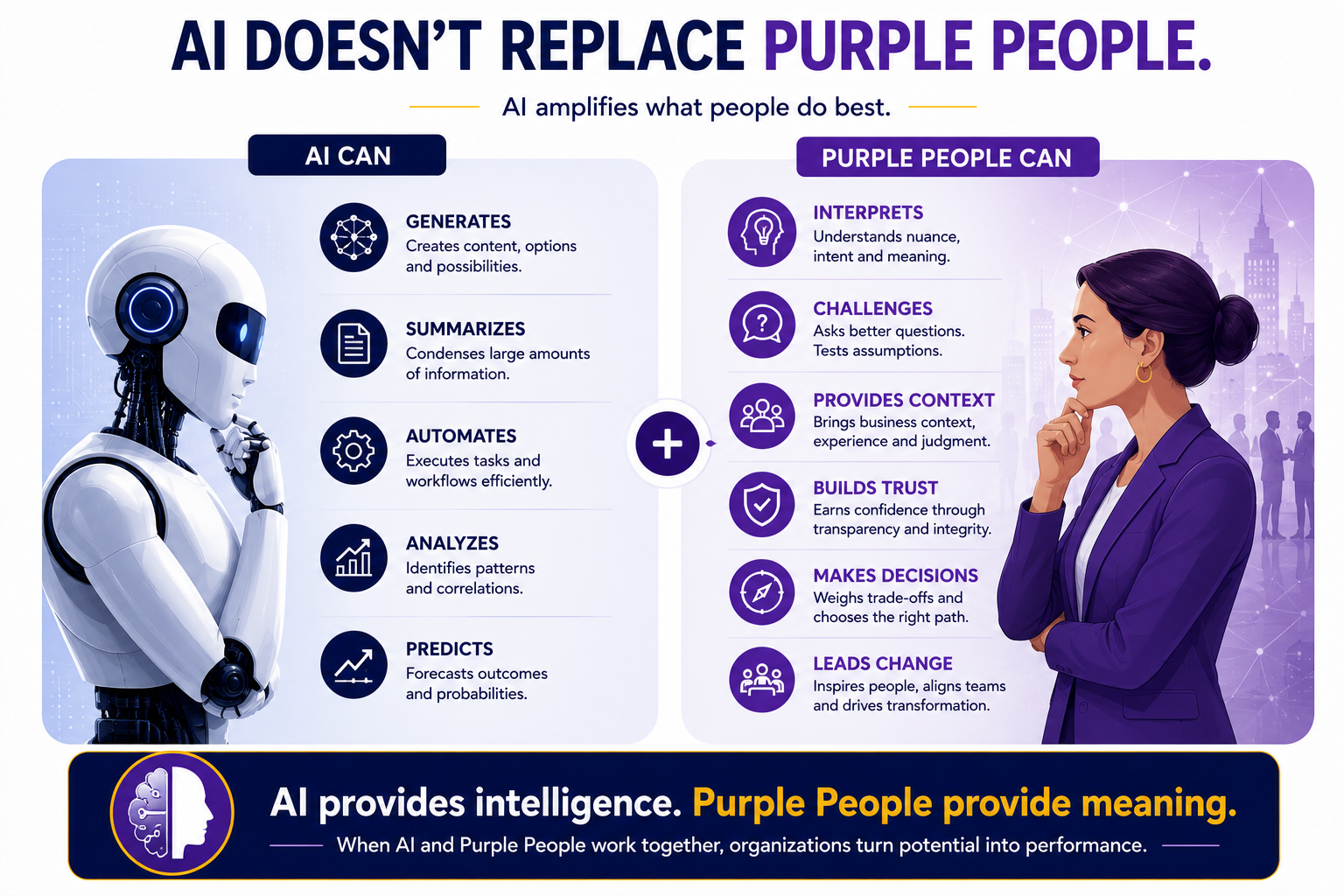
AI can generate recommendations in seconds. It can summarize information, automate routine analysis, and identify patterns that people may overlook. What it cannot do independently is fully understand the unique commercial context, organizational priorities, regulatory obligations, customer relationships, or strategic intent that shape every important business decision.
Those remain profoundly human responsibilities.
Purple People provide that context.
They help ensure that AI operates with trusted information, governed data products, clear business meaning, and an understanding of what success actually looks like inside the organization. They become the connective tissue between business strategy, technology capability, governance, and intelligent systems.
Importantly, Purple People are not a new job title.
They represent an organizational capability.
Some Purple People will come from technology. Others will emerge from business operations, finance, marketing, supply chain, customer service, data, governance, or executive leadership. What connects them is not their department. It is their ability to see beyond traditional organizational boundaries and bring people, information, governance, and AI together around better decisions.
For many years, organizations have invested in building better technology. The next step is to invest just as deliberately in building the human and organizational capability to use that technology well.
Technology availability is not the issue; organizational capability is.
That is why AI needs Purple People.
1 The expression Purple People has previously been used within the business rules community to describe professionals who bridge business and IT. In this article, Cameron Price extends the concept to include trusted information, active governance, organizational capability, human judgment, and AI-enabled decision-making. ↩
Why AI Needs Business Context
Artificial intelligence is often described as though intelligence alone is enough.
It is not.
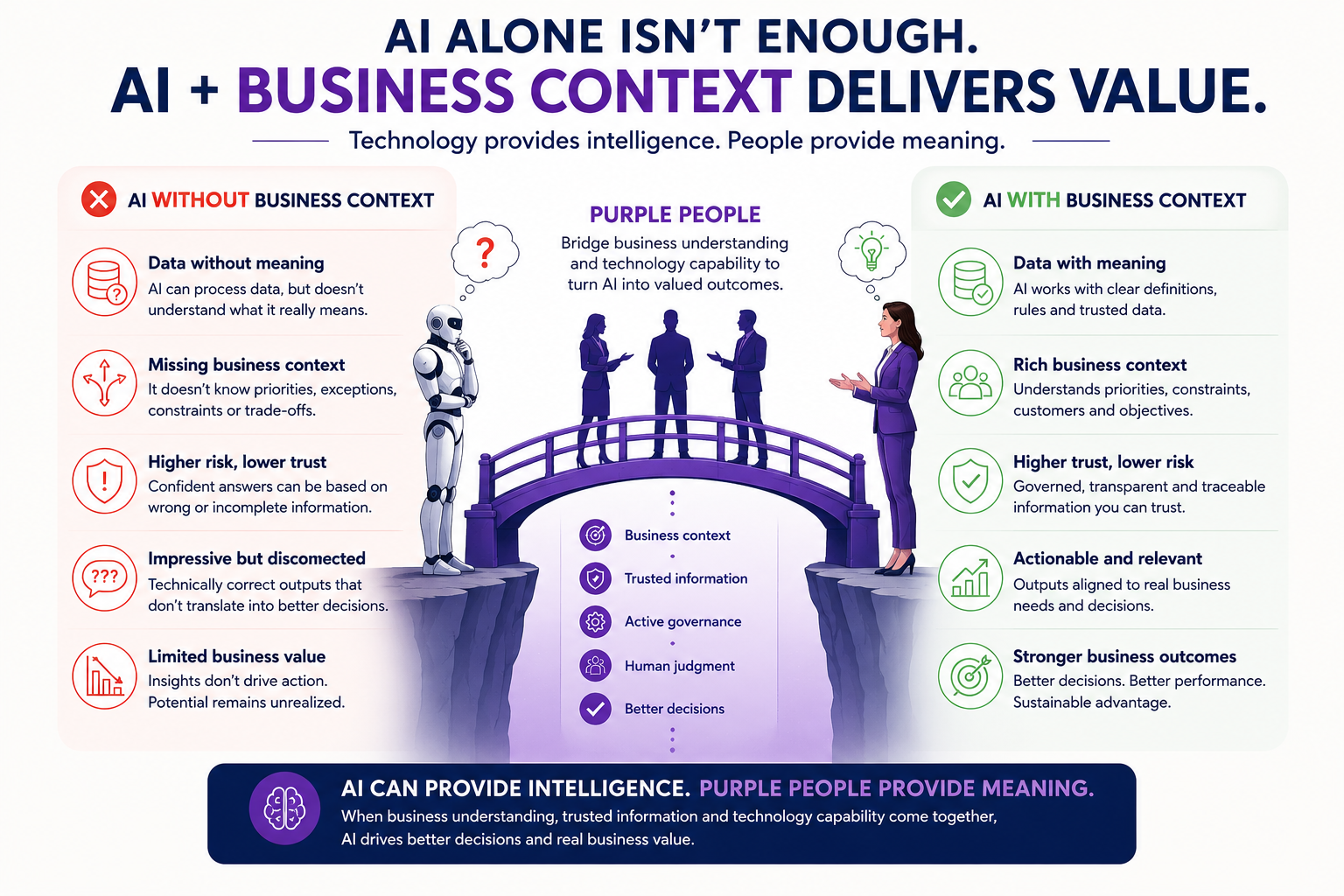
AI can process extraordinary volumes of information, identify patterns, generate recommendations, summarize complex material, and automate tasks at a speed no human team could match. But speed and scale do not automatically create understanding. An AI system can only work with the information, definitions, rules, and context made available to it.
That distinction matters.
Inside every organization, the same data can mean different things to different people. Revenue may be calculated one way by finance and another way by sales. A customer may be defined differently across marketing, operations, and service. Risk may have one meaning in a regulatory context and another in a commercial one. Even apparently simple measures can be shaped by local assumptions, historical practices, contractual obligations, and industry-specific rules.
AI does not naturally understand those distinctions.
It does not know which definition the organization trusts, which exceptions matter, which source is authoritative, or which decision the information is intended to support. It does not know whether a pattern is commercially meaningful, operationally realistic, legally permissible, or strategically relevant unless that context has been made explicit.
This is why trusted information matters.
For AI to support real business decisions, it must be connected to data that is governed, clearly defined, fit for purpose, and understood in context. It must be possible to trace where that information came from, how it was prepared, which policies apply to it, and who is permitted to use it. Without those foundations, AI may still produce an answer, but the organization may have little reason to trust it.
The risk is not simply that the answer is wrong; the greater risk is that the answer appears credible.
A confident recommendation generated from incomplete, inconsistent, or poorly understood information can move through an organization quickly. It may influence a pricing decision, a customer interaction, a hiring choice, a supply chain response, or a regulatory submission before anyone has examined the assumptions behind it.
That is where governance becomes practical rather than procedural.
Governance cannot sit outside the flow of work as a policy document or approval stage that people encounter after a decision has already been made. It must be active at the point where information is created, prepared, shared, and used. The rules, access controls, definitions, lineage, and accountability attached to information must travel with it.
Purple People help make that possible.
They understand enough about the business to recognize which context matters. They understand enough about data, governance, and technology to ensure that context is reflected in the way information is prepared and made available to AI. They can identify where definitions conflict, where assumptions have been left unstated, and where a technically valid answer may still be commercially wrong.
They also understand that a good AI response is not the same as a good business decision.
A business decision involves judgment. It requires an understanding of timing, trade-offs, consequences, confidence, accountability, and the wider environment in which the organization operates. AI may contribute evidence or recommendations, but people remain responsible for interpreting that information and deciding what should happen next.
This is particularly important as AI moves from assisting people to acting through intelligent agents.
An AI assistant may summarize a report or suggest an action. An AI agent may initiate that action, update a system, contact a customer, allocate a resource, or trigger a wider process. As that level of autonomy increases, the need for trusted information, embedded governance, and clear business context becomes more important, not less.
Organizations therefore need more than AI-ready technology. They need AI-ready information.
They need data that is trusted, governed, clearly understood, and available at the point of decision. They need organizational processes that preserve accountability while allowing people and intelligent systems to work together. They need individuals who can connect the technical capability of AI with the realities of the business.
That is the role Purple People play.
They help ensure that AI is not operating beside the business, producing technically impressive outputs that people struggle to apply. They connect AI to the decisions, responsibilities, and outcomes that matter.
AI can provide intelligence. Purple People provide meaning. And without meaning, intelligence rarely becomes value.
From Technology Transformation to Organizational Transformation
One of the biggest mistakes organizations make during periods of technological change is believing that technology itself creates transformation.
History suggests otherwise.
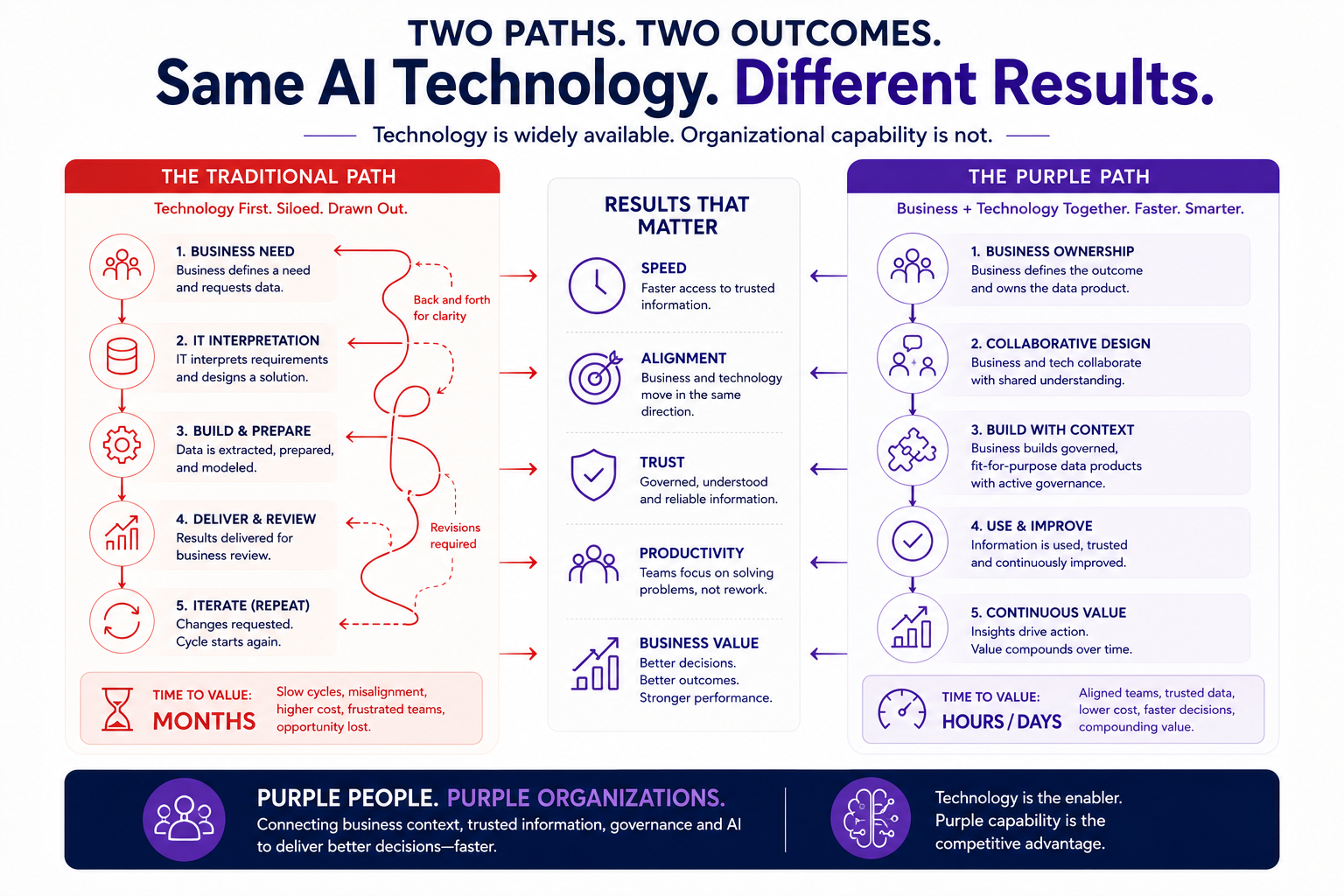
Electricity did not transform manufacturing simply because factories installed electric motors. Real productivity gains came when manufacturers redesigned production lines around the capabilities that electricity made possible. The internet did not create entirely new industries because organizations built websites. It created new value because businesses fundamentally changed how they communicated, sold products, served customers, and collaborated across the world. Cloud computing followed the same path. Organizations that merely moved existing applications into the cloud often saw modest improvements. Those that redesigned their operating models around cloud-native capabilities fundamentally changed the speed and scale at which they could innovate.
Artificial intelligence is following exactly the same pattern.
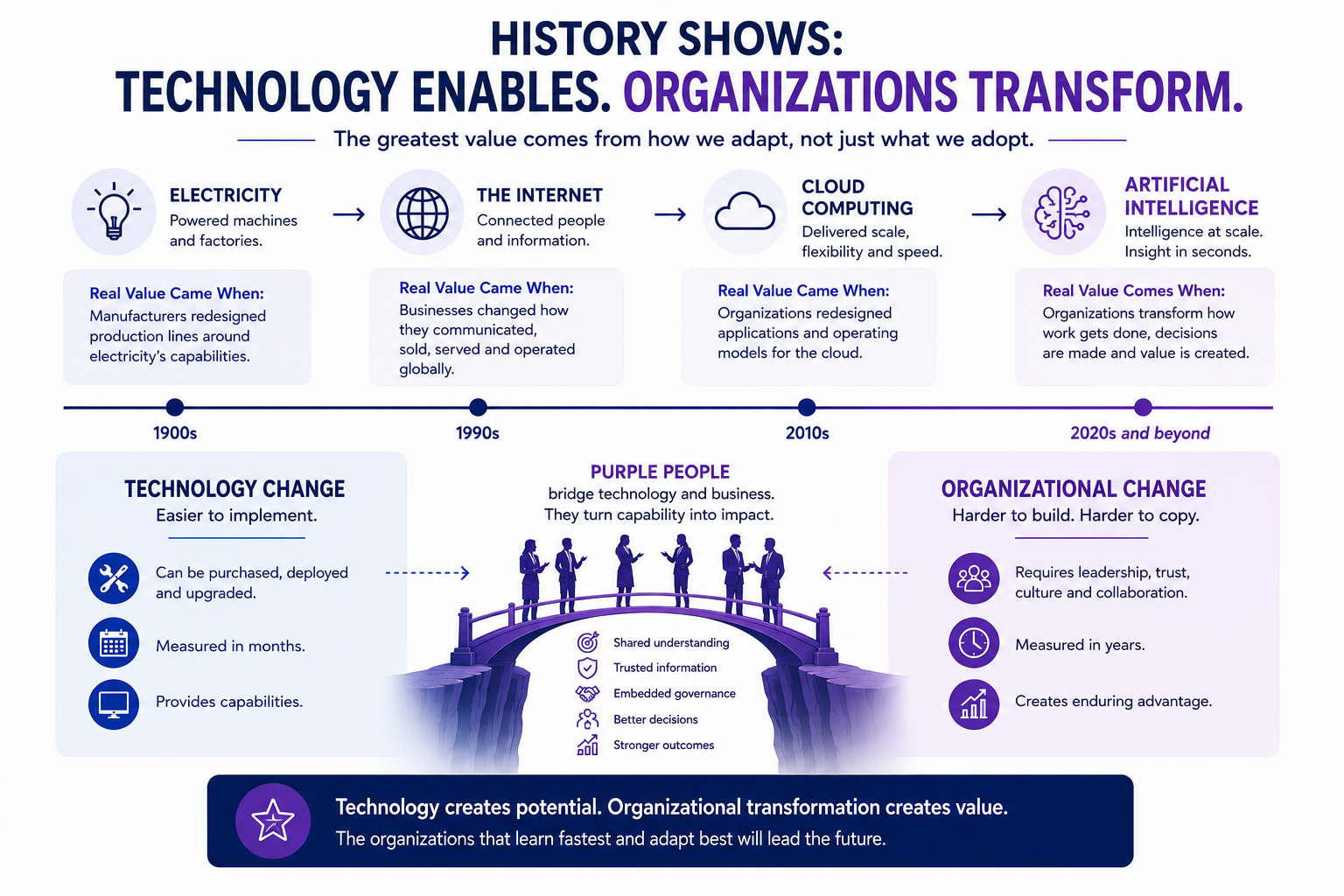
The organizations creating the greatest value from AI are not simply deploying new models or experimenting with copilots. They are rethinking how work gets done, how decisions are made, how information flows across the enterprise, and how people and intelligent systems collaborate. McKinsey & Company's research consistently shows that organizations realizing the greatest returns from AI combine technology investment with changes to workflows, governance, leadership, and organizational operating models rather than treating AI as a standalone technology initiative (McKinsey & Company, 2025).
This is where many organizations unintentionally limit their own progress.
AI initiatives are frequently positioned as technology programs. Responsibility sits within IT, data, or innovation teams. Success is measured through model performance, infrastructure deployment, or technical milestones. While these achievements are important, they rarely tell the whole story.
The real measure of success is whether better decisions are being made.
- Has planning improved?
- Are customer experiences becoming more personalized?
- Are frontline teams responding more quickly?
- Are risks being identified earlier?
- Are leaders making decisions with greater confidence because trusted information is available when they need it?
These are organizational outcomes rather than technical ones. Technology enables them. People deliver them.
This is why the conversation needs to move beyond digital transformation and toward organizational transformation.
Organizations do not become AI enabled simply because they purchase AI software. They become AI enabled when the way people work evolves alongside the technology. New habits emerge. Teams collaborate differently. Business and technology begin solving problems together rather than passing work between departments. Governance becomes embedded within daily operations rather than existing as a separate compliance exercise. Trusted information becomes part of every decision instead of something people search for after the fact.
This kind of change is considerably harder than implementing software. Technology can often be purchased, deployed, and upgraded within months. Organizational capability takes years to build.
It requires leadership, trust, education, shared language, cultural change, and an operating model that encourages collaboration instead of reinforcing functional boundaries. Peter Senge argued many years ago that sustainable advantage comes from organizations that continuously learn and adapt faster than those around them (Senge, 1990). Artificial intelligence makes that observation even more relevant today. As technology evolves at an unprecedented pace, the organizations that learn fastest will almost certainly outperform those that simply acquire the newest tools.
Purple People become essential to that learning process.
They help organizations navigate change because they understand both perspectives. They recognize the possibilities technology creates while remaining grounded in the practical realities of the business. They help remove friction between departments, build trust around information, and ensure that AI initiatives remain focused on meaningful business outcomes rather than technical activity alone.
Eventually, every competitor will have access to similar AI models. Many will purchase the same software. Many will use the same cloud platforms. Many will automate similar processes. What they cannot easily replicate is an organization where business, technology, trusted information, and governance work together naturally. That is not a technology advantage. It is an organizational advantage. And history repeatedly shows that organizational advantages endure long after technological advantages disappear.
Building Purple Organizations
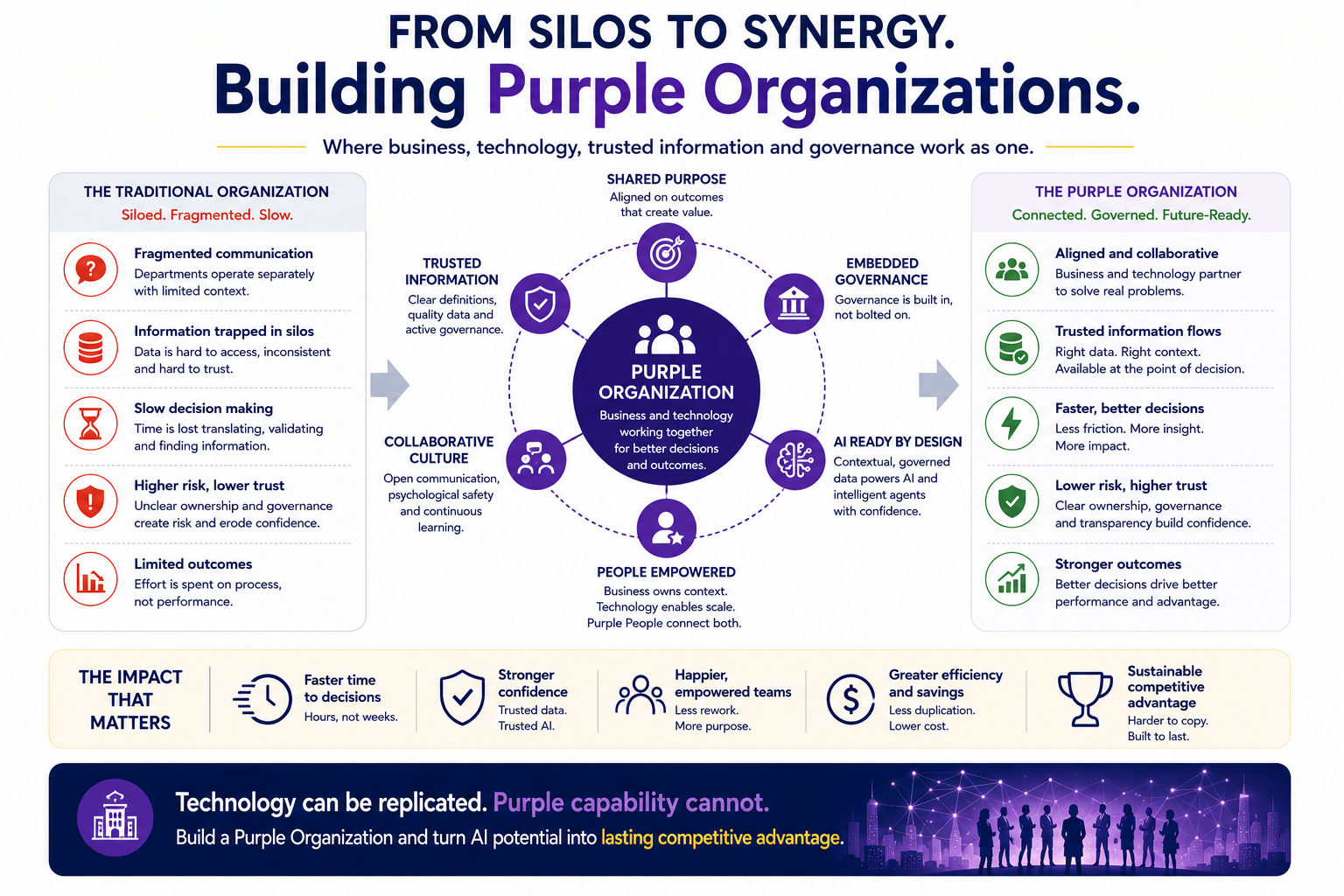
If Purple People represent an individual capability, then Purple Organizations represent an organizational one.
One person can bridge the gap between business and technology for a project or a team. An entire organization that thinks this way can fundamentally change how decisions are made, how work gets done, and how value is created.
That is the real opportunity presented by artificial intelligence.
Too often, organizations attempt to solve collaboration challenges by creating more processes. New committees are formed. Additional governance layers are introduced. More documentation is produced. More meetings are scheduled between business and technology teams in the hope that communication will improve. Sometimes it does. More often, complexity simply increases.
Purple Organizations take a different approach.
Instead of relying on organizational structures to force collaboration, they create an environment where collaboration becomes a natural part of how work is done. Business teams have greater ownership of the information they rely on. Technology teams spend less time interpreting business requirements and more time building secure, scalable platforms that enable innovation. Governance becomes embedded within everyday work instead of existing as a separate function. Trusted information becomes easier to discover, understand, and use.
The result is an organization that moves faster because fewer conversations are spent translating between departments and more time is spent solving real business problems. This shift also changes the role of technology teams.
For years, data engineers, architects, and developers have found themselves acting as translators between business questions and technical implementation. They spend significant amounts of time clarifying requirements, interpreting business language, revisiting assumptions, and making iterative changes as understanding evolves.
These activities are necessary, but they are rarely the highest-value use of highly skilled technical people.
When organizations develop Purple capability, that dynamic begins to change.
Business teams become more confident in defining the outcomes they are trying to achieve. They work with trusted, governed information that reflects their own business context. Technology teams remain responsible for building secure, scalable, enterprise-grade platforms, but they are no longer expected to own every business decision or interpret every operational nuance.
Each group focuses on what it does best.
This is particularly important as organizations increasingly adopt AI agents capable of performing work rather than simply assisting people.
An AI agent making recommendations about inventory needs different context from one supporting financial planning. A customer service agent requires different information from an operational planning agent. Governance, permissions, business definitions, and trusted data products cannot be generic. They must reflect the unique needs of each decision and each business domain.
Purple Organizations understand this.
They recognize that successful AI is not built on general intelligence alone. It is built on trusted organizational knowledge, clear accountability, governed information, and collaboration between the people who understand the business and the people who enable the technology.
This is why the future of AI is not solely a technology conversation; it is a leadership conversation.
Leaders shape culture. They influence how departments work together. They determine whether governance is treated as a barrier or as an enabler. They decide whether information remains fragmented across organizational silos or becomes a trusted enterprise asset available at the point of decision.
Organizations that deliberately build Purple capability create an environment where business, technology, governance, and AI continuously reinforce one another. They become organizations that learn faster, adapt faster, and make better decisions because trusted information flows naturally to the people and intelligent systems that need it.
Ultimately, Purple Organizations are not defined by the technologies they purchase. They are defined by the capability they build. That capability will become increasingly difficult for competitors to replicate, even as access to artificial intelligence becomes universal.
The Next Competitive Advantage
Artificial intelligence will continue to advance at extraordinary speed. Models will become more capable. Agents will become more autonomous. AI tools will become easier to use, less expensive, and increasingly embedded in the systems people rely on every day. Before long, access to powerful artificial intelligence will no longer be unusual. It will be expected.
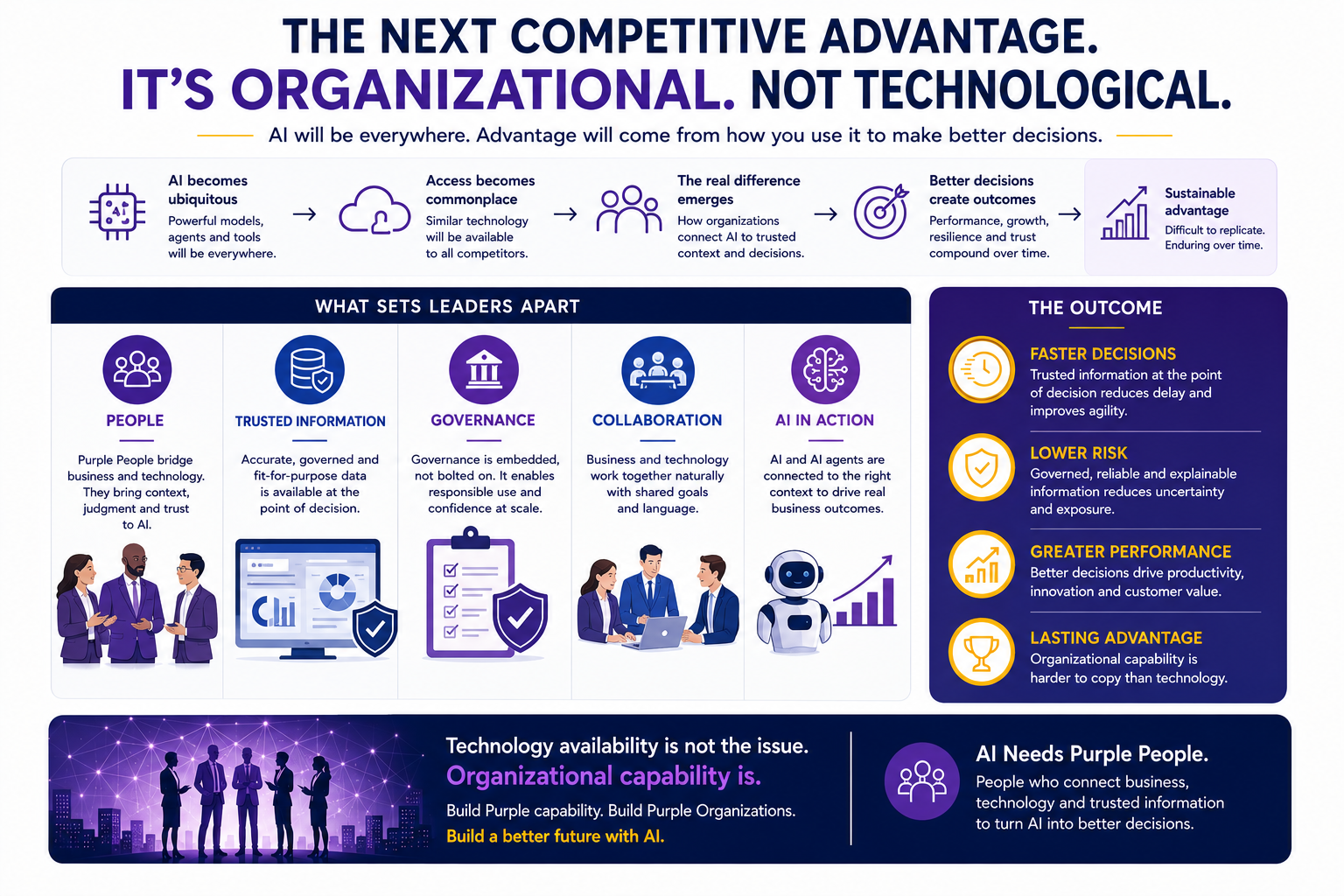
That means access alone will not create lasting competitive advantage.
The real difference will be found in how effectively an organization connects AI to trusted information, business context, governance, human judgment, and the decisions that determine performance.
This is why organizational capability matters so much.
AI can generate an answer, but it cannot independently determine whether that answer reflects the realities of the organization. It cannot fully understand the history behind a customer relationship, the competing priorities shaping an operational decision, the regulatory consequences of an action, or the strategic intent behind a leadership choice unless that context has been deliberately made available. People provide that context.
Purple People connect it.
They bring together the commercial understanding of the business and the technical fluency required to work with data, governance, platforms, and AI. They help ensure that intelligent systems are connected to trusted information and meaningful outcomes rather than operating as impressive but disconnected technologies.
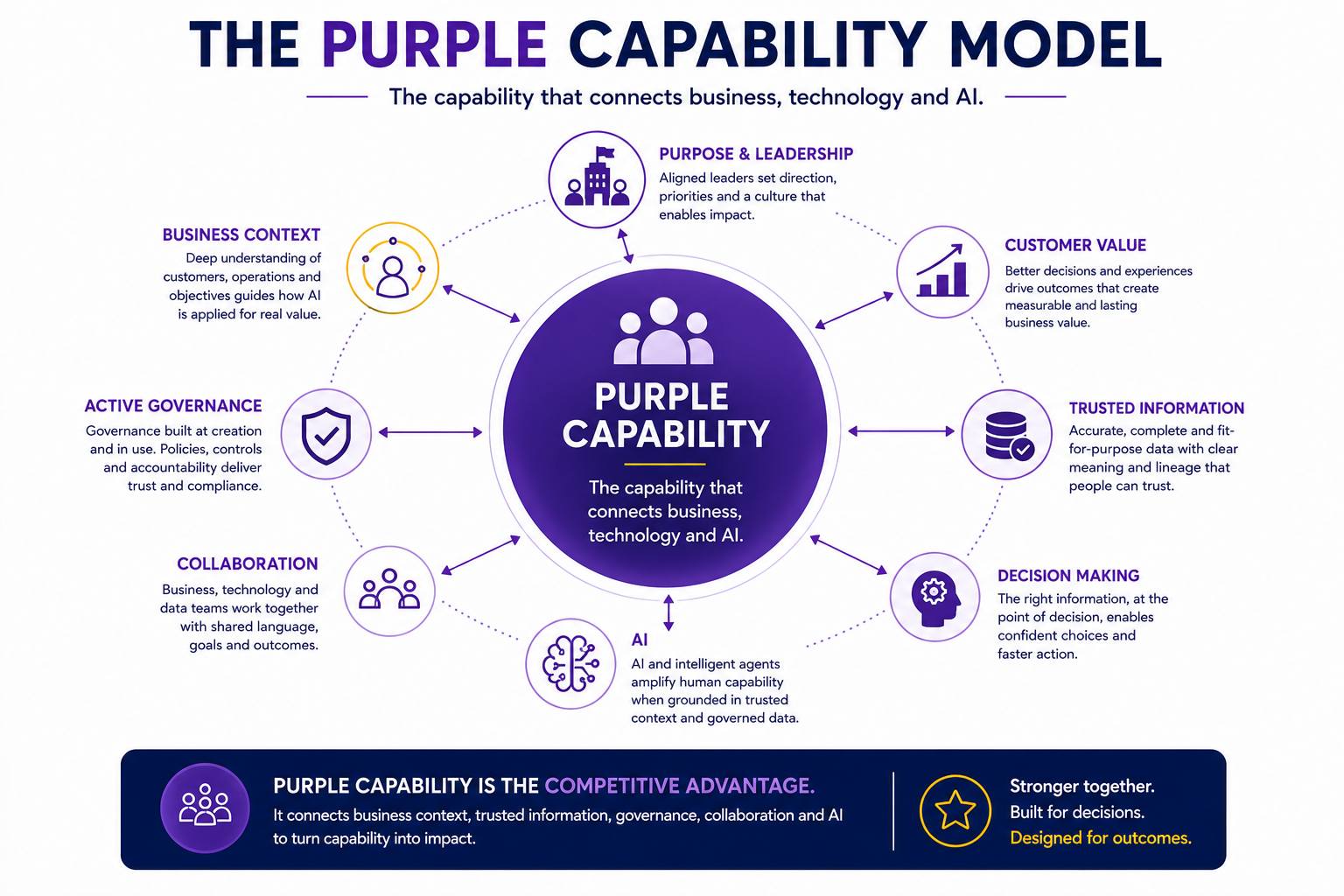
Yet the ambition should extend beyond identifying a small number of exceptional individuals. Organizations must build Purple capability more broadly. They must create environments where business and technology work together naturally, where trusted information is available at the point of decision, where governance is embedded in how information is created and used, and where people understand how to work responsibly and confidently alongside intelligent systems.
That is how Purple People become Purple Organizations.
The organizations that succeed in the AI era will not necessarily be those that move first or spend the most. They will be those that learn fastest, adapt most deliberately, and connect their people, information, governance, and technology around better decisions. Their advantage will not come from possessing technology that others cannot access. It will come from building an organizational capability that others cannot easily copy. Technology availability is not the issue; organizational capability is.
That is why AI needs Purple People.
Join a Data Conversation,
Cameron Price

Cameron Price is the CEO and Founder of Data Tiles and the creator of Latttice, the AI-powered Data Product Workbench. With more than 30 years of experience across data strategy, analytics, cloud, governance, and enterprise transformation, Cameron has built his career around one clear mission: helping organizations turn data into better decisions. Through Data Tiles, he is focused on business-led, decision-driven data tools that bring trusted, governed data products to the point of decision.
Connect with Cameron on LinkedInAI Needs Purple People — with Cameron Price
References
Alphabetical by author. Titles link to publicly available sources where possible.
- Business Rules Journal. (2009). Business Rules Forum 2008 Experts Panel: Emerging Trends and Decisioning. Business Rules Journal, 10(5), May 2009.
- Brynjolfsson, E., and McAfee, A. (2014). The Second Machine Age: Work, Progress, and Prosperity in a Time of Brilliant Technologies. W. W. Norton & Company.
- Davenport, T. H., and Ronanki, R. (2018). "Artificial Intelligence for the Real World." Harvard Business Review, January–February 2018.
- Drucker, P. F. (1954). The Practice of Management. Harper & Brothers.
- Edmondson, A. C. (2018). The Fearless Organization: Creating Psychological Safety in the Workplace for Learning, Innovation, and Growth. Wiley.
- Gartner. (2025a). Top Strategic Technology Trends for 2025: AI Governance Platforms. Gartner.
- Gartner. (2025b). Research and guidance on AI trust, risk, security management, governance, and organizational readiness. Gartner.
- Iansiti, M., and Lakhani, K. R. (2020). Competing in the Age of AI: Strategy and Leadership When Algorithms and Networks Run the World. Harvard Business Review Press.
- McKinsey & Company. (2025). The State of AI: How Organizations Are Rewiring to Capture Value. McKinsey Global Survey.
- Microsoft & LinkedIn. (2024). 2024 Work Trend Index Annual Report: AI at Work Is Here. Now Comes the Hard Part. Microsoft and LinkedIn.
- Senge, P. M. (1990). The Fifth Discipline: The Art and Practice of the Learning Organization. Doubleday.
- World Economic Forum. (2025). Future of Jobs Report 2025. World Economic Forum.
People also ask
Explore the connected concepts that anchor the Decision-Driven Enterprise.