From Data-Driven to Decision-Driven
Why Data Products Are Becoming the New Operating Model for Data
By Cameron Price — CEO & Founder, Data Tiles
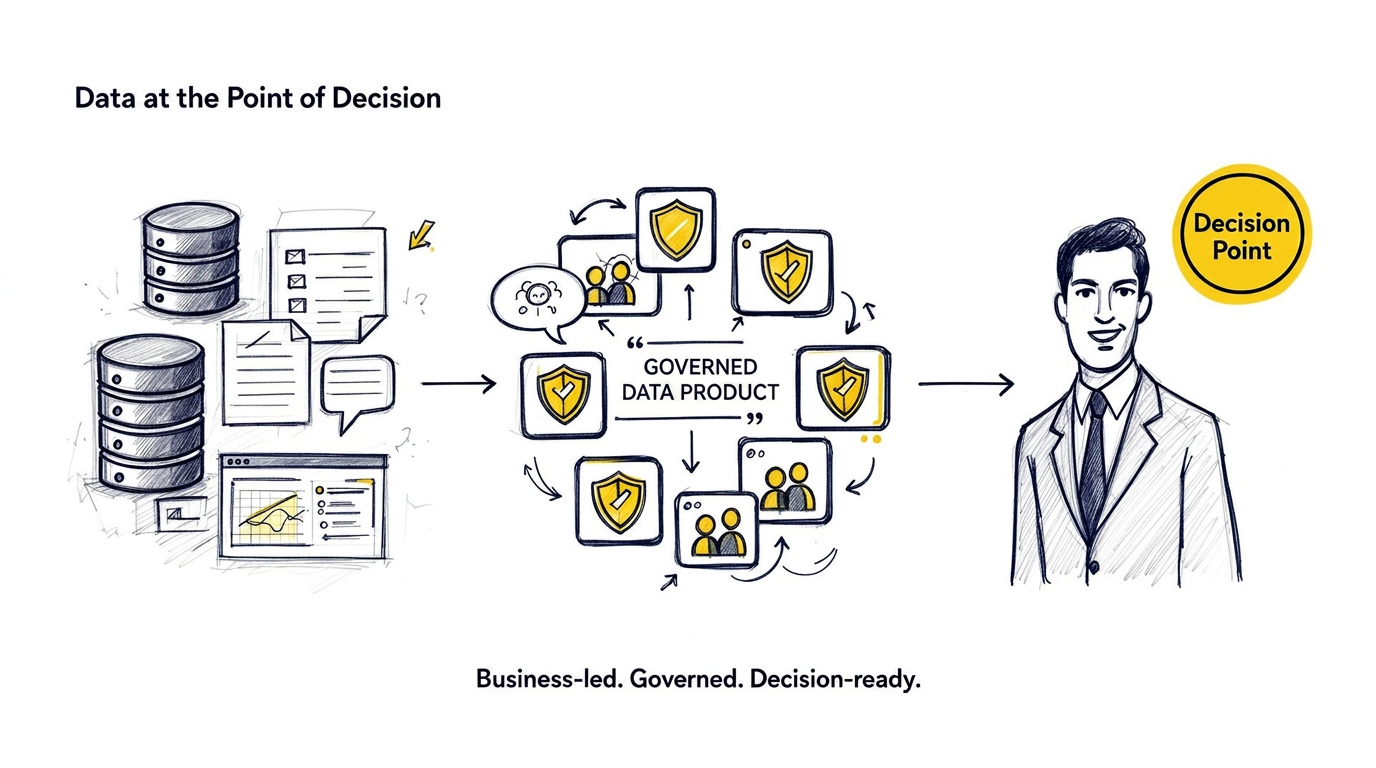
Organizations have spent years trying to become data-driven, investing heavily in platforms, warehouses, lakehouses, catalogs, dashboards, governance frameworks, and AI strategies. Yet many still face the same challenge: data remains too far away from the decisions it is meant to improve.
In this article, Cameron Price argues that the next phase of the data industry is not simply data-driven. It is decision-driven. The future belongs to organizations that can bring trusted, governed, business-ready data to the point of decision, at the moment it is needed.
Data products are becoming the operating model that makes this possible. When designed correctly, they connect business ownership, governance, context, trust, and consumption into a reusable product that can serve people, analytics, applications, and AI agents.
For Data Tiles, this is the mission: enabling better decisions through business-led, AI-powered, zero-code data tools that help organizations move from knowing data exists to using it when it matters most.
From Data-Driven to Decision-Driven
Over the last few months, I have been working with Gartner as the industry collaborates around a clearer definition of data products and the components required to make them successful. And I have to say, it feels like a Magic Quadrant is forming.
That might sound like a throwaway comment, but I think it signals something important. The data product category is moving from loosely defined industry language into something more structured, more measurable, and more commercially significant. The market is starting to mature. But beneath that maturity, something even more important is happening. The industry is moving from being data-driven to being decision-driven.
That distinction matters.
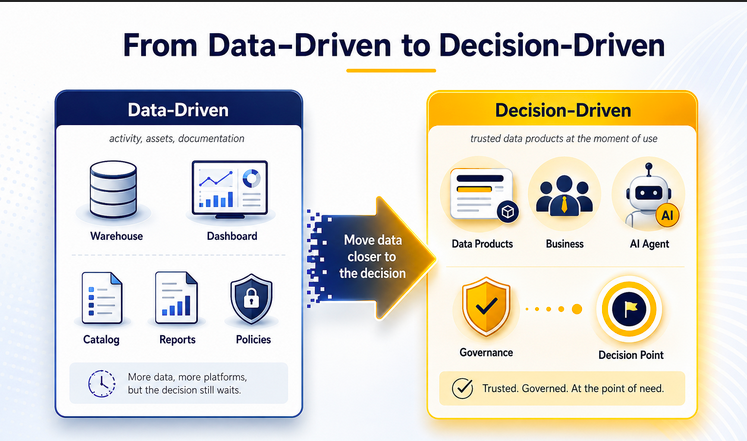
For years, organizations have invested heavily in becoming data-driven. They have built data platforms, warehouses, lakes, lakehouses, catalogs, dashboards, governance frameworks, operating models, and more recently, AI strategies. Yet many still struggle with the same fundamental challenge: data remains too far away from the decisions it is meant to improve. That is the gap our industry now needs to close.
Being data-driven has often meant making more data available. It has meant collecting it, centralizing it, governing it, cataloging it, visualizing it, and reporting on it. Being decision-driven means something different. It means ensuring the right data, context, controls, insight, and confidence are available at the point of decision. That is a very different operating model.
This is where I believe the next phase of the data industry is heading. The aspiration is no longer simply to become data-driven. That was the language of the last era. The aspiration now is to become decision-driven.
Data only becomes valuable when it changes a decision, improves an outcome, reduces risk, automates a process, powers an AI agent, or gives a business leader the confidence to act. That has been the soul focus of Data Tiles from the beginning: enabling better decisions. Not better data for the sake of better data, not more dashboards for the sake of more dashboards, and not more governance documentation for the sake of governance theater. Better decisions.
For Data Tiles, that means data at the point of decision. It means business-led data tools that allow people to make decisions when they are needed, not weeks or months later when the data has lost context, trust, urgency, or purpose. As I have advocated for some time, the goal is to bring data closer to the decision. Eventually, I believe data and decisions will become inseparable. When that happens, our industry will look vastly different from the one we know today.
Data Products Are Moving Into the Mainstream
On the data product side of the equation, the shift is already underway.
That is a staggering level of adoption. It tells us that data products are no longer an experimental concept sitting on the edge of modern data strategy. They are becoming a mainstream mechanism for delivering data value. But it also raises an important question: if so many organizations are deploying data products, how many are deploying them successfully?
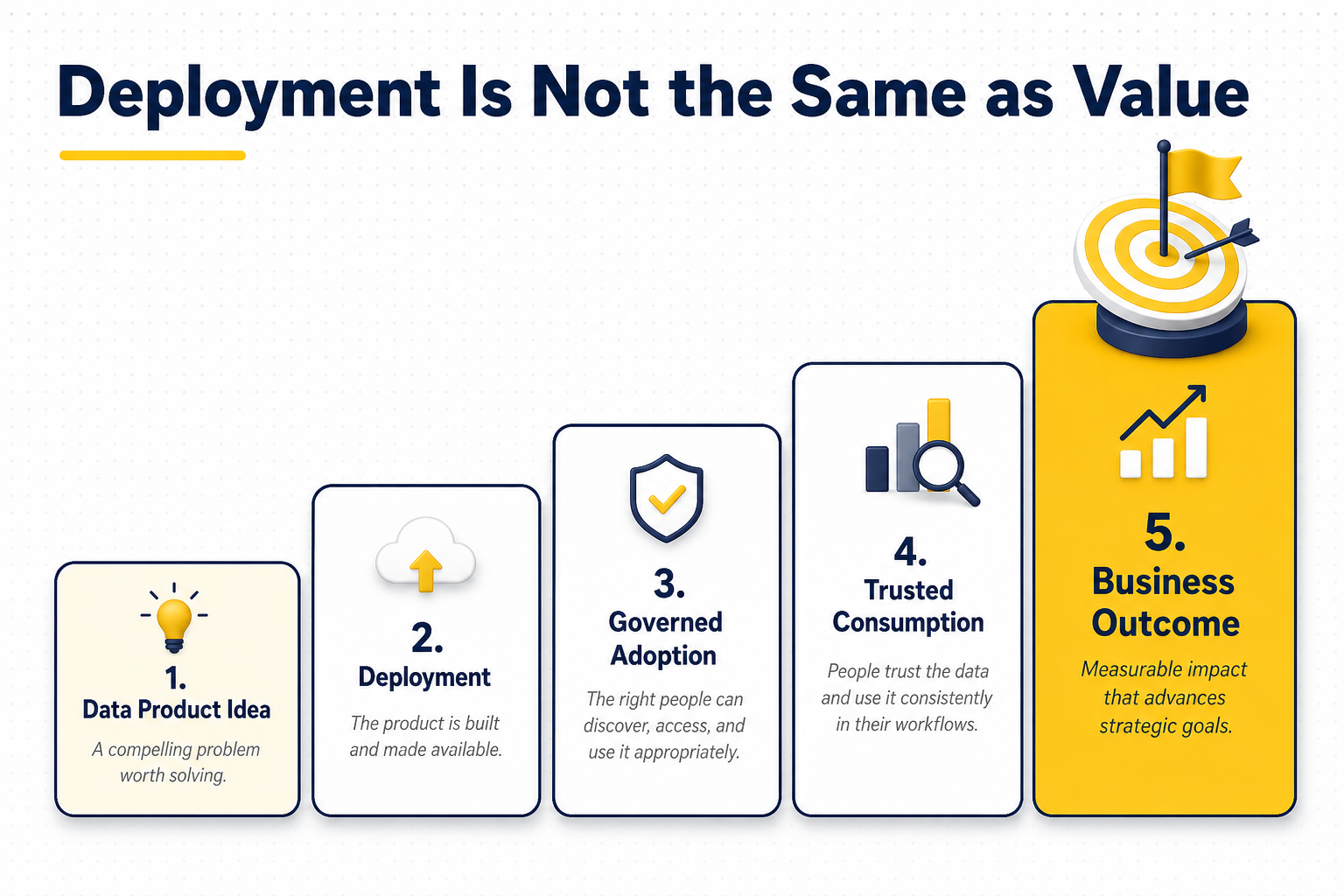
This is where I think the next wave of research needs to go, because, much like AI, there is a large gap between deployment and value. Many organizations can say they have deployed AI. Far fewer can show measurable business impact, governed adoption, repeatable delivery, and sustained trust.
That point matters because it tells us the industry is not short of technology. It is short of measurable business value. The same pattern is emerging with data products. There are a lot of data product initiatives underway, but based on my experience, there is also a high level of failure, confusion, and rework.
That failure is not always visible in the early stages. A company may have a data product inventory. It may have domains. It may have product owners. It may even have a catalog full of data assets labeled as products. But if those products are not trusted, governed, consumable, reusable, and connected to business decisions, then the organization has not really changed the operating model. It has simply renamed the assets.
The Problem Is Not the Concept. It Is the Delivery Model
Nina Showell, Senior Director Analyst at Gartner, shared with me that highly consumable data products are now considered a best practice. Mature organizations are already deploying them successfully. The laggards, however, spent much of last year debating what a data "product" actually means.
That debate matters, but only up to a point. At some stage, organizations need to move beyond definitions and start solving the harder problem: how data products are actually created, owned, governed, secured, shared, consumed, and measured.
This is where many initiatives begin to fail. Too often, data products are treated as technical artifacts. They are reduced to tables, pipelines, semantic models, dashboards, curated datasets, or reusable data assets. But in a decision-driven world, that is not enough.
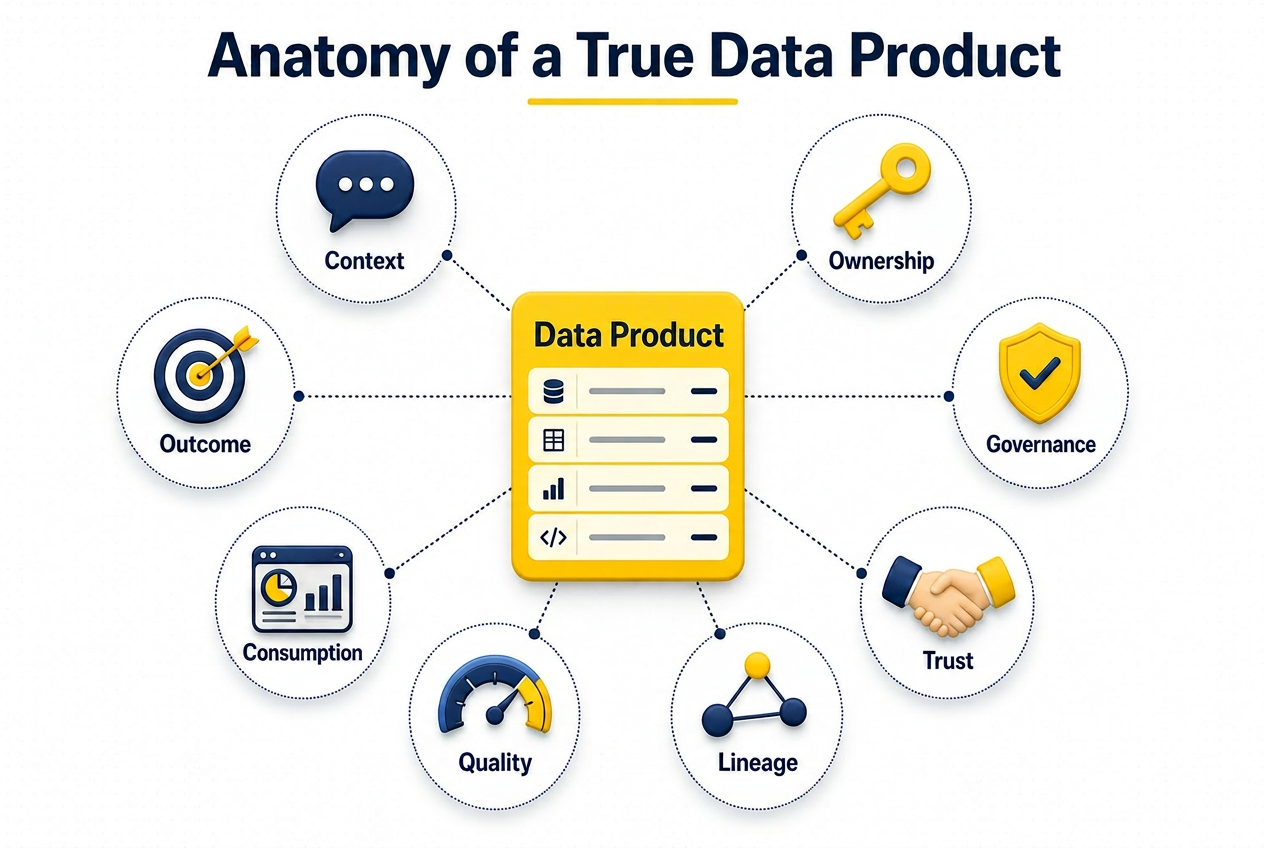
A true data product needs business context. It needs a clear purpose. It needs an owner. It needs usage intent. It needs policies, controls, lineage, quality expectations, and consumption patterns. It needs to be designed around a decision or outcome, not simply around a source system or data domain.
This aligns with the original principles behind data mesh, where data as a product, domain-oriented ownership, self-serve infrastructure, and federated computational governance were intended to change both the architecture and the operating model of data. Thoughtworks has consistently framed data mesh around domain ownership, product thinking, and accelerating insight delivery, not merely around creating more technical layers in the data stack.
That distinction is important. The original promise of data products was never just better packaging of datasets. It was better ownership, better context, better usability, better governance, better trust, and better delivery into business decisions. In other words, the operating model has to change.
Business Ownership Becomes the Critical Success Factor
The reason many data product initiatives struggle is that they remain trapped in an engineering-led delivery model. The business asks for data, data teams interpret the request, engineers build pipelines, analysts create dashboards, governance teams document assets after the fact, and consumers then decide whether what was delivered is useful. That model is too slow, too indirect, and too disconnected from the decision.
It also creates one of the most persistent problems in data: loss of context. By the time a business need has moved from domain owner to analyst to engineer to governance team to dashboard and finally back to the business, the original decision context has often been diluted. The business question may have changed. The urgency may have passed. The assumptions may no longer hold. The data may be technically correct but no longer fit for purpose.
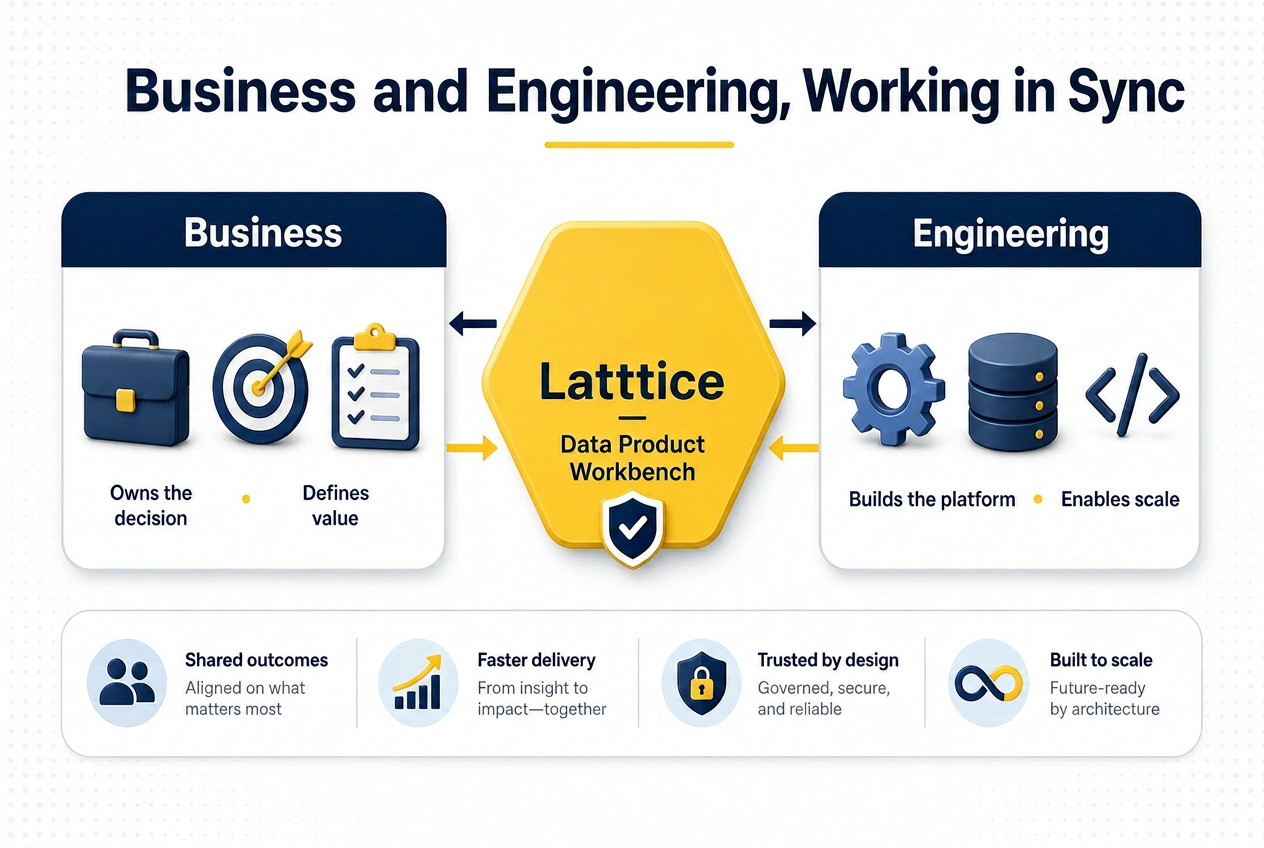
This is why business ownership matters. In a decision-driven organization, the business must play a much more active role in defining and shaping data products. That does not mean business users become data engineers. It means the business owns the intent, the context, the meaning, the decision logic, and the value case. Technology should then enable that ownership through governed, low-friction creation and consumption.
This is the fundamental change. Data products cannot simply be engineered and handed over. They must be co-designed with the decision in mind, with governance embedded from the start, and with consumption treated as a first-class requirement.
The next generation of data platforms will not be judged purely by how much data they store, how many pipelines they run, or how many dashboards they produce. They will be judged by how quickly trusted data reaches the people, applications, workflows, and AI agents making decisions.
Decision-Driven Means Designing Around the Moment of Use
This is where I think many organizations need to rethink the meaning of value. For too long, data value has been measured by activity: how much data has been ingested, how many dashboards have been built, how many reports have been automated, how many assets have been cataloged, and how many governance policies have been documented. Those things matter, but they are not the end point. The end point is the decision.
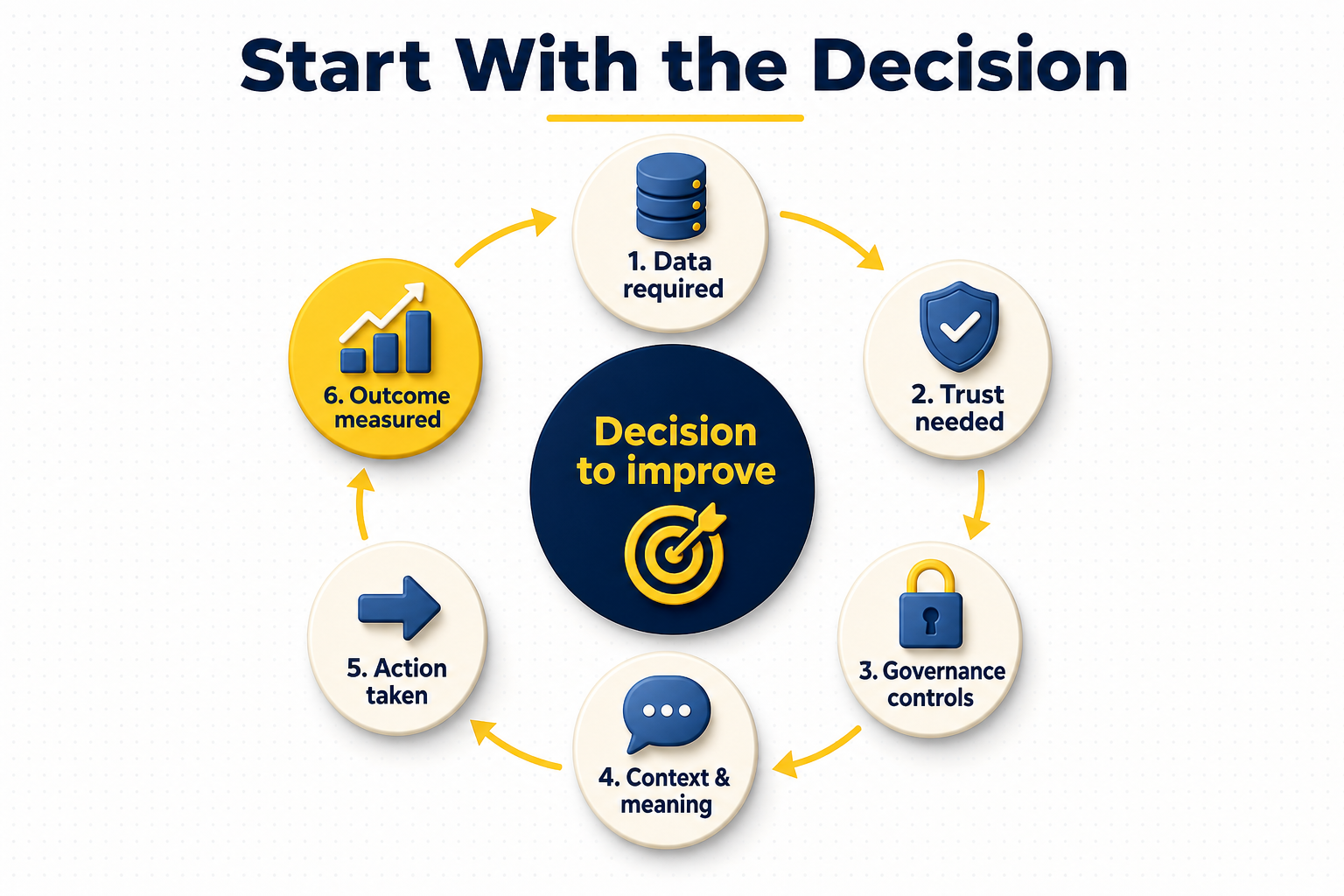
A decision-driven organization starts with a different set of questions. What decision are we trying to improve? Who is making it? When do they need to make it? What data do they need? What level of trust is required? What governance controls must apply? What context is needed to interpret the data correctly? What action should follow? How will we know whether the decision improved?
That is a much more useful way to design data products. It forces the organization to connect data work to business outcomes. It also forces governance, quality, ownership, and consumption to be considered from the beginning rather than added after the fact.
Data without context can mislead. Data without ownership can lose trust. Data without governance can create risk. Data without usability can sit unused. And data without a decision can become another expensive enterprise asset looking for a purpose.
Consumability, Governance, and Trust
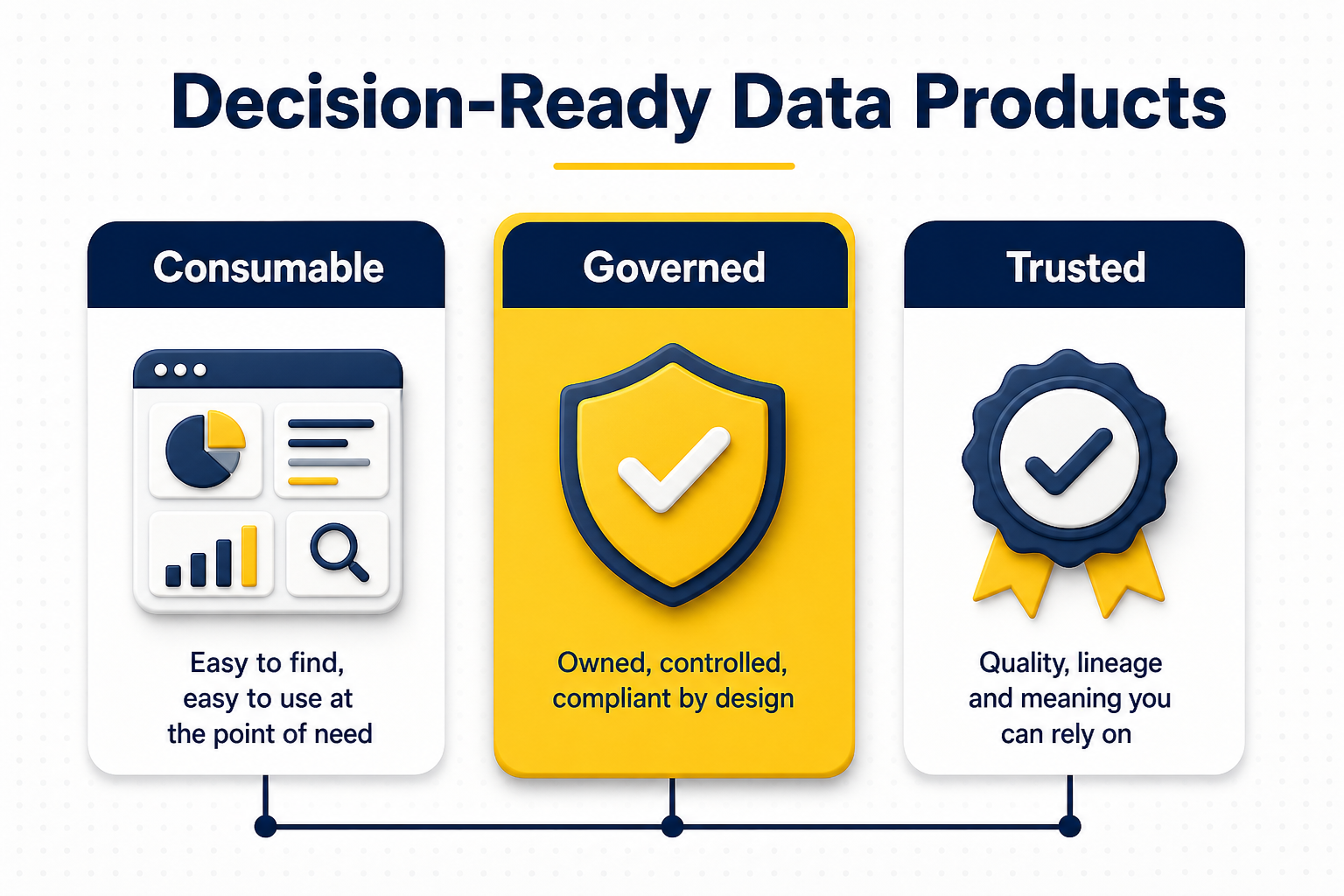
If data products are to become the foundation of decision-driven organizations, then their success will depend on three things: consumability, governance, and trust.
First, they must be highly consumable. A data product that requires specialist interpretation, manual stitching, or tribal knowledge is not really a product. It is another asset waiting to be decoded. Consumability is not a cosmetic issue. It is central to business value. A product must be understandable, usable, discoverable, and supported by enough context for a consumer to know what it is, where it came from, what it means, how it should be used, and what decisions it can support.
Second, data products must be actively governed. Governance cannot remain a passive documentation exercise. Policies, access rules, sensitivity classifications, lineage, usage constraints, and quality expectations need to be embedded into how the product is created and consumed.
This is particularly important as AI becomes more deeply embedded in decision-making.
If AI agents, analytics applications, business users, and operational workflows are going to rely on data products, then those products need to carry trust, context, and control with them.
Third, data products must be trusted at the point of decision. Trust is not created by a catalog entry alone. It is created through transparency, ownership, quality, explainability, and consistent delivery against business expectations.
This is where I believe the market is heading. The data product category will not be defined by who can create another layer of curated datasets. It will be defined by who can help organizations create trusted, governed, decision-ready products that can be used by people, applications, analytics, and AI agents.
That final point is critical because we are now moving into an era where decisions will increasingly be augmented or automated by AI.
That should be a wake-up call. AI will not fix weak data foundations. AI will expose them. If the data is not trusted, governed, contextual, and fit for purpose, the decision will not be trusted either.
Data Products Are the Operating Model Between Data and Decisions
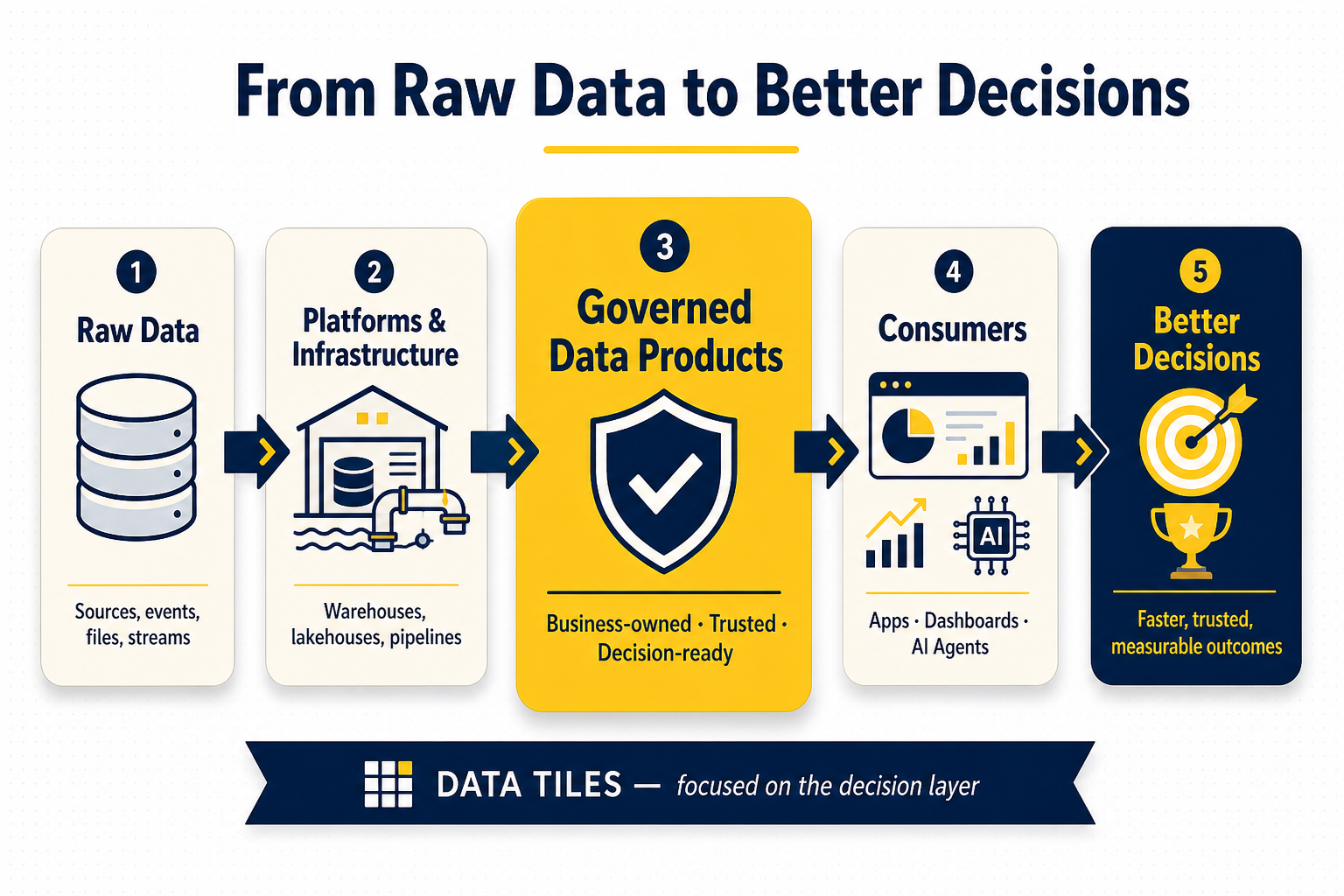
This is why I believe data products are becoming the new operating model for data. They sit between raw data and business decisions. They turn source data into something owned, governed, contextualized, reusable, and consumable. They give the business a clearer way to define what it needs. They give technology teams a clearer way to support those needs. They give governance teams a clearer way to operationalize policy. They give AI systems and analytics tools a more reliable foundation to consume. And most importantly, they create a direct connection between data work and business value.
That is the operating model shift. The old model was built around moving data into platforms. The new model is built around moving trusted data into decisions.
This does not mean infrastructure no longer matters. It absolutely does. Cloud platforms, warehouses, lakehouses, pipelines, catalogs, governance platforms, and integration tools remain important. But they are not the decision layer. They are the foundation.
The decision layer is where data becomes useful. That is where the business asks better questions, creates fit-for-purpose data products, applies governance in context, and uses the results to act with greater confidence.
That is also where Data Tiles has focused its mission. Enabling better decisions is not a marketing line for us. It is the reason we built Latttice.
We believe business teams need tools that let them create and use trusted data products without waiting months for engineering interpretation. We believe governance needs to be active at the point data is accessed and used. We believe data products need to be business-led, AI-powered, zero-code, and built around decisions.
Because the business does not make decisions inside a pipeline. It does not make decisions inside a catalog. It does not make decisions inside a warehouse. It makes decisions at the point of need. That is where data must show up.
The Industry Is About to Change Quickly
The move from data-driven to decision-driven is not just a language shift. It is a structural change in how organizations think about data value. It changes the role of the CDAO. It changes the relationship between business and technology. It changes the way governance operates. It changes how data platforms are evaluated. It changes the skills required to deliver value. And it changes the definition of success.
Success will no longer be measured by how much data has been centralized, cataloged, or made available. It will be measured by how effectively data improves decisions and outcomes.
That is why data products matter. But it is also why many current implementations will fall short. The organizations that succeed will not be the ones that simply rename datasets as products. They will be the ones that redesign the creation, governance, and consumption of data around the decisions that matter most.
They will ask what decision needs to improve before asking what data needs to move. They will give business teams more ownership without compromising governance. They will embed trust and controls into the product creation process. They will make data consumable by people, applications, analytics, and AI agents. They will measure value by outcomes, not output.
Most importantly, they will understand that decision velocity, decision quality, and decision trust are becoming the real measures of modern data maturity.
The future of data is not just about having more of it. It is about knowing how, when, where, and why to use it. The future of data is not just data-driven. It is decision-driven. And data products will be one of the core mechanisms that gets us there.
For me, that is where the industry is heading. And for Data Tiles, that is the mission: enabling better decisions through data at the point of decision, with business-led data tools that help organizations move from knowing data exists to using it when it matters most.
Join a Data Conversation,
Cameron Price

Cameron Price
CEO & Founder, Data Tiles
Cameron Price is the CEO and Founder of Data Tiles and the creator of Latttice, the AI-powered Data Product Workbench. With more than 30 years of experience across data strategy, analytics, cloud, governance, and enterprise transformation, Cameron has built his career around one clear mission: helping organizations turn data into better decisions. Through Data Tiles, he is focused on business-led, decision-driven data tools that bring trusted, governed data products to the point of decision.
Connect with Cameron on LinkedInCameron on Decision-Driven Data Strategy
Decision-Driven Ability Assessment
How decision-driven is your organization today? This short assessment is designed to help you reflect on whether your data, governance, business ownership, and AI readiness are truly connected to the decisions that matter most. It does not collect personal information.
8 questions · ~3 minutes · No personal information collected
Each question uses a 1–5 scale from "Not yet" to "Leading". Results are shown immediately.
Want to talk about becoming decision-driven?
If your organization is trying to connect data products, governance, AI readiness, and business outcomes, we would welcome a conversation.
Connect with Cameron
CEO & Founder
Speak with Cameron Price about decision-driven data strategy, data products, AI readiness, and how organizations can bring trusted data to the point of decision.
Connect on LinkedInEmail John Goode
Global Chief Revenue Officer
Reach out to John Goode to discuss how your organization can become more decision-driven for business outcomes and AI adoption.
Email John@data-tiles.ioReferences
Gartner. "What Is Data and Analytics?" Gartner describes the role of data and analytics as equipping business leaders and employees to make better decisions and improve decision outcomes across strategic, tactical, operational, real-time, and cyclical decisions.
Gartner. "Gartner Survey Finds One-Third of CDAOs Cite Measuring Data, Analytics and AI Impact as Top Challenge." Gartner reports that 30% of CDAOs identify measuring data, analytics, and AI impact on business outcomes as their top challenge.
Gartner / Industry Coverage. Gartner 2024 CDAO Agenda Survey. Gartner research referenced across the market indicates growing adoption of data products, including findings showing significant deployment and exploration of data products.
Gartner / Reuters. "Over 40% of Agentic AI Projects Will Be Scrapped by 2027, Gartner Says." Reuters reports Gartner's prediction that many agentic AI projects may be canceled due to unclear business value, costs, and misapplication, while also forecasting increased autonomous decision-making.
Thoughtworks. "Data Mesh." Thoughtworks frames data mesh around domain ownership, product thinking, and accelerating insight delivery, reinforcing the operating model shift behind data products.
Zhamak Dehghani / Martin Fowler. "Data Mesh Principles and Logical Architecture." This foundational article describes the four principles of data mesh: domain-oriented decentralized data ownership, data as a product, self-serve data infrastructure as a platform, and federated computational governance.
McKinsey & Company. "Catch Them If You Can: How Leaders in Data and Analytics Have Pulled Ahead." McKinsey highlights the importance of getting data out of silos and into the hands of decision makers and partners across the enterprise.
McKinsey & Company. "Untangling Your Organization's Decision Making." McKinsey argues that organizations can improve the speed and quality of decisions by paying closer attention to what they are deciding.
Harvard Business Review. "What AI-Driven Decision Making Looks Like." HBR discusses how data can improve operational decisions, while emphasizing that data still needs the right process to turn it into value.
Harvard Business Review. "The Right Way to Make Data-Driven Decisions." HBR warns that data-driven decision-making can go wrong when leaders misinterpret data or fail to apply it effectively.
Deloitte. "Trustworthy AI Governance in Practice." Deloitte's Trustworthy AI framework emphasizes the need for cross-functional governance, controls, and accountability across the AI lifecycle.
People also ask
Explore the connected concepts that anchor the Decision-Driven Enterprise.