
Passive
Legacy Data Governance (Passive)
Focuses on passive table schemas, static data catalogs, and manual documentation that lives far away from daily execution. It answers where data sits, but leaves AI and leaders blind to outcomes.
Move beyond passive technical tracking. Protect the choices, actions, and intelligence that move your business forward with Decision Integrity and Decision Provenance.
The chasm
Passive
Focuses on passive table schemas, static data catalogs, and manual documentation that lives far away from daily execution. It answers where data sits, but leaves AI and leaders blind to outcomes.
Active
Connects business definitions, policy and evidence with the decisions they support. Latttice helps business teams build data products with semantic context and active governance; Lllenz provides an AI Factory environment. Decision accountability also requires organizations to connect the relevant systems, consumers and action records. This framework does not imply automatic capture of every external decision or universal policy enforcement.
Core framework
Decision Integrity is confidence that a decision was made using data that was trusted, current and permitted for that use, and that the definitions, policies and context behind the decision were valid and consistent.
View Glossary Definition for Decision Integrity →Decision Provenance is the reconstructable record of what informed a decision: the data, context, policies and product version behind it, and the human or AI consumer that acted on it. Reconstructing that record requires organizations to connect the relevant evidence, systems, policies, consumers and actions. Governance and versioning alone do not establish complete decision provenance.
Explore Decision Provenance →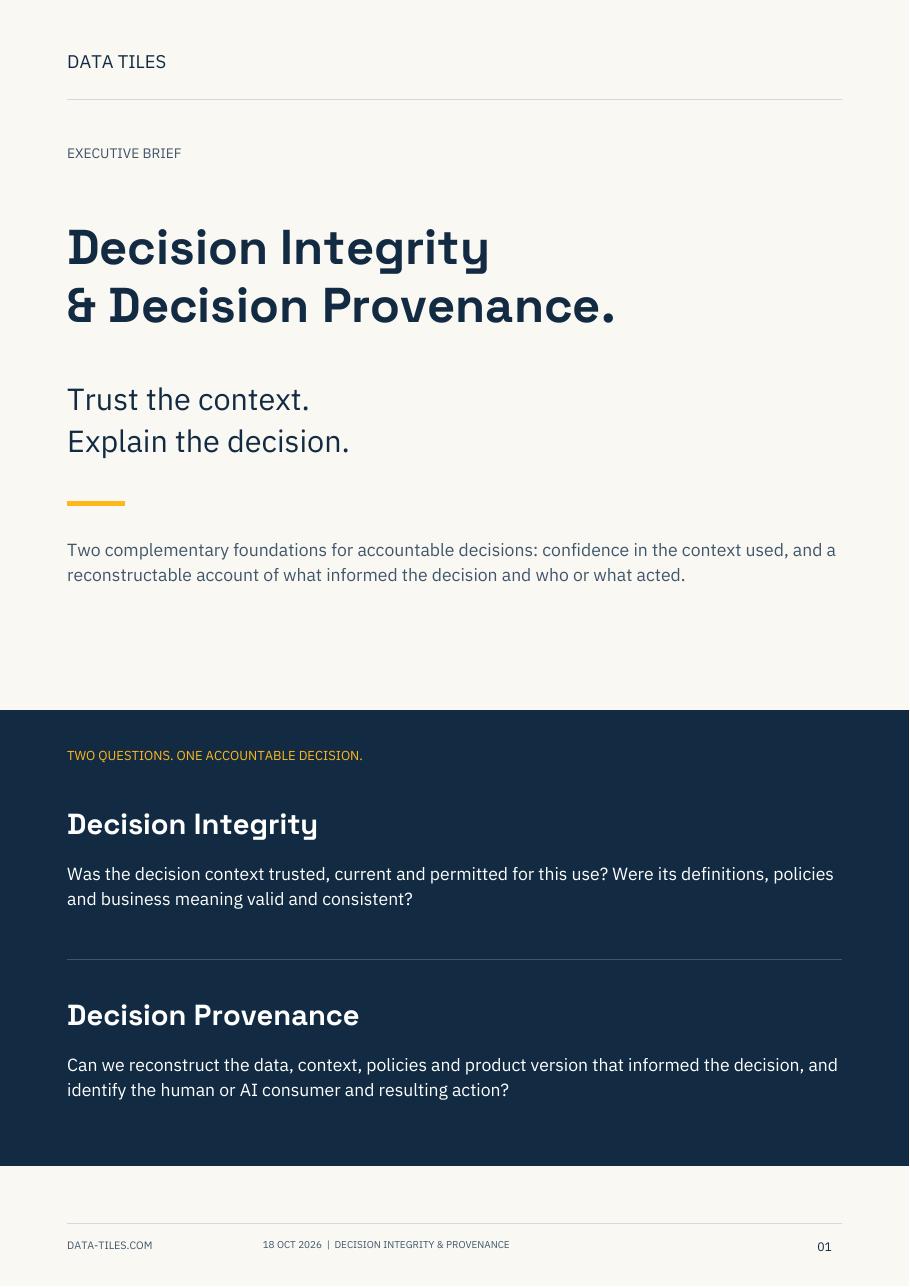
Take the perspective with you
Explore how valid definitions, policy and context support decision confidence, and how connected evidence helps explain what informed a decision.
Assess the decision context. Check whether definitions, policies and context were valid, current and permitted for the decision.
Connect the evidence. Identify data, product versions, relevant controls, consumers and actions across participating systems.
Test the chain. Assign accountable owners and identify missing evidence rather than assume complete capture or universal enforcement.
PDF · 3 pages · Includes QR codes to both decision frameworks. Download and share with colleagues.