Context
Structured information, history, documents and external context assembled around the decision.
Bringing data closer to the decision.
Cameron Price, Founder & CEO, Data Tiles
Presented at the 3rd Industry Summit on Data Product-Oriented Architectures
Antwerp Management School, Antwerp, Belgium · September 17, 2026
Business teams still wait too long for the data needed to make important decisions. Cameron’s Antwerp presentation argues for a different model: abstract technical complexity from the business user’s experience while the engineering, sophistication and control remain underneath.
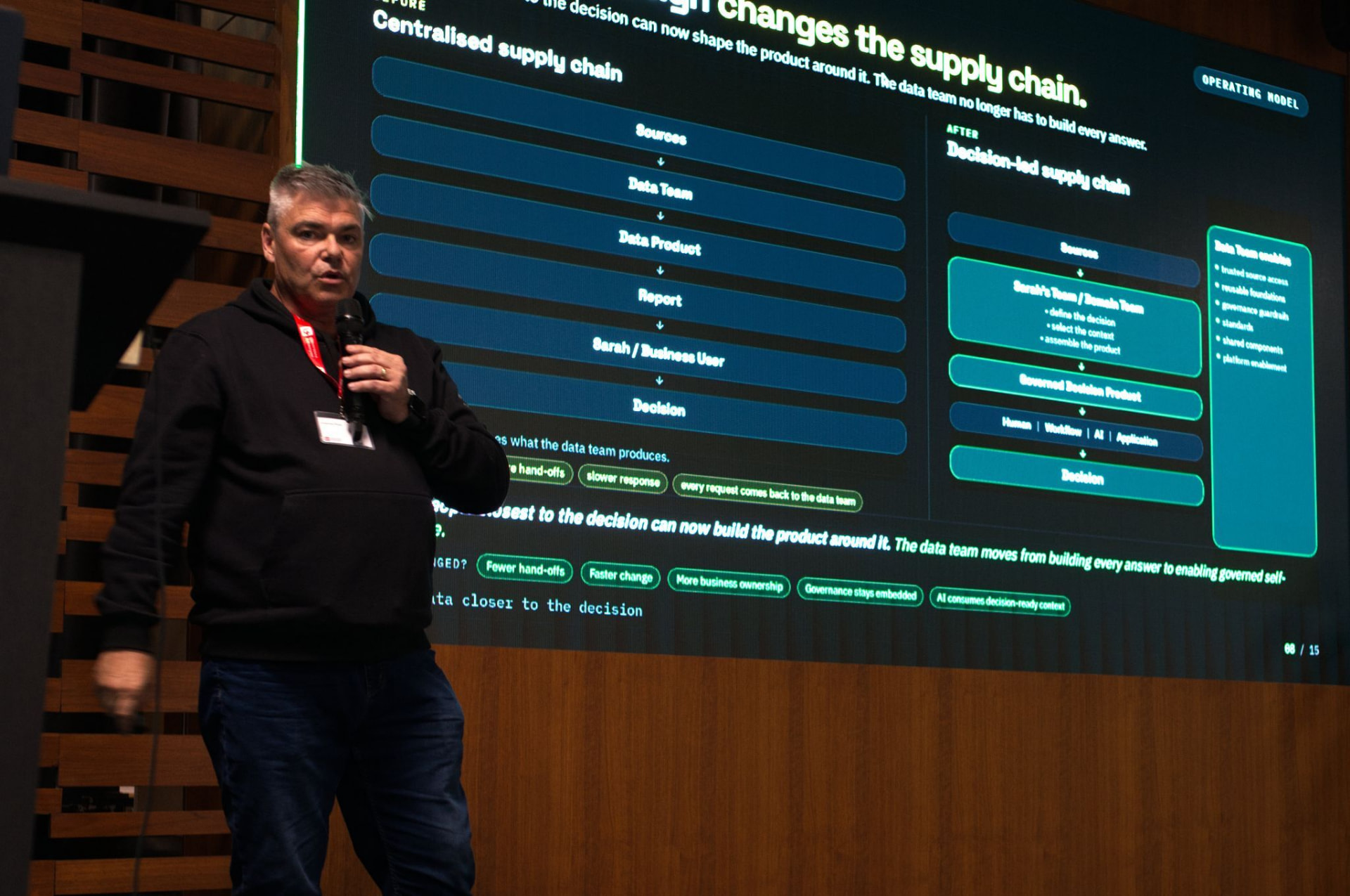
Start with the decision. Work backwards to the data.


Cameron Price — CEO & Founder, Data Tiles
For years, organizations optimized the journey from source data to data products. The decision sat at the end of that supply chain, waiting for reports, handoffs and interpretation.
Cameron’s challenge was to reverse the perspective. Begin with the decision, then work backwards to the context, evidence, meaning and controls it needs.
Start with the decision.
Work backwards to the data.
Should this claim be investigated?
Sarah doesn’t need more data. She needs context.
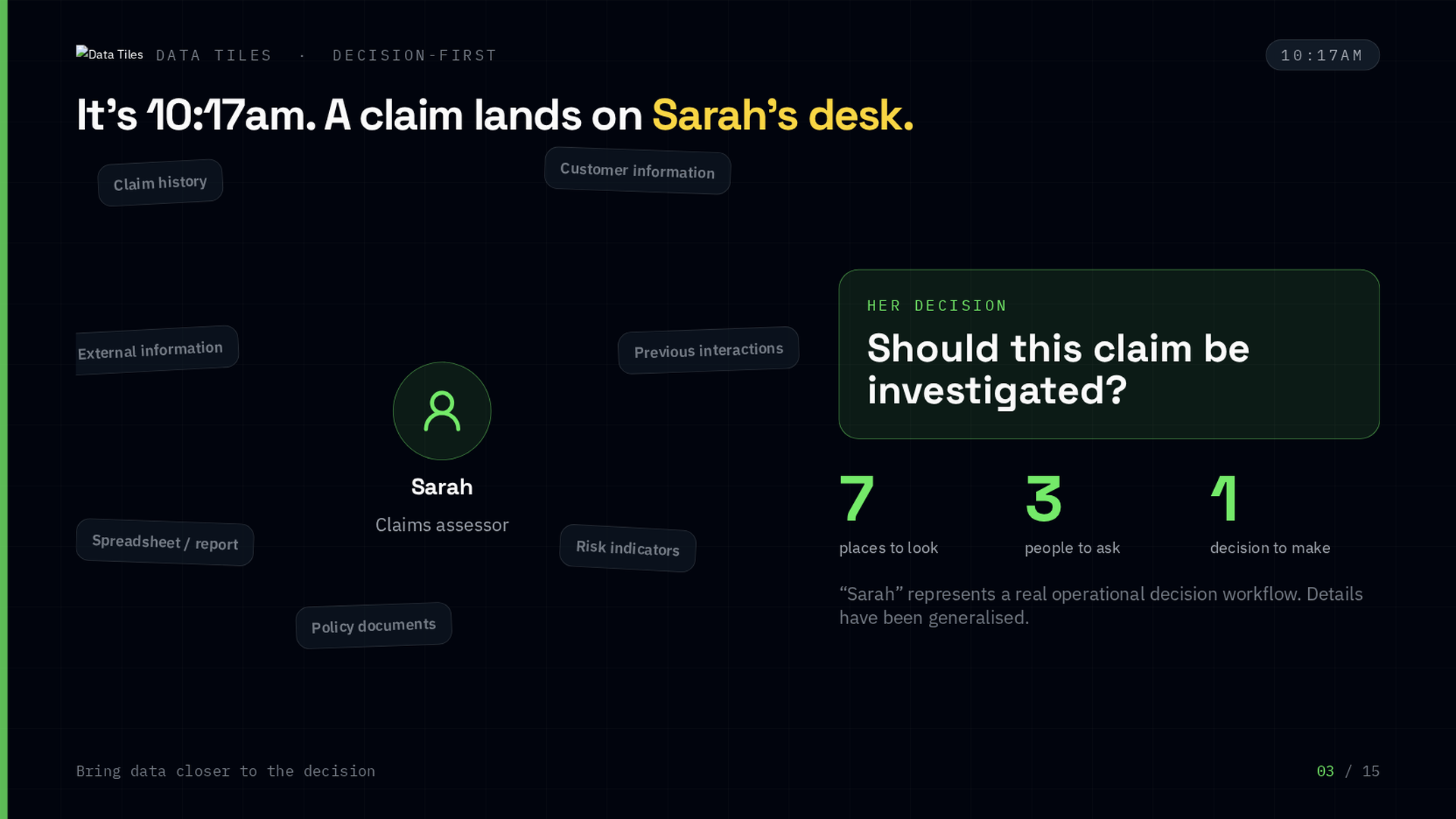
Structured information, history, documents and external context assembled around the decision.
What it means, how it is related, which definition is trusted and what it means in this business context.
Who can see it, what they can see, which rules apply, where it came from and whether its use can be explained.
One governed context. Many decision experiences.
Human · BI · Application · Workflow · AI · Agent
Technical complexity does not disappear. It moves out of the business user’s experience. Latttice works with technical and business metadata to create semantic understanding while relationships, security, access controls and governance remain intact.
The business user works with information in terms they understand. Engineering and data teams remain essential for platforms, pipelines, integration, reusable services and the governed foundations beneath every product.
Complexity is abstracted away. Control is not.
Understands the decision
Understands the evidence
Understands how it will be used
Design together around the decision.
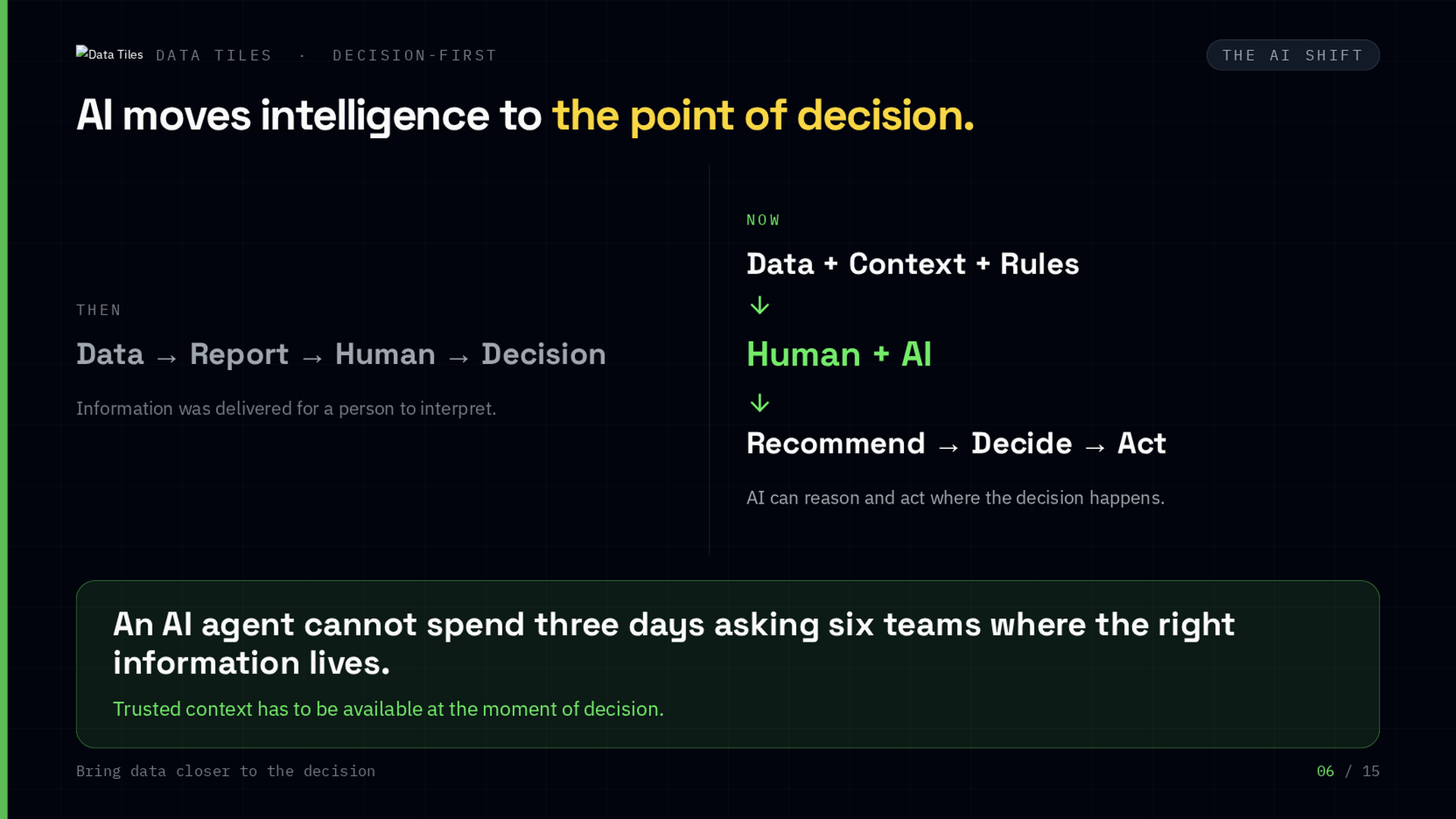
Then
Data → Report → Human → Decision
Now
Data + Context + Rules
↓ Human + AI
↓ Recommend → Decide → Act
An AI agent cannot spend three days asking six teams where the right information lives. Trusted context has to be available at the moment of decision.
The same governed, decision-centric data product can support a human, dashboard, business intelligence experience, application, workflow, AI assistant or autonomous agent.
What recurring decision are we trying to improve?
What would someone need to know to make it well?
Where does that information live today?
How will we know the decision improved?
Build backwards.
Start with the decision. Work backwards to the data.
The value of data isn’t the data. It’s the decision it helps someone make.
Browse Cameron’s original 15 slides in sequence. The presentation wording, diagrams, visual language and slide order are preserved from the source deck.
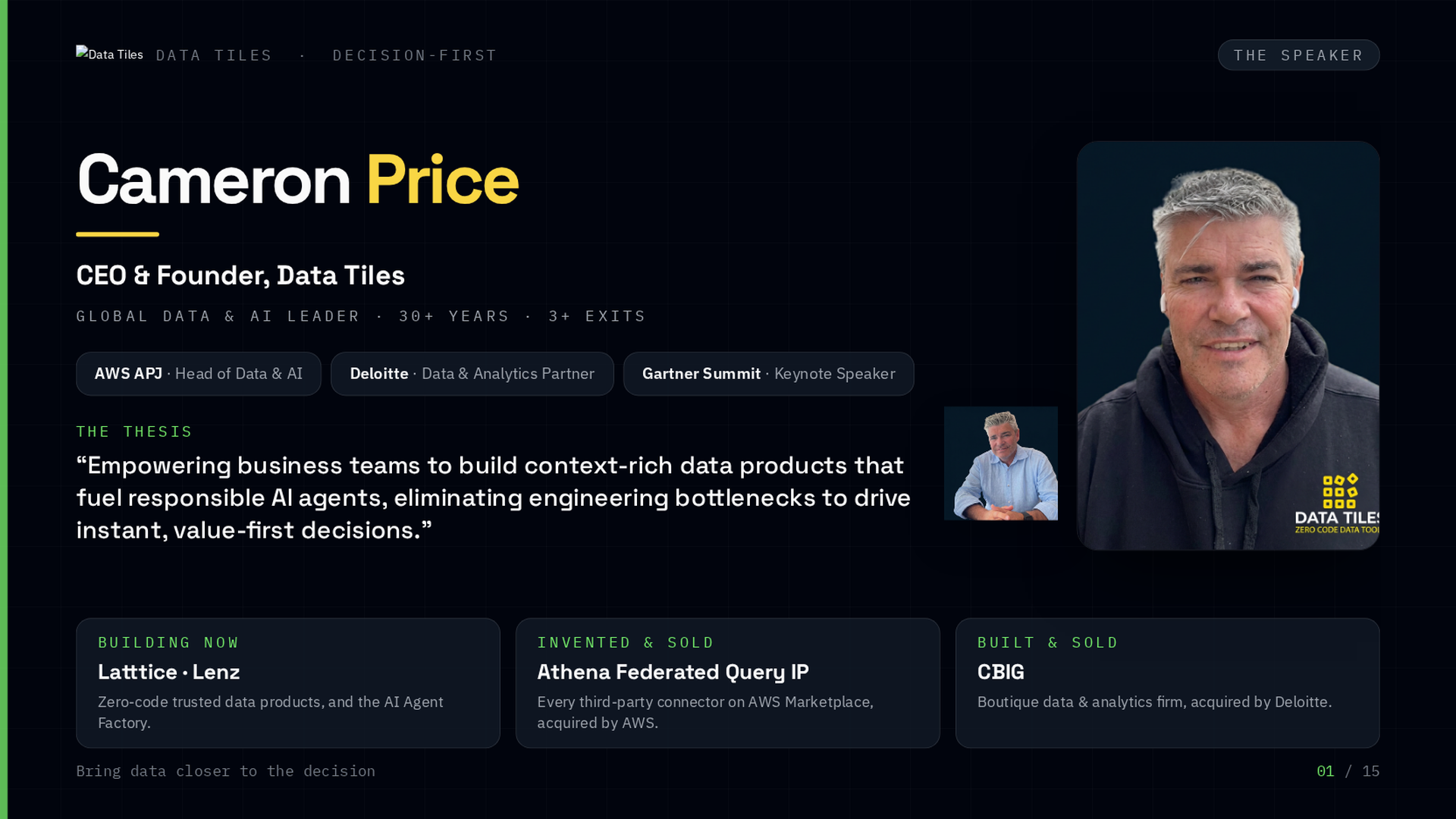
Original slide 1
Cameron Price, CEO & Founder, Data Tiles
A six-page executive brief drawn from the Antwerp presentation: the decision as the last mile, the four questions, context, meaning and governance, the decision-led operating model, and one governed context published everywhere.
Cameron Price presents a decision-led supply chain for governed data products.
Additional conference photographs can be added here as the official event collection becomes available.
PRLog
The full post-conference press release is published on the Data Tiles newsroom.
Read the press release