Intelligence
- Enterprise question
- What can the system understand, infer, recommend or generate?
- What provides it
- The model and its reasoning capabilities
Executive Framework · A Data Tiles framework
Intelligence, context, authority and evidence must work together. None can substitute for another.
Enterprise AI is often discussed as though trust can be delivered by the model alone. It cannot. A capable model may understand and recommend, but the organization must still determine which information it should use, what it is permitted to do and how the resulting decision can be reconstructed. The Four Layers of Trusted Enterprise AI give leaders a practical way to separate those responsibilities.
“AI can supply intelligence. The enterprise must retain authority.”
When leaders ask whether an AI system can be trusted, they are often asking it to perform four different roles at once. Each role matters, but each requires a different kind of assurance.
A model can be highly capable while using incomplete business context. It can make a sensible recommendation without having authority to act. It can remain within its technical permissions while relying on outdated or inappropriate information. It can also generate a convincing explanation that is not the same as an independent record of what occurred.
For an executive team, the distinction is practical. Confidence in the model is not the same as confidence in the decision. The business still needs named owners for the information, the permissions and the record that will support accountability afterward.
The model should contribute intelligence. The enterprise must provide the context, retain authority and preserve the evidence.
The framework separates what the model contributes from what the enterprise must establish around it. Read each row as a distinct responsibility, not as a sequence in which one layer replaces the previous one.
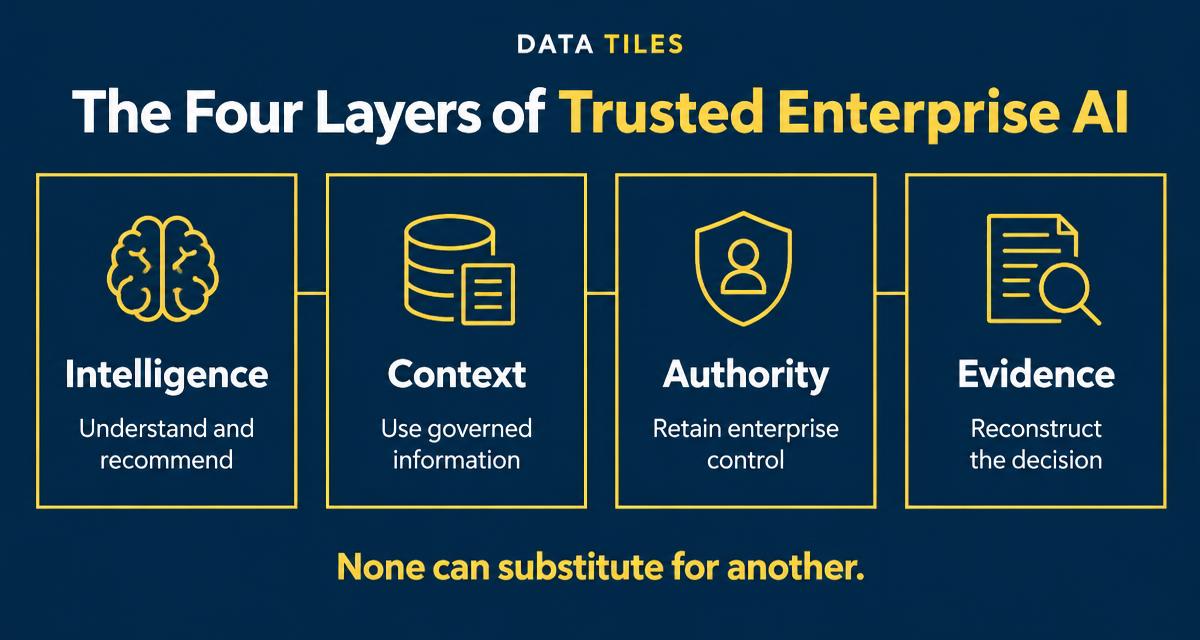
Intelligence is the model’s ability to interpret information, recognize patterns, reason about a task, generate content and recommend actions. It may also help an agent adapt when circumstances change, such as when an invoice does not match an order or a customer request needs clarification.
These capabilities can improve the speed and quality of business work. They do not automatically establish what a business term means, whether the information is appropriate for the decision or whether the organization has authorized the proposed action. A recommendation remains a recommendation until the surrounding enterprise responsibilities have been satisfied.
Capability answers what the system can do. It does not answer what the organization should allow it to do.
Context is the trusted, fit-for-purpose information required for a particular decision. It gives the model more than values from a system. It gives those values business meaning, explains their relationships and establishes the conditions under which they should be used.
The objective is not to give AI access to everything. It is to provide the governed context required for the particular decision. A decision-ready data product brings relevant information together with its business meaning and governance for a defined purpose. Business owners establish what the decision needs; data teams remain essential to the enterprise foundations, integrations and quality that make that information usable.
More accessible data is not always better context. Trusted context is selected, understood and governed for a purpose.
Evidence allows the organization to reconstruct how a recommendation, decision or action occurred. It must be more than a persuasive explanation generated afterward. The relevant record needs to connect what informed the decision with the policy, approval and action that produced the outcome.
An audit log alone may not be enough. A log may show that a payment occurred without showing which supplier information was used, whether a dispute was known or which approval applied. Decision Provenance is the reconstructable record of what informed a decision and under which policy. The organization must connect the relevant evidence across its data products, systems, approvals and actions; it should not assume that one product automatically captures every part of that chain.
Decision Integrity concerns confidence in the trustworthiness, currency and permitted use of the data, together with the validity and consistency of the definitions, policies and context. Provenance helps reconstruct the decision. Integrity concerns whether its foundations were appropriate and reliable. Both matter when a board, customer or regulator asks the organization to defend an outcome.
The layers work together, but they answer different questions. Investment in one does not remove the need to establish the others. Four familiar examples make the distinction clear.
Trusted enterprise AI therefore depends on a clear separation of responsibilities combined with an end-to-end operating model. Leadership needs to know who owns each layer, how the layers connect and where an unresolved responsibility will stop the decision from becoming an action.
Intelligence without context can be confidently wrong. Context without authority cannot safely become action. Authority without evidence cannot be defended.
As an example, consider an agent supporting the finance team with a supplier invoice. The business outcome is straightforward: pay the right supplier, the right amount, at the right time, without bypassing the organization’s controls.
The agent identifies the invoice, compares it with the purchase order and recommends payment.
The agent receives governed supplier, invoice, contract, delivery, dispute and payment information appropriate to that decision.
The payment system independently enforces approval limits, segregation of duties and authorized approvers. The agent cannot waive or reinterpret those controls.
The organization retains the information used, the policy that applied, the approval received, the action taken and the resulting transaction.
A useful recommendation requires intelligence. A defensible payment requires all four layers.
Data Tiles contributes to the full decision-driven operating model through decision-driven design, governed business context, Active Governance and evidence. It does not replace the organization’s existing security, identity, data-platform or transaction-control environment. The responsibilities remain connected, but they are not all supplied by one product.
The decision provides the starting point. The organization defines the business outcome, the decision owner, the information required, the appropriate authority and the evidence that must be retained. This gives business, data, governance, security and AI teams a common purpose before they choose how to deliver it.
Latttice is the zero-code Data Product Workbench that helps business and data teams create governed, decision-ready data products. It contributes primarily to the Context and Evidence layers by bringing together business meaning, governed enterprise data, relationships, lineage, quality expectations, policy, access conditions and evidence for a defined purpose.
The governed data product created in Latttice is the central business asset in this framework. It supplies the trusted context and data-product evidence that people, applications, workflows and AI can reuse.
That contribution supports the information foundation for decisions and AI. It does not replace existing data platforms, catalogs, identity systems or infrastructure controls, and it does not establish a complete record of every external approval or action on its own.
Lenz is one environment for designing AI agents around a defined business decision and the trusted data products they need. The lasting enterprise asset is the governed data product. It can be reused across people, BI, applications, workflows and AI without depending on one model or agent builder.
Authority also depends on the customer’s existing identity systems, permissions, security infrastructure, workflow controls, approval systems, transaction platforms and runtime controls. The enterprise remains responsible for establishing and operating the controls that govern its actions.
Data Tiles does not replace the enterprise control environment. Latttice helps AI operate from governed business context and preserves data-product evidence that can be combined with enterprise approvals, actions and logs.
What decision or recommendation are we asking AI to support?
Is the system using approved, current and fit-for-purpose business information?
Are its permissions and actions independently constrained by enterprise controls?
Can we reconstruct the information, policy, approval and action behind the outcome?
If a leadership team cannot answer all four questions, the issue is not necessarily that the AI model is inadequate. One of the surrounding enterprise layers may be missing.
A four-page executive leave-behind: the four layers, the central role of the governed data product and a five-question diagnostic.
We will help you examine the intelligence it requires, the context it depends on, the authority it should hold and the evidence your organization needs to retain.