Data Tiles White Papers
Leading ideas, practical insights, and bold predictions on data, AI, data products, data mesh, and the future of business decision-making.
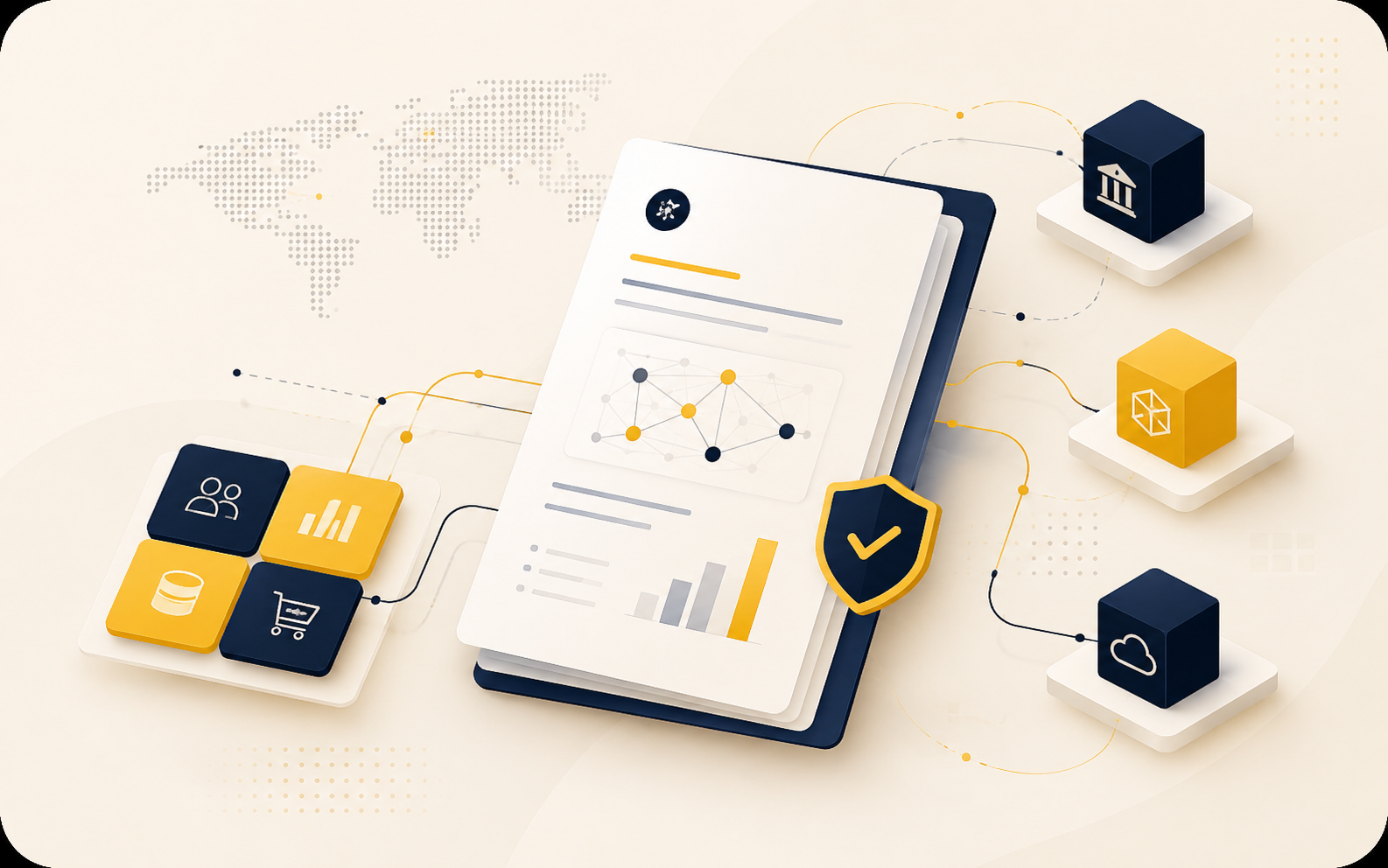
From Data-Driven to Decision-Driven
Why data products, active governance, and AI factories are becoming the new operating model for business outcomes. A new white paper from Cameron Price, CEO and Founder of Data Tiles.
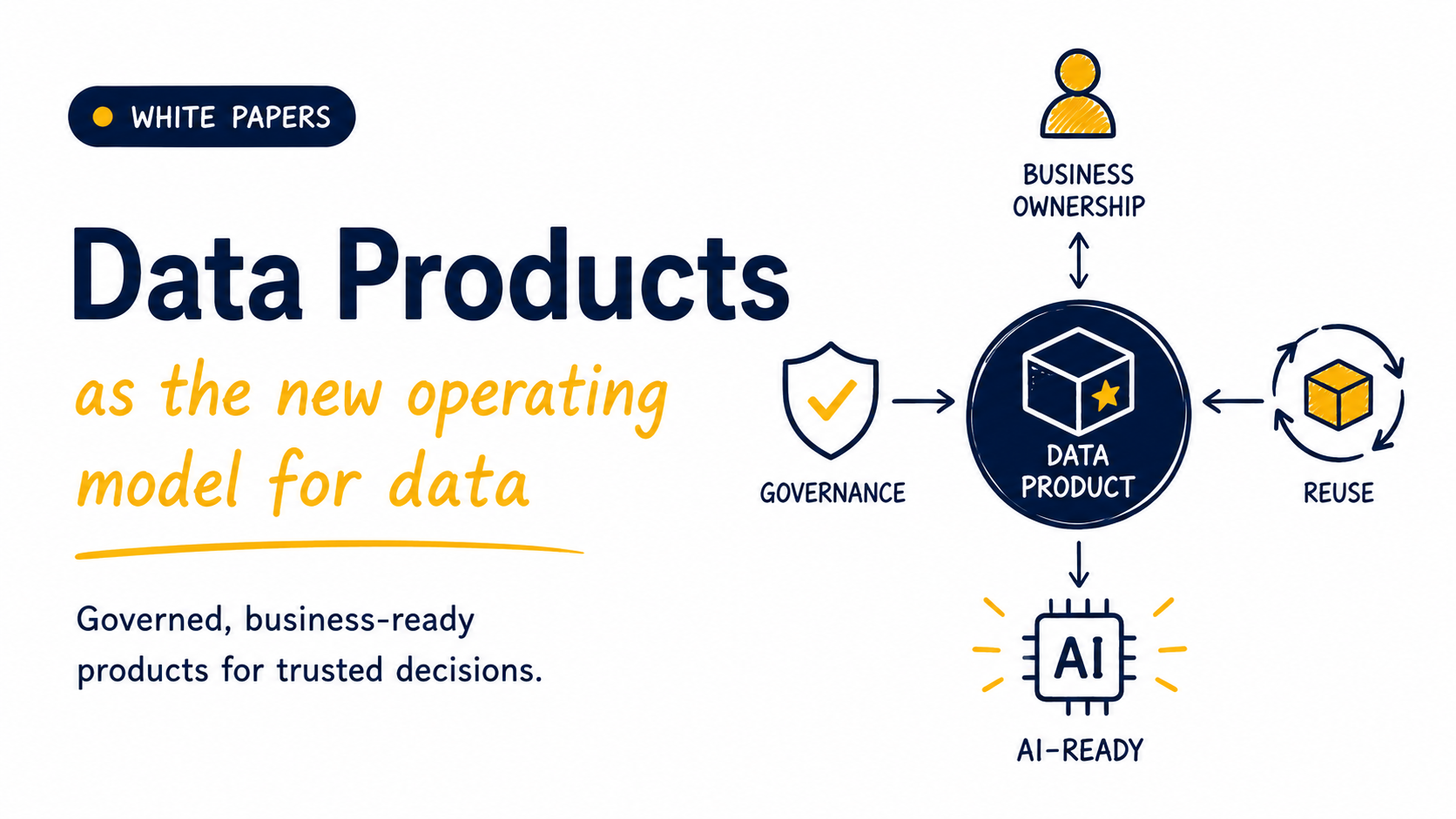
A New Operating Model for Trusted Decisions
Organizations have invested enormous time, money, and energy into becoming data-driven. They have built sophisticated platforms, centralized data in warehouses and lakehouses, implemented governance programs, and hired teams of engineers, analysts, and scientists. And yet, in board rooms, the same questions persist.
Why does it still take so long to act on data? Why is the data we trust the most often the data we use the least? Why does AI not feel ready to scale? This paper argues the answer is a shift from being data-driven to being decision-driven, with governed data products as the core operating mechanism.
By Cameron Price · Founder & CEO, Data Tiles
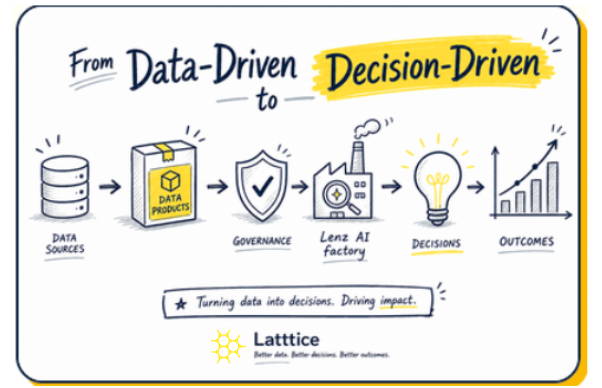
Decision-Driven
Start with the decision that needs to improve, then work backward to data, governance, and AI.
Active Governance
Embed ownership, lineage, quality, and policy into how data products are built and consumed.
AI Factory
Lenz turns trusted data products into AI agents and workflows with measurable outcomes.
"AI is not simply creating demand for more data. It is creating demand for a new operating model. That operating model is decision-driven."
— Cameron Price
What's Inside
The Decision-Driven Shift
Why the next chapter of data strategy starts with the decision, not the dataset, and what that means for leaders.
Data Products as the Operating Mechanism
How governed, business-ready data products replace pipelines and dashboards as the unit of value delivery.
Latttice + Lenz: The AI Factory
How the Latttice data product foundation and Lenz AI factory combine into a decision-driven platform.
From Data-Driven to Decision-Driven
Includes the interactive Decision-Driven Ability Assessment and a downloadable A4 PDF worksheet.
Read the White PaperThe Data Catalyst
The human bridge between business, data, AI, and trusted decisions. A new white paper from Cameron Price, Founder & CEO of Data Tiles.
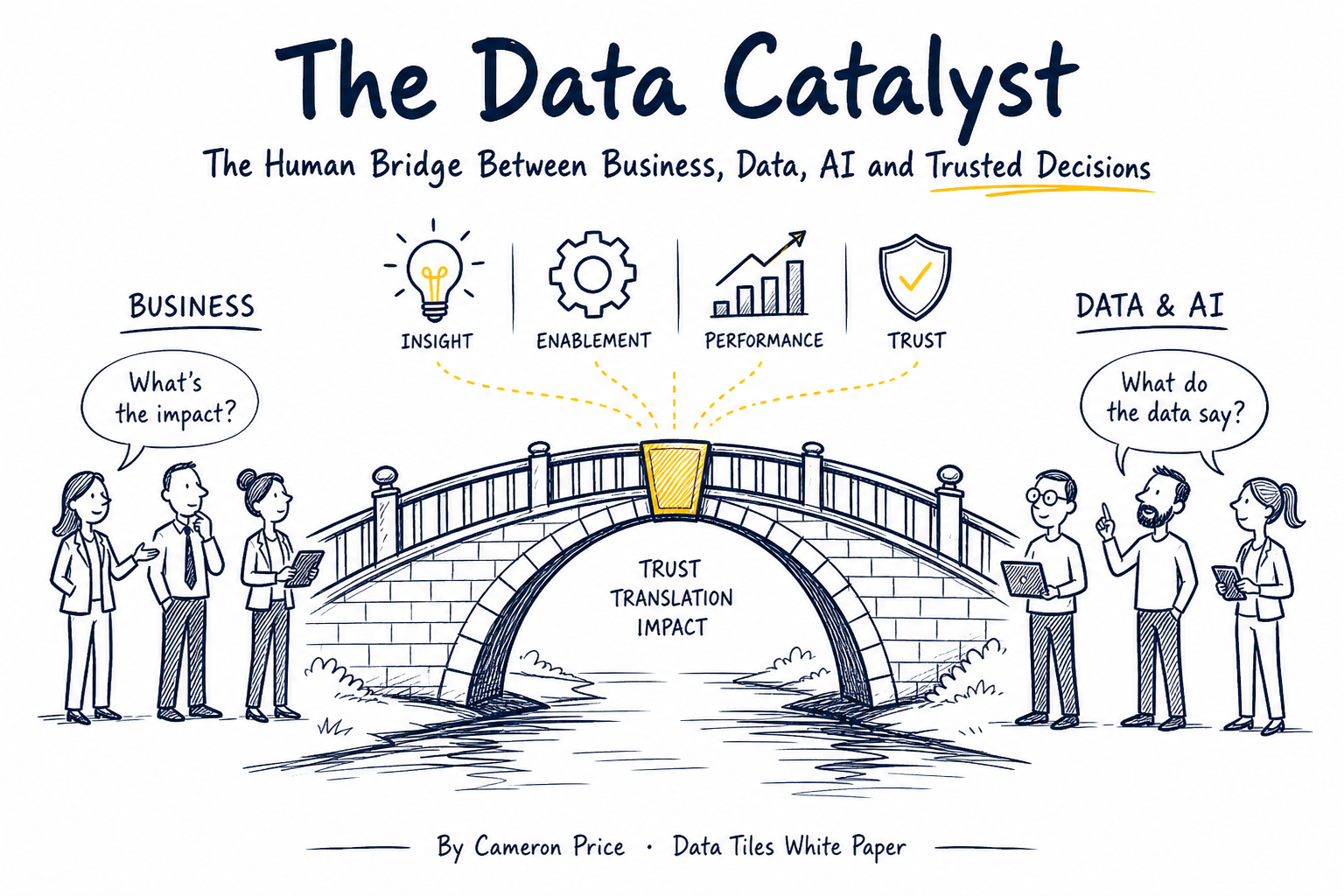
What Is the Data Catalyst?
The Data Catalyst is the human bridge between business need and data capability. It is the role that helps organizations turn technical data investment into business value by translating business questions, shaping trusted data products, supporting governance in practice, and helping teams move from data access to decision impact.
Organizations do not just need more data platforms. They need people who can translate business intent into trusted data products, align technical capability with business outcomes, and help teams move from data activity to decision impact.
By Cameron Price · Founder & CEO, Data Tiles
Translator
Turns business questions into clear data requirements and decision-ready data products.
Connector
Brings together business teams, data teams, governance teams, and technology platforms around shared outcomes.
Accelerator
Reduces friction between need, access, trust, and action, helping organizations move faster with confidence.
"Your role will not disappear. It will evolve. The future belongs to those who can translate technical capability into business knowledge."
— Cameron Price
The Data Catalyst
The human role that will define the next era of data, AI, and business performance. An executive thought leadership paper by Cameron Price.
Read the White Paper8 Steps to Trusted Data Products
A practical executive guide to business-led, governed, AI-ready data products. Trusted data at the point of decision.
Why Trusted Data Products Now Define AI Readiness
Every enterprise AI initiative eventually collides with the same wall: the underlying data is fragmented, ungoverned, and difficult to trust. Models hallucinate, dashboards disagree, and executives lose confidence in the numbers, just when decisions need to accelerate.
This executive guide reframes the problem. Trusted Data Products, owned by the business, governed by design, and accessible at the point of decision, are emerging as the foundation that makes AI and operational analytics actually work at scale.
Drawing on patterns from Gartner, McKinsey, and leading data organizations, the paper sets out a clear eight-step sequence for moving from raw data and disconnected pipelines to a portfolio of business-ready, AI-grade data assets.
"The organizations winning with AI are not the ones with the most models. They are the ones with the most trusted, governed, business-owned data products feeding those models."
From the executive summary
What's Inside
An Executive Sequence
Eight ordered steps leaders can use to assess where they are, where the gaps sit, and what to do next.
An AI-Readiness Lens
How governed Data Products become the trust layer for generative AI, agents, and operational decisioning.
Active vs Passive Governance
Why traditional catalog-and-policy governance fails AI workloads, and what active governance looks like in practice.
The Eight Steps at a Glance
A repeatable sequence for moving from raw, untrusted data to a portfolio of governed, AI-ready Data Products that business teams actually use.
Start with the Decision
Anchor every Data Product to a real business decision, not a dataset.
Define the Product
Treat data like a product: owner, consumers, SLAs, lifecycle.
Govern by Design
Embed policy, quality, and lineage into the product itself.
Make it Business-Led
Hand the pen to domain experts, with engineering as the platform.
Connect, Don't Copy
Federated access over endless duplication and shadow pipelines.
Make it AI-Ready
Semantics, context, and guardrails that LLMs and agents can use safely.
Measure Trust
Move from uptime metrics to trust, usage, and decision impact.
Scale the Portfolio
Operate Data Products as a managed portfolio, not a backlog of projects.
Why This Matters Now
AI Is Only as Good as Its Data
Trusted Data Products are the difference between an impressive demo and a deployable AI capability.
Decision Velocity Is the New Edge
Operational decisions can no longer wait for a quarterly data warehouse refresh.
Governance Has Become Strategic
Regulation, AI risk, and board scrutiny have moved governance from back office to boardroom.
Business Ownership Is Non-Negotiable
Data without a business owner is debt. Data Products give that ownership a structure.
Written For
Chief Data Officers, Chief AI Officers, Heads of Data Platform, and business leaders accountable for turning data investment into decisions, faster, more trusted, and ready for the AI era.
8 Steps to Trusted Data Products
An executive sequence for AI-ready, governed, business-led data products, with a Cameron Price sign-off.
Read PaperDebating Data Contracts
Catalyst or Roadblock in Data Mesh?
Data contracts have emerged as a critical discussion point in data mesh implementations. These formal agreements between data producers and consumers define expectations, schemas, and quality standards.
The debate centers on whether data contracts accelerate data mesh adoption by providing clarity and trust, or whether they introduce bureaucratic overhead that slows innovation and agility in distributed data environments.
The Case for Data Contracts
Trust and Reliability
Contracts establish clear expectations between producers and consumers, building confidence in data quality and availability. Teams can depend on consistent data structures and service levels.
Breaking Changes Prevention
Formal agreements prevent unexpected schema changes that could break downstream applications. Versioning and deprecation policies protect consumers from disruption.
Documentation and Discovery
Contracts serve as living documentation, making data products discoverable and understandable. New teams can quickly assess whether a data product meets their needs.
The Case Against Data Contracts
Bureaucratic Overhead
Creating and maintaining contracts adds process complexity that can slow down agile data product development and iteration cycles.
Reduced Flexibility
Strict contracts may limit the ability to evolve data products quickly in response to changing business needs and emerging requirements.
Implementation Challenges
Organizations struggle with tooling, enforcement, and cultural adoption of contract-driven approaches across distributed teams.
Finding the Right Balance
Start Simple
Begin with lightweight contracts for critical data products
Build Culture
Foster collaboration between producers and consumers
Iterate and Learn
Gather feedback and refine contract requirements
Invest in Tooling
Automate contract validation and enforcement
The most successful data mesh implementations find a pragmatic middle ground. They use data contracts where they add clear value, particularly for critical, widely-consumed data products, while maintaining flexibility for experimental and rapidly evolving domains. The key is treating contracts as enablers of trust rather than barriers to innovation.
Data Contracts Debate
Explore both sides of the data contracts discussion and learn how to implement them effectively in your organization.
Read PaperBeyond Isolated Data Products
Sustained Value through Data Mesh Architecture
Organizations are moving beyond isolated data products to embrace comprehensive data mesh architectures that deliver sustained business value. This approach transforms how enterprises manage, share, and derive insights from their data assets.
Data mesh architecture represents a paradigm shift in data management, enabling organizations to scale their data capabilities while maintaining quality and governance standards across distributed teams.

The Evolution of Data Architecture
Traditional Silos
Isolated data products operating independently with limited integration
Centralized Systems
Monolithic data warehouses attempting to serve all organizational needs
Data Mesh Approach
Distributed architecture with domain-oriented ownership and federated governance
Sustained Value
Continuous improvement and scalable data capabilities across the enterprise
Key Principles of Data Mesh
Domain Ownership
Teams own their data products end-to-end, ensuring accountability and expertise
- •Decentralized responsibility
- •Domain expertise applied
- •Faster decision-making
Data as a Product
Treating data with product thinking principles for quality and usability
- •User-centric design
- •Quality guarantees
- •Discoverable assets
Self-Serve Platform
Infrastructure that enables teams to create and consume data products independently
- •Reduced dependencies
- •Accelerated delivery
- •Standardized tools
Federated Governance
Balanced approach to standards while maintaining domain autonomy
- •Global standards
- •Local flexibility
- •Compliance assured
Benefits of Data Mesh Architecture
Scalability
Grow data capabilities without bottlenecks as domains expand independently
Agility
Faster time-to-market for data products with reduced dependencies
Quality
Domain experts ensure data accuracy and relevance for their areas
Beyond Isolated Data Products
Discover how data mesh architecture delivers sustained value through distributed ownership and federated governance.
Read Paper