Data Tiles
Data Tiles · Executive GuideWhite Paper · 2026
Trusted Data at the Point of Decision

8 Steps to Building Trusted Data Products for AI and Better Decisions

A practical executive guide to business-led, governed, AI-ready data products.

Business-built trusted data products powered by AI and Active Governance.

Executive Companion
Download Executive Blueprint

One-page planning template for operationalizing trusted data products.

Doodle infographic of interconnected trusted data products with AI overlays and business users
Data TilesPowered by Latttice
Executive Summary

Trusted data products are becoming foundational for AI and operational decision-making.

The enterprise data conversation has moved on. The question is no longer how to centralise more data, or even how to deploy more AI. The question is whether the business can act, with confidence, at the moment of decision.

That is what trusted data products deliver: governed, reusable, AI-ready units of value that sit between fragmented source systems and the decisions an enterprise needs to make every hour, every day.

This guide sets out eight steps that consistently separate the organizations getting compound value from data and AI from those still publishing dashboards into a void. The steps are practical, not theoretical, and they are sequenced for boards, operating committees, and the leaders responsible for turning data ambition into operating reality.

The next decade of enterprise advantage will not be won by the company with the most data. It will be won by the company that can be most trusted at the point of decision.
Data Tiles Research
8
Practical steps to a trusted data product portfolio
1
Operating model: business-led, governed by design
0
Code required to build a trusted product on Latttice

The enterprise challenge is no longer access to data alone. The challenge is reducing the operational distance between fragmented information and the moment a business decision must be made. Trusted data products compress that distance.

FIGURE 1

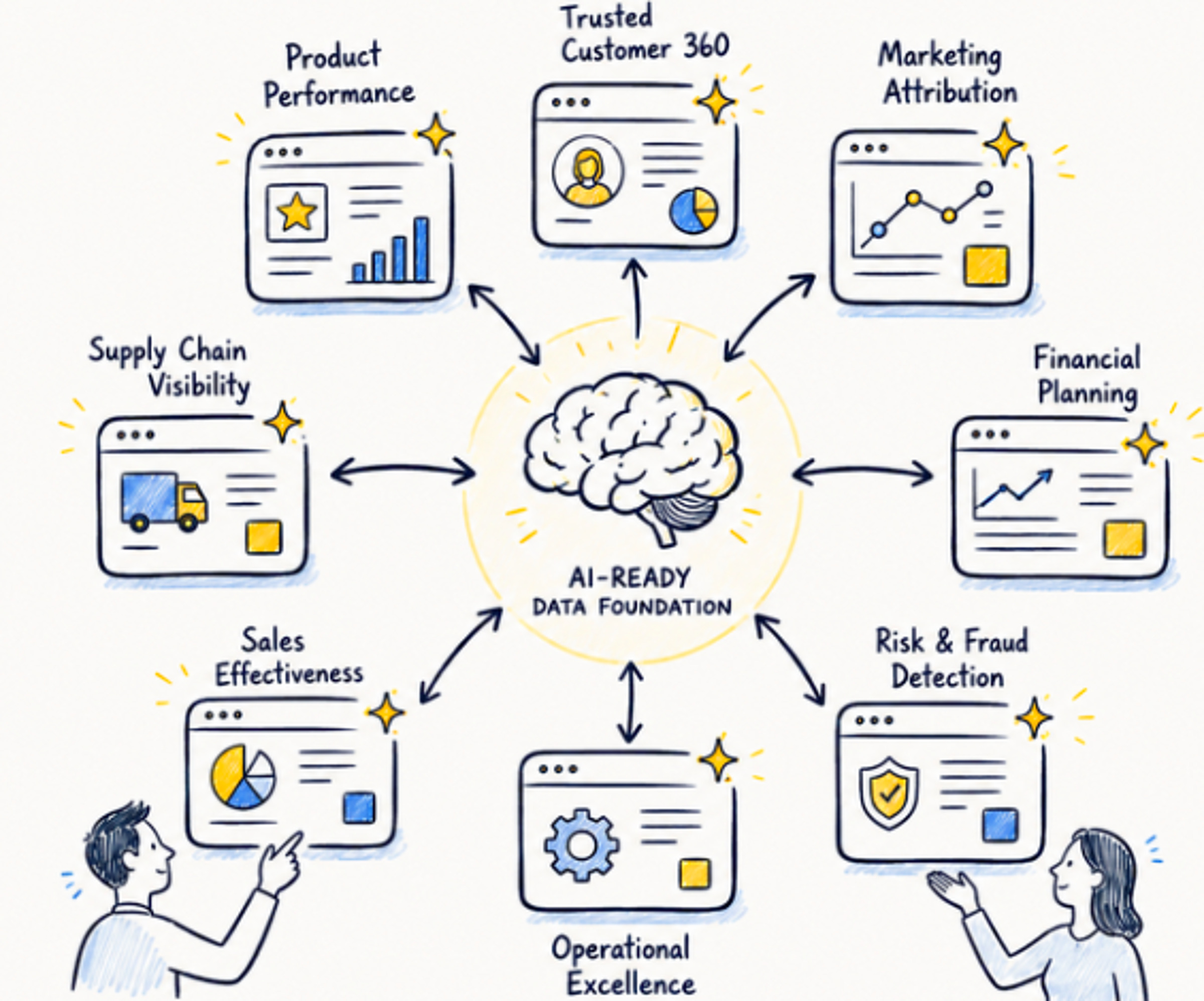
From Data to Decisions — Faster

AI-Ready Data Foundation at the center, connecting Trusted Customer 360, Product Performance, Marketing Attribution, Supply Chain Visibility, Financial Planning, Sales Effectiveness, Operational Excellence, and Risk & Fraud Detection.
Figure 1

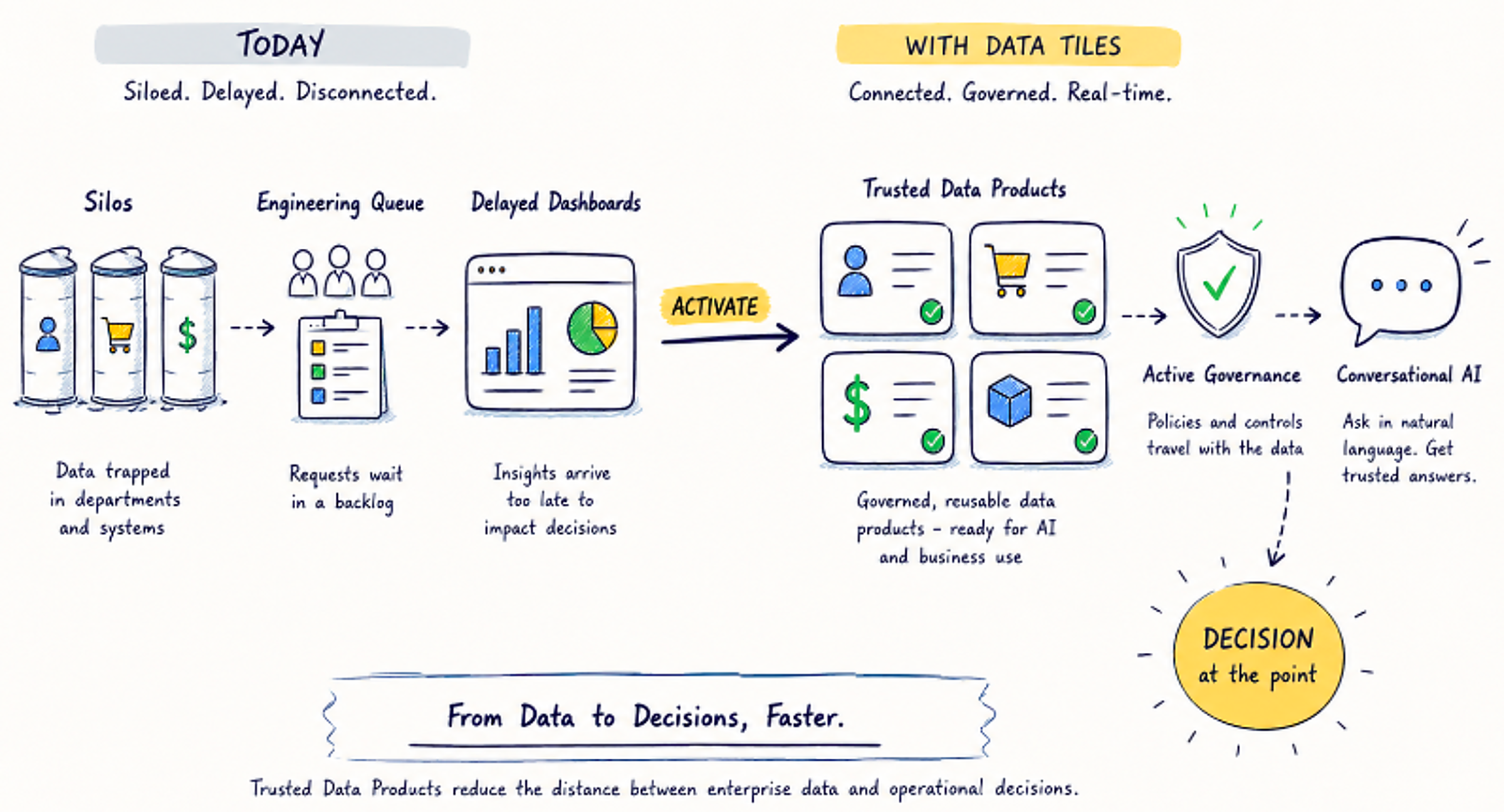
From Data to Decisions, Faster.

Trusted Data Products reduce the distance between enterprise data and operational decisions.

Context

The evolution of enterprise data.

Every era of enterprise data architecture solved a different problem. The current era is solving for trusted, AI-ready operational decisions.

FIGURE 2

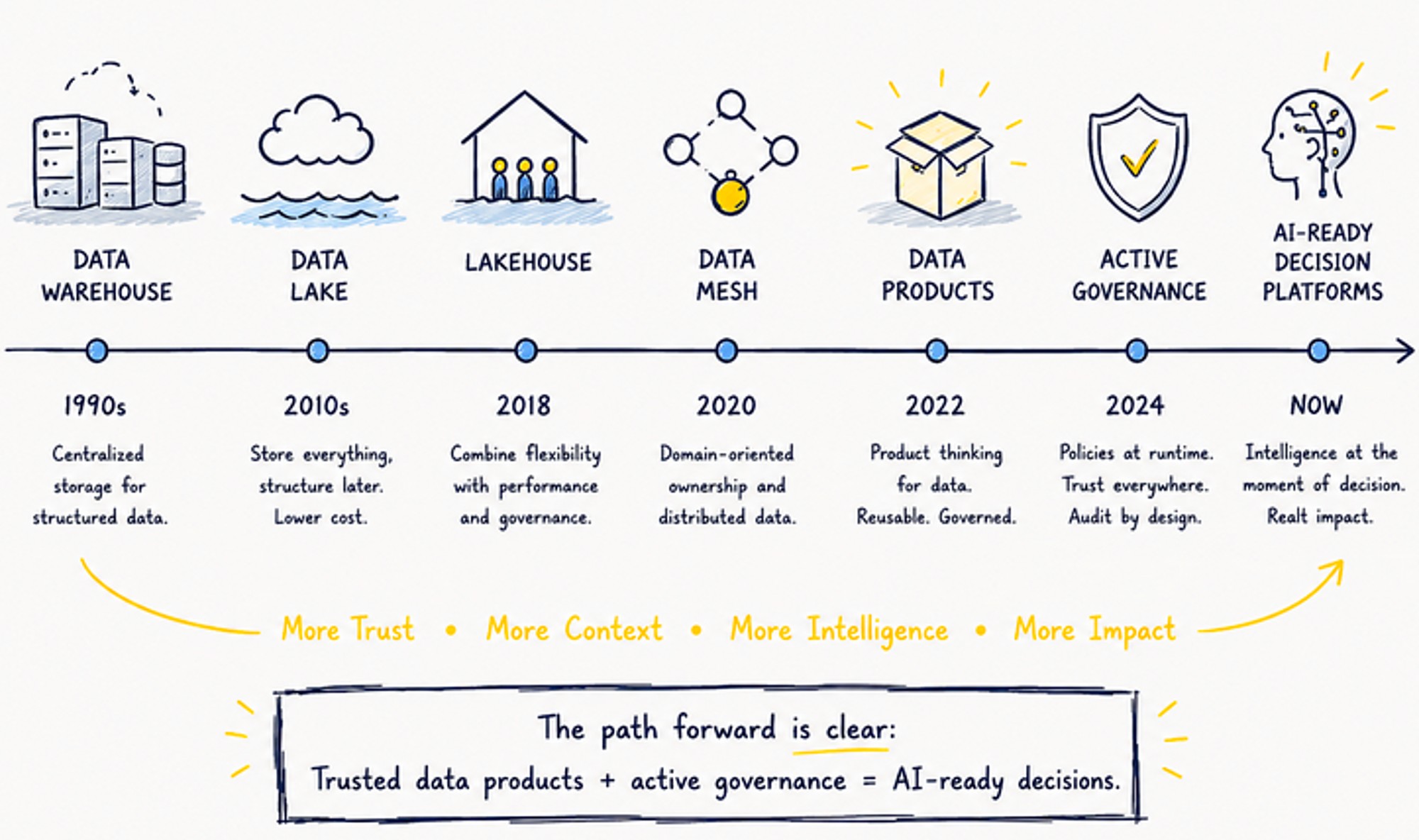
The Evolution of Enterprise Data

The Evolution of Enterprise Data — timeline from Data Warehouse (1990s), Data Lake (2010s), Lakehouse (2018), Data Mesh (2020), Data Products (2022), Active Governance (2024), to AI-Ready Decision Platforms (Now).
Figure 2

The Evolution of Enterprise Data.

Each era added capability. The current era adds trust, at runtime, for AI.

Foundation

AI-ready data foundations.

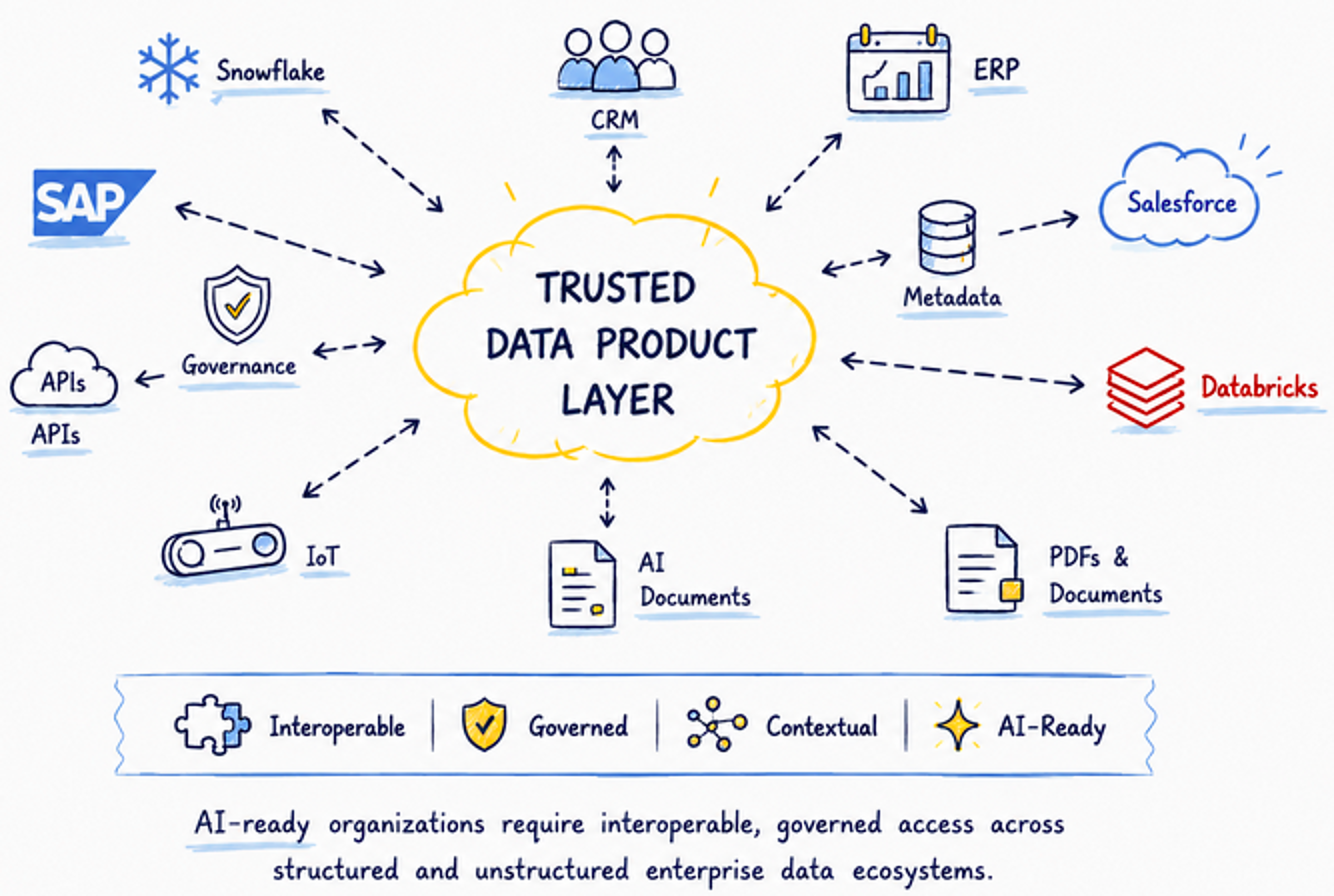
AI does not eliminate architectural complexity. It amplifies the importance of governed interoperability, trusted metadata, and reusable operational data products.

FIGURE 3

AI-Ready Data Foundations

AI-Ready Data Foundations — Trusted Data Product Layer connecting sources surrounded by Governance, Metadata, AI and Interoperability
Figure 3

AI-Ready Data Foundations.

A Trusted Data Product Layer connects every source, surrounded by governance, metadata, AI and interoperability.

The Eight Steps

A practical sequence for executive teams.

01
Step 01

Start With the Decision

Anchor every data product to the business decision it changes.

The most common failure in enterprise data is building beautiful pipelines that never reach a decision. Trusted data products are designed in reverse: start with the call a business needs to make, then assemble the data, signals, and governance that make it confident.

Decision-first scoping forces clarity on owners, timing, and consequence. It also collapses ambiguity about what “done” looks like, because the data product is only finished when the decision is faster, safer, or smarter than it was before.

If a data product does not change a decision, it is not a product. It is a report.
02
Step 02

Identify the Data Product Opportunity

Find the high-value decisions where trust, speed, and governance compound.

Not every decision deserves a data product. The high-leverage opportunities cluster where the same question is asked repeatedly, where the underlying data is fragmented across systems, and where the cost of being wrong is operational, not theoretical.

A short portfolio review across customer, supply, risk, and finance domains usually surfaces a dozen candidates. The discipline is to choose the few where a governed, reusable product unlocks a long tail of downstream value.

70%
of enterprise decisions still rely on ad-hoc extracts
3x
reuse multiplier on a well-scoped data product
03
Step 03

Build an AI-Ready Data Foundation

AI does not change the laws of data. Trust, lineage, and context still rule.

AI inherits the quality, bias, and blind spots of the data underneath it. An AI-ready foundation is one where data products carry their own metadata, lineage, semantics, and policy context, so any downstream model or agent can reason about what it is using and why it can trust it.

This is the difference between AI that generates plausible answers and AI that produces defensible decisions. The foundation does not need to be perfect, but it must be governed, interoperable, and inspectable by design.

An AI strategy without a trusted data foundation is a press release waiting to fail.
04
Step 04

Activate Governance at Runtime

Move governance from PDF policy to runtime control.

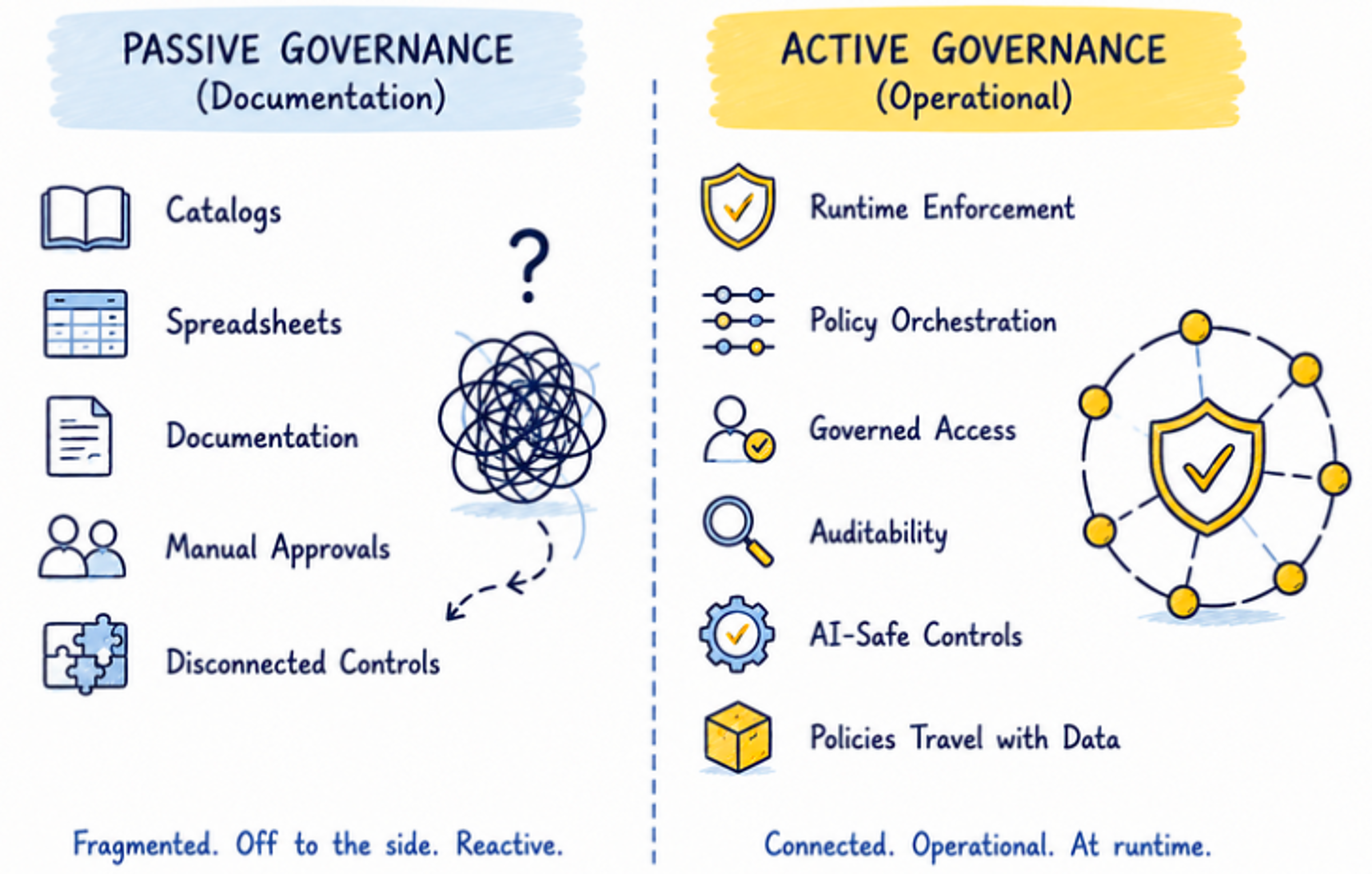
Most enterprises have governance documented. Few have governance enforced. Active Governance is the shift from passive catalogs and spreadsheets to runtime policy orchestration that travels with the data product, regardless of where it is consumed.

Done well, governance becomes invisible to the business and undeniable to the regulator. It accelerates use rather than blocking it, because trust is established once and inherited everywhere.

FIGURE 4

Passive Governance vs Active Governance

Passive Governance (catalogs, spreadsheets, documentation, manual approvals, disconnected controls) versus Active Governance (runtime enforcement, policy orchestration, governed access, auditability, AI-safe controls, policies travel with data).
Figure 4

Passive Governance vs Active Governance.

Active Governance moves controls from the document to the runtime.

05
Step 05

Bring AI to the Data Product

Conversational interfaces close the last mile between data and decision.

The dashboard is no longer the destination. With a trusted data product as the substrate, AI brings retrieval, summarization, and explanation directly into the flow of work, in language the business already uses.

The result is a decision experience: ask a question, receive a governed answer, see the lineage and the policies that shaped it, act with confidence.

10x
reduction in time-to-insight when AI sits on governed products
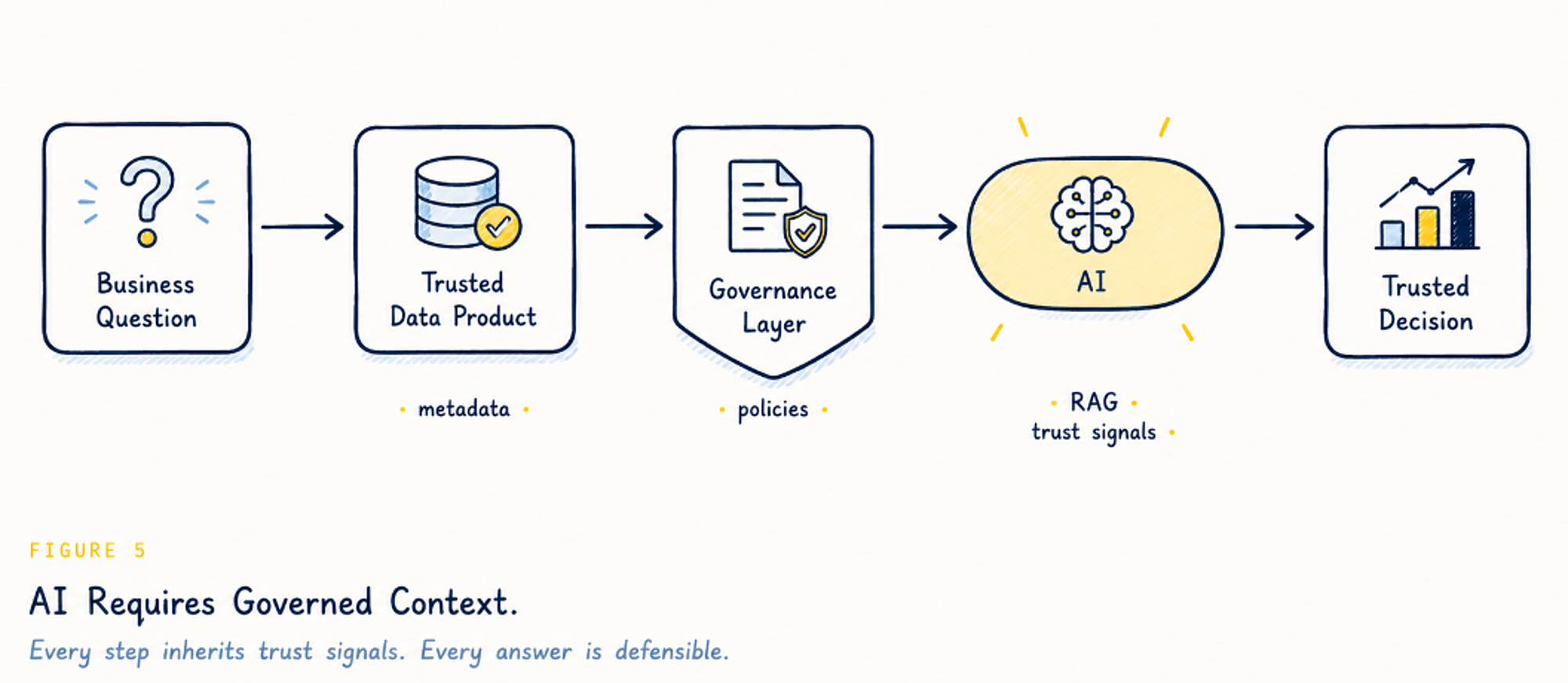
FIGURE 5

The Trusted Data Product Platform

AI Requires Governed Context — Business Question flows through a Trusted Data Product and Governance Layer into AI, producing a Trusted Decision. Every step inherits trust signals.
Figure 5

The Trusted Data Product Platform.

Sources, governance, and consumers connected through a single trusted layer, with active governance, quality, observability, scale, and openness underneath.

06
Step 06

Enable Business-Led Product Creation

The business builds. Engineering enables. Governance is the floor, not the ceiling.

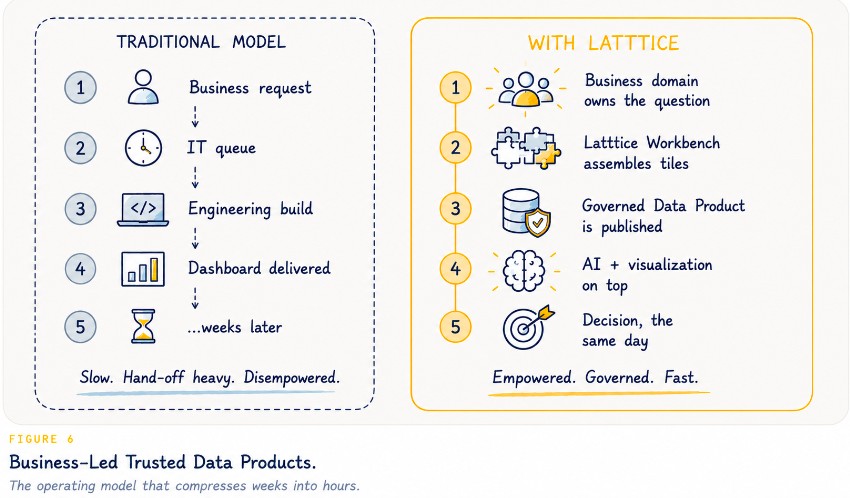
Trusted data products are not engineering projects in disguise. The operating model that works at scale puts the business domain in the driver’s seat, with a workbench that lets domain experts assemble, govern, and publish products themselves.

Latttice is purpose-built for this moment: a zero-code workbench where business teams compose trusted data products, with governance, lineage, and AI-readiness wired in from the first click.

When the business builds the data product, the data product finally sounds like the business.
FIGURE 6

Business-Led Trusted Data Products

Business-Led Trusted Data Products — Traditional Model (business request → IT queue → engineering build → dashboard delivered → weeks later) vs With Latttice (business domain owns the question → Latttice Workbench assembles tiles → Governed Data Product is published → AI + visualization on top → decision, the same day).
Figure 6

Business-Led Trusted Data Products.

The operating model that compresses weeks into hours: empowered, governed, fast.

07
Step 07

Measure Decision Impact

Instrument the decisions, not just the pipelines.

Pipeline uptime and table freshness are necessary but not sufficient. The metric that matters is decision impact: how many decisions were made faster, with higher confidence, with fewer reworks, because a trusted data product was available at the point of need.

Mature programs treat decision impact like product analytics, complete with usage cohorts, friction signals, and a continuous loop back into product design.

47%
of executives cannot trace AI outputs back to source decisions*
08
Step 08

Scale Through Trusted Data Products

Compound value by treating data products as a portfolio, not a project.

Scale is not about producing more data products. It is about producing reusable, composable, and discoverable ones. Each governed product becomes a building block for the next, with AI and analytics layered on top of a shared, trusted substrate.

This is how enterprises move from one-off wins to a true data product ecosystem, where new decisions can be assembled in days instead of quarters.

FIGURE 7

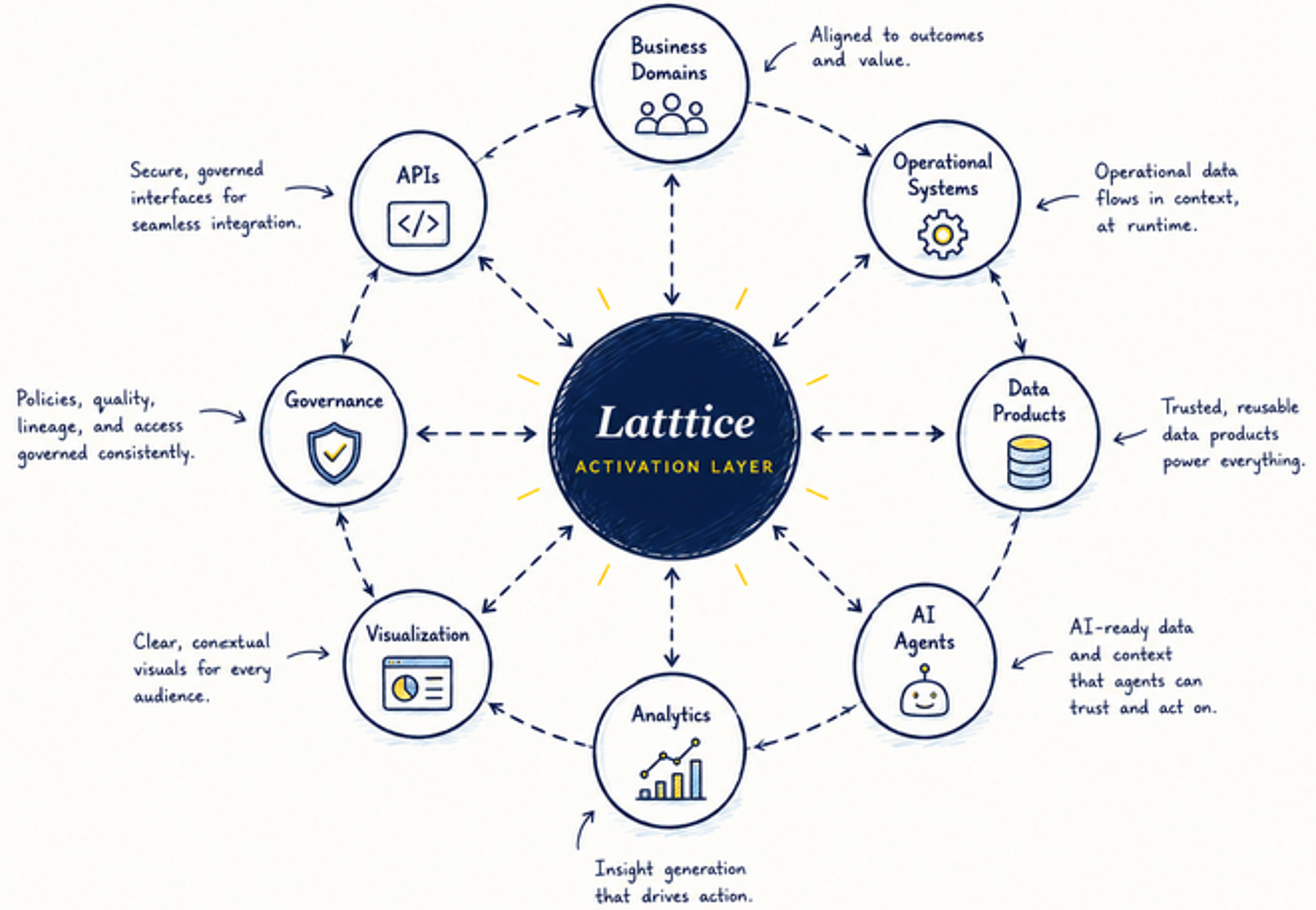
The Trusted Data Product Ecosystem

Latttice Activation Layer — connecting Business Domains, Operational Systems, Data Products, AI Agents, Analytics, Visualization, Governance, and APIs
Figure 7

The Trusted Data Product Ecosystem.

Latttice sits centrally as the activation layer for a connected, governed, AI-ready ecosystem.

Realizm

Why most data product initiatives stall.

The honest picture across the market is that the majority of data product programs plateau within their first eighteen months. The technology is rarely the reason. The pattern is structural.

Initiatives are launched as engineering deliveries, not as business products. Governance is documented but never enforced at runtime. AI is layered onto fragmented architectures in search of a thesis. Adoption stays low even when investment is high, because the work was never anchored to a decision the business was waiting to make.

FIGURE 8

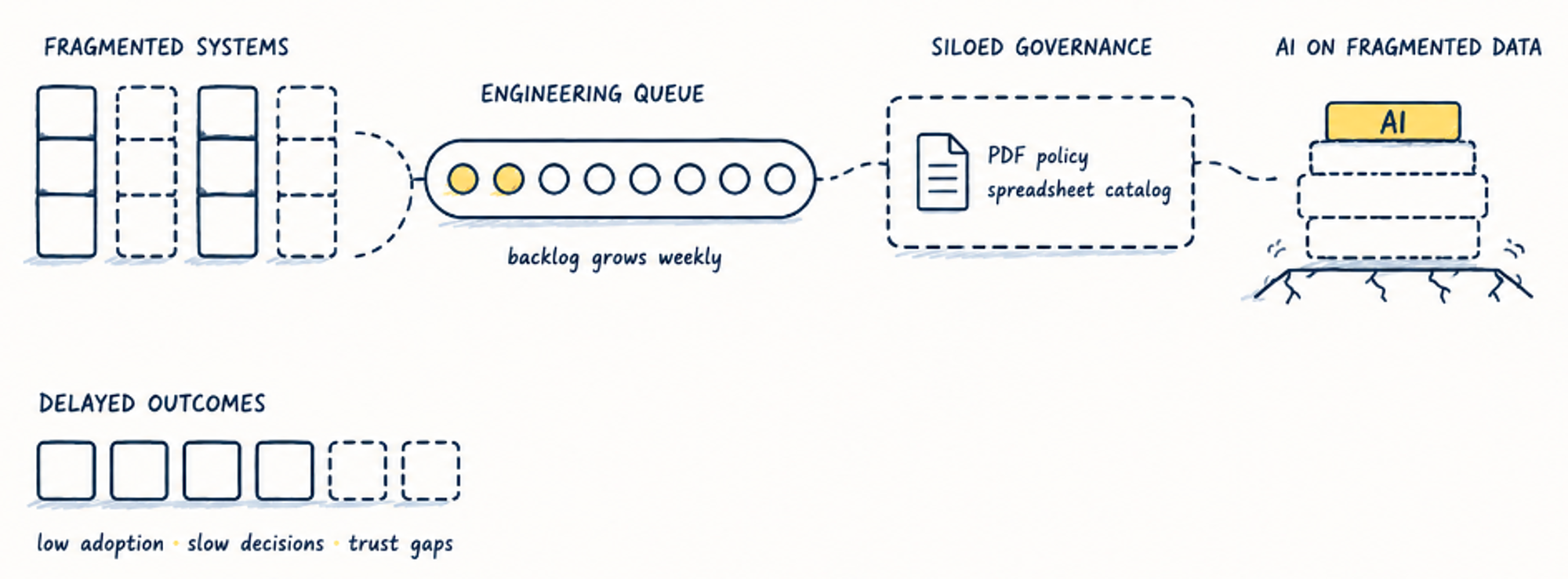
Traditional Failure Patterns

Traditional failure patterns — fragmented systems, clogged engineering queue, siloed governance, AI on fragmented data, and delayed outcomes
Figure 8

Traditional Failure Patterns.

Fragmented systems, clogged engineering queues, siloed governance and AI layered on shaky foundations.

Executive Pause

Trust is the new data strategy.

AI amplifies the quality of the data beneath it, for better, or for worse.

The Shift

From dashboards to decision experiences.

The industry is moving past the dashboard. Static reports and refresh schedules are giving way to governed decision experiences: conversational, contextual, operational, and trusted by design.

In this model the question is asked in language the business already uses, the answer arrives with its lineage and policies attached, and the next action is shaped, not just observed.

Dashboards reported the past. Decision experiences shape the next action.
FIGURE 9

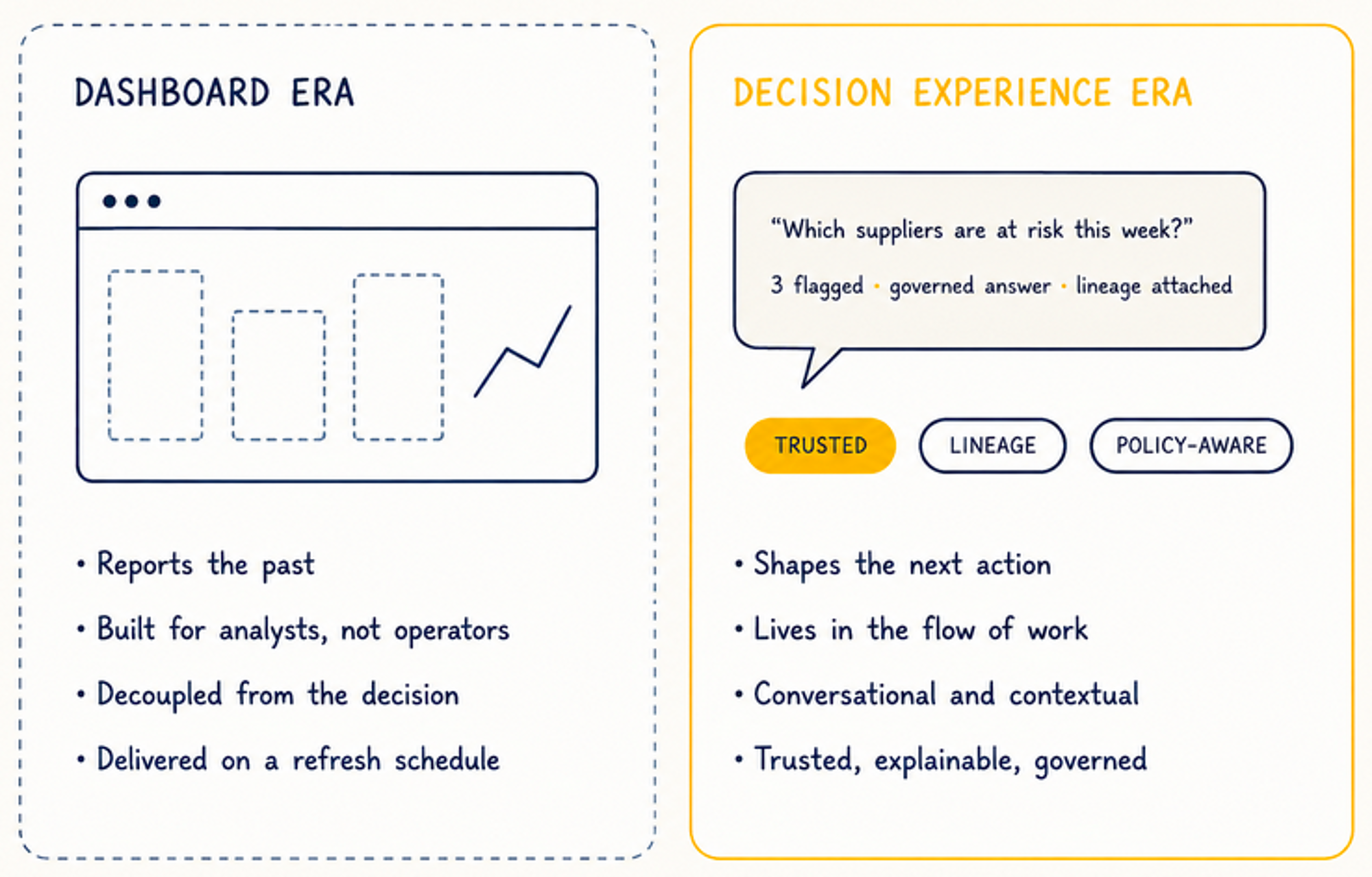
Dashboard Era vs Decision Experience Era

Dashboard Era vs Decision Experience Era — reports of the past versus conversational, governed, trusted decision experiences
Figure 9

Dashboard Era vs Decision Experience Era.

One reports. The other decides.

Differentiator

Active governance is becoming the missing layer.

Most enterprises have policy. Far fewer have policy that executes. Active Governance is the operational layer that turns documented intent into runtime enforcement, across every data product, every AI agent, every downstream consumer.

Policies travel with the data. Access controls evaluate context. Lineage and trust signals are inherited by every model and every answer. Governance becomes a tailwind for AI, not a checkpoint behind it.

FIGURE 10

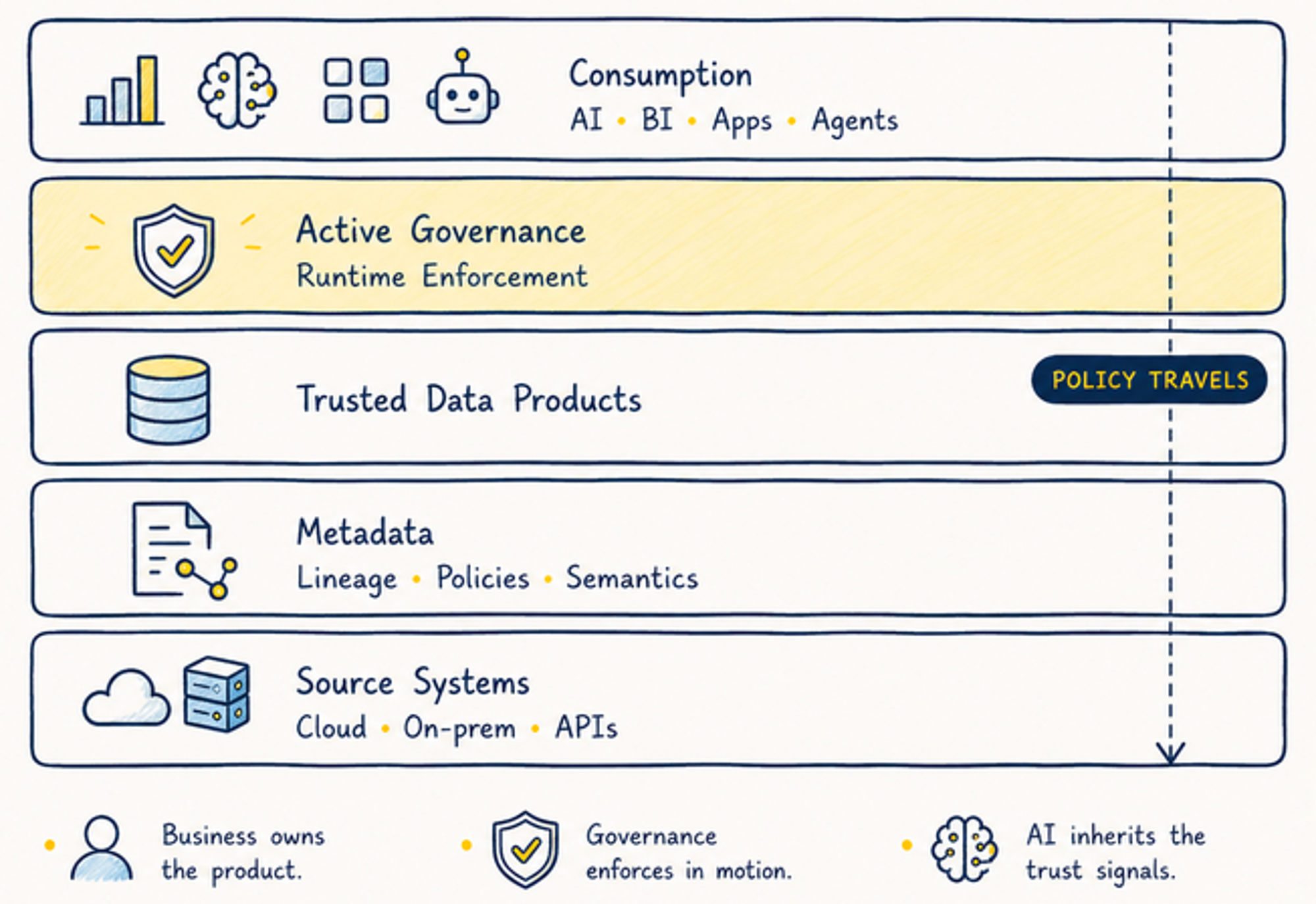
Active Governance Architecture

Active Governance Architecture — consumption, active governance runtime enforcement, trusted data products, metadata, and source systems with policy travelling across the stack
Figure 10

Active Governance Architecture.

Metadata, lineage, policies and AI controls operating as a connected runtime, not a sidecar.

Operating Model

The operational data product model.

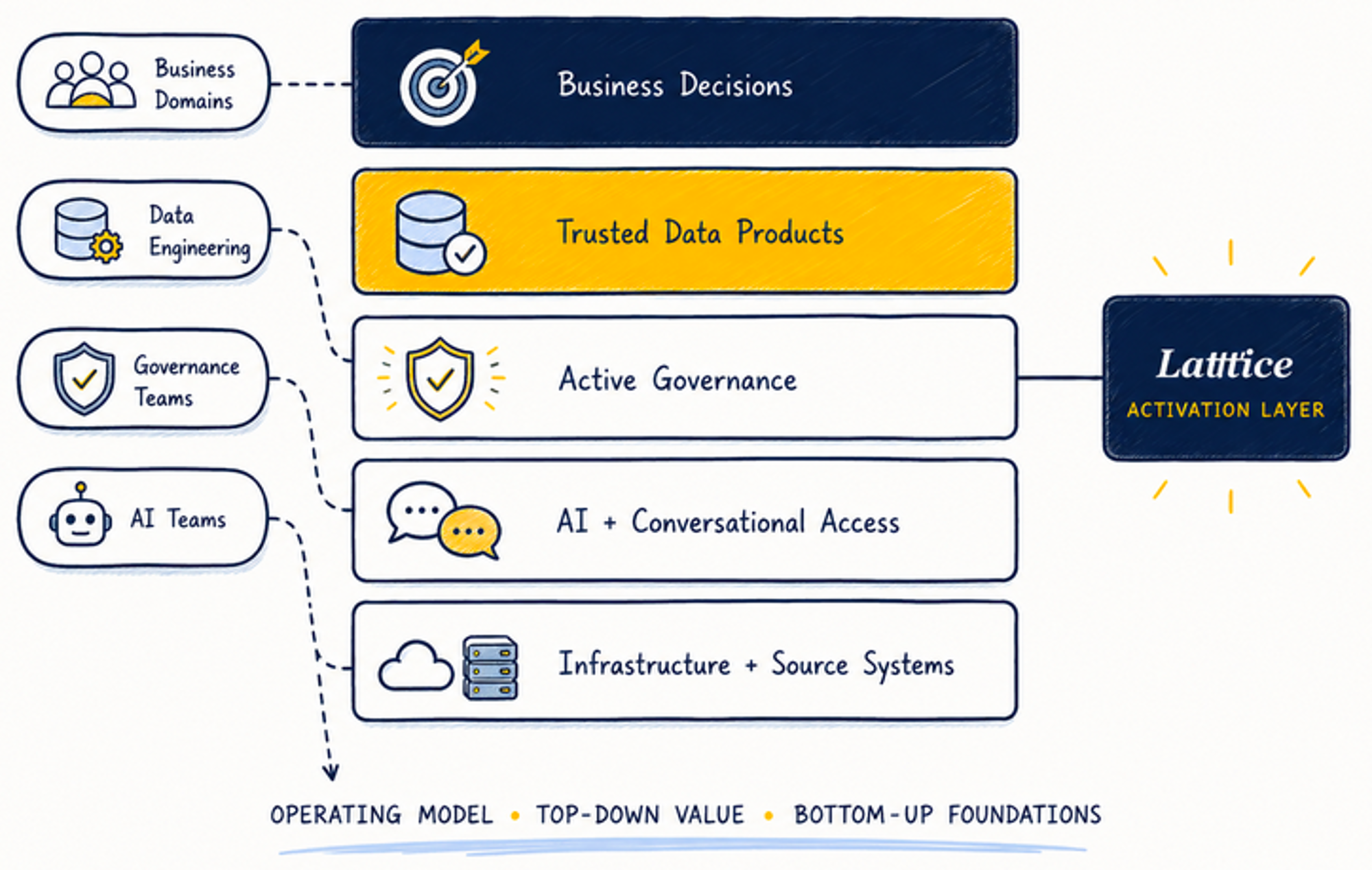
Executives need to see how trusted data products actually operate inside the enterprise. The model is layered: business decisions on top, source systems at the base, with active governance and AI access as the connective tissue.

Domains own the questions. Engineering enables the platform. Governance teams set the policies that travel with the data. AI teams compose on top of products they did not have to rebuild.

Latttice sits across this stack as the activation layer: the workbench that lets business teams compose, govern, and publish trusted data products without writing code.

FIGURE 11

The Operational Data Product Model

The Operational Data Product Model — layered stack from infrastructure to business decisions with Latttice as the activation layer
Figure 11

The Operational Data Product Model.

A layered operating model with Latttice as the activation layer between domains, governance, AI and infrastructure.

In Practice

What this looks like on the operational floor.

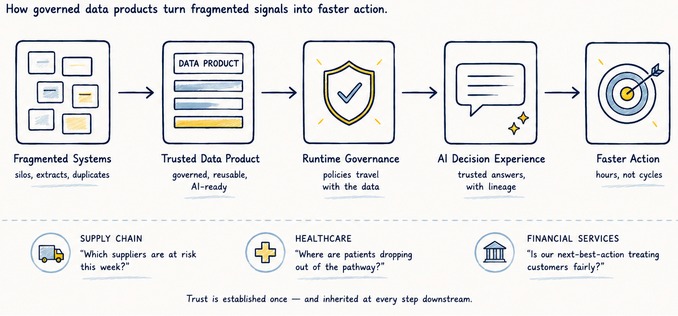
Across sectors, the same pattern repeats. A business question is asked. Trusted data products answer it with governed context. Runtime governance ensures the answer can be defended. AI inherits the trust. The decision is acted on, in hours, not cycles.

The examples below are deliberately operational. They are not pilots or demos. They are the shape of work once trusted data products are part of the everyday operating fabric.

FIGURE 12

Trusted Decision Flow

Trusted Decision Flow — Fragmented Systems to Trusted Data Product to Runtime Governance to AI Decision Experience to Faster Action, with Supply Chain, Healthcare and Financial Services callouts.
Figure 12

Trusted Decision Flow.

From fragmented systems to faster business action. Trust established once, inherited at every step downstream.

Supply Chain

Supplier risk, answered in the meeting.

Fragmented
ERP, procurement, logistics and external risk feeds spread across four systems.
Trusted Product
A governed Supplier Risk product combining tier-1 commitments, on-time performance and external signals.
AI Asks
“Which suppliers are at risk this week, and where is the exposure?”
Governed Answer
A ranked list with lineage to source systems and a clear policy trail.
Outcome
Mitigation decisions made in hours rather than the next review cycle.
Healthcare

Care pathway visibility, without compromising consent.

Fragmented
EMR, scheduling, claims and patient-reported data sitting in separate domains.
Trusted Product
A Care Pathway product with consent and de-identification policies enforced at runtime.
AI Asks
“Where are patients dropping out of the pathway, and why?”
Governed Answer
A governed cohort view with audit-ready evidence of policy compliance.
Outcome
Earlier intervention, with regulators satisfied by design.
Financial Services

Customer treatment that an auditor can defend.

Fragmented
Core banking, CRM, risk and complaints, owned by different functions.
Trusted Product
A Customer 360 product with fair-treatment policies and explanation requirements built in.
AI Asks
“Is our next-best-action treating these customers fairly?”
Governed Answer
An explainable recommendation with the policy logic visible to the operator.
Outcome
Faster commercial decisions, stronger conduct posture.
Urgency

Why this matters now.

Four pressures are now compounding at the same time across the enterprise.

Executive pressure from Boards and CEOs to operationalize AI. Business pressure from domains expected to increase revenue, reduce cost, and improve decisions using AI. Regulatory pressure demanding stronger governance, traceability and accountability. And operational pressure on technology teams expected to deliver all of this while doing more with less.

None of these pressures are slowing down.

The organizations that move first to a trusted, governed, AI-ready operating model buy themselves room to maneuver. Those that wait will spend the next cycle retrofitting governance, rebuilding trust, and scaling AI on fragmented foundations.

Executive Pressure

Boards and executive teams increasingly expect measurable AI outcomes tied directly to operational performance, competitive responsiveness and enterprise productivity.

— McKinsey / Gartner / IDC

Business Pressure

Business domains are under growing pressure to improve operational efficiency, increase revenue and reduce decision latency through AI-enabled workflows and trusted data access.

— Deloitte / Forrester

Regulatory Pressure

High-risk AI use cases will require documented governance, traceability and human oversight throughout the AI lifecycle.

— European Union — EU AI Act

Operational Pressure

Technology teams are increasingly expected to operationalize AI, governance and interoperability while managing growing complexity with constrained resources.

— IDC / Gartner / Thoughtworks

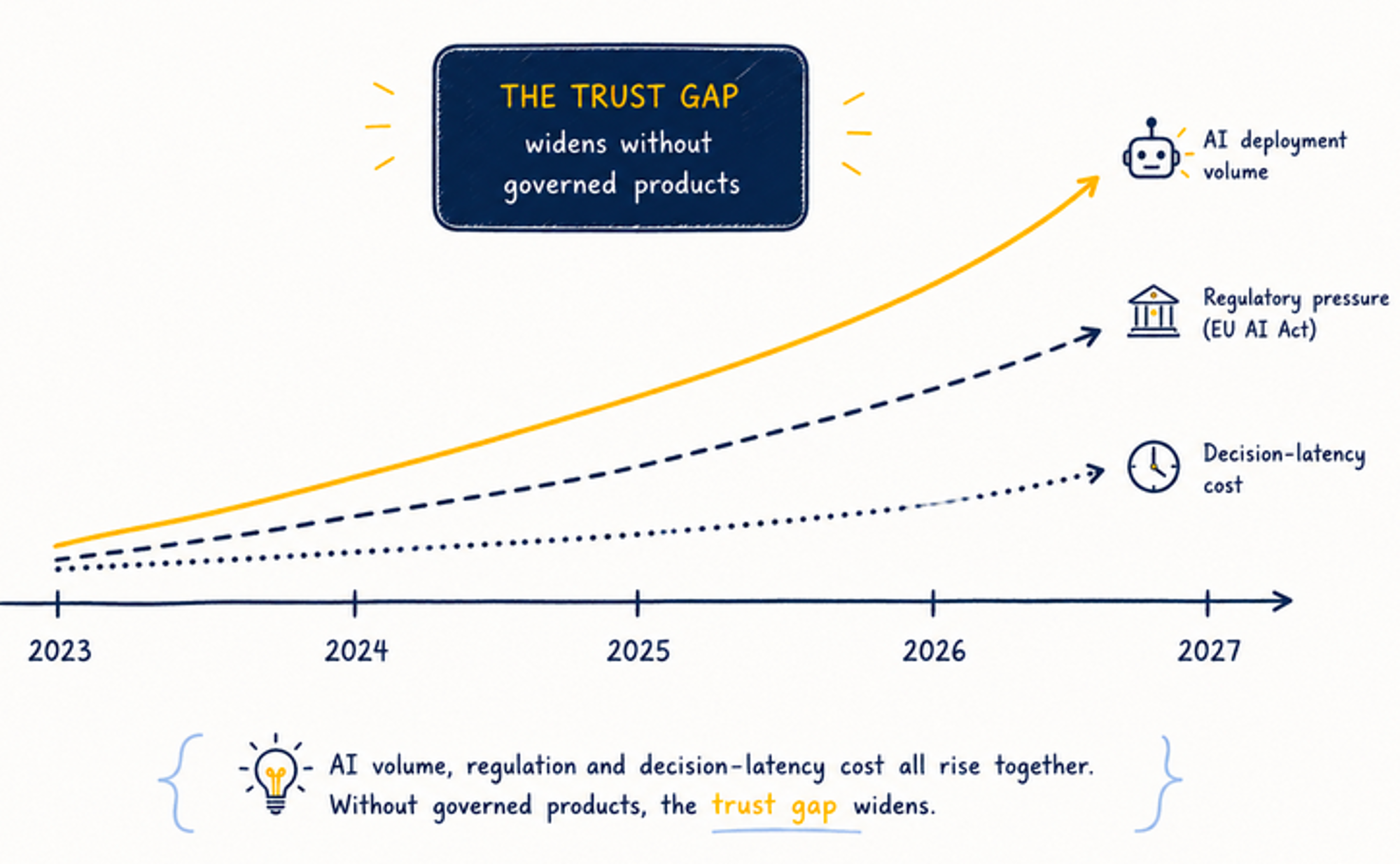
FIGURE 13

The Trust Gap Widens

The Trust Gap Widens — AI deployment volume, regulatory pressure and decision-latency cost rising together from 2023 to 2027
Figure 13

The Trust Gap Widens.

AI volume, regulation and decision-latency cost all rise together. Without governed products, the trust gap widens.

Executive Pause

The future belongs to organizations that can act at the moment of decision.

Not the ones with the most data. The ones whose teams can move, with confidence, when the moment arrives.

Closing Perspective

The Future Is Decision-Driven.

The enterprises that will define the next decade are not the ones with the loudest AI announcement. They are the ones whose teams can act, at the moment of decision, with data they trust and governance they can prove.

Trusted data products are how that future gets built. One decision, one domain, one governed product at a time.

Cameron Price, Data Tiles
Author

Join a Data Conversation,
Cameron Price.

Cameron is the founder of Data Tiles and a long-standing voice in the enterprise data and governance community. He works with executive teams to translate data ambition into operating reality, with a particular focus on business-led data products, Active Governance, and the path to trusted AI at the point of decision.

Start a conversation
Executive Companion

Executive Blueprint.
Trusted Data Product Planning Template

This one-page executive blueprint is designed to help leadership teams identify, prioritize, and operationalize trusted data products that improve decisions, accelerate AI readiness, and activate governance at runtime.

  • Trusted Decision Flow — fragmented systems to faster action.
  • The 8 executive steps, each framed as a single planning question.
  • Business Planning Canvas — decision, owner, friction, sources, governance, metrics.
  • Operating Model Shift — traditional path versus the Latttice path.
Download the Blueprint (PDF)Take the Readiness Assessment Workshop-ready · A4 landscape · Printable

The enterprises leading the next decade will not be the ones with the most data. They will be the ones whose teams can act confidently at the moment of decision.

Trusted data products make that possible.

References

Sources and further reading.

A curated set of research, regulatory, and practitioner sources informing the perspectives in this guide.

Analyst Research
  • 01
    Gartner
    Research on Data Products, Active Metadata and Decision Intelligence.
  • 02
    IDC
    Operational Data Governance and AI Adoption Studies.
  • 03
    Forrester
    Trusted AI, Data Governance and Active Metadata Management.
  • 04
    BARC
    Data, BI & Analytics Trend Monitor — Data Products and Governance.
Consulting Perspective
  • 01
    McKinsey & Company
    Generative AI Readiness and the Data-Driven Enterprise.
  • 02
    Deloitte
    Trustworthy AI and the Modern AI Operating Model.
  • 03
    Thoughtworks
    Technology Radar — Data Mesh, Data Products and Policy-as-Code.
Regulatory & Standards
  • 01
    NIST
    AI Risk Management Framework (AI RMF 1.0).
  • 02
    European Union
    Regulation on Artificial Intelligence (EU AI Act).
Practitioner Voices
  • 01
    Sanjeev Mohan
    Independent industry analysis on Data Products and AI governance.
  • 02
    Mike Ferguson
    Research and practitioner guidance on Data Mesh and governed AI.
  • 03
    John Santaferraro
    Industry commentary on decision intelligence and operational analytics.

Indicative figures and industry perspectives cited throughout this guide are drawn from a synthesis of the sources above and Data Tiles field engagements. Full citations are available on request.

Next

Trusted Data at the Point of Decision.

Three ways to take the next step.