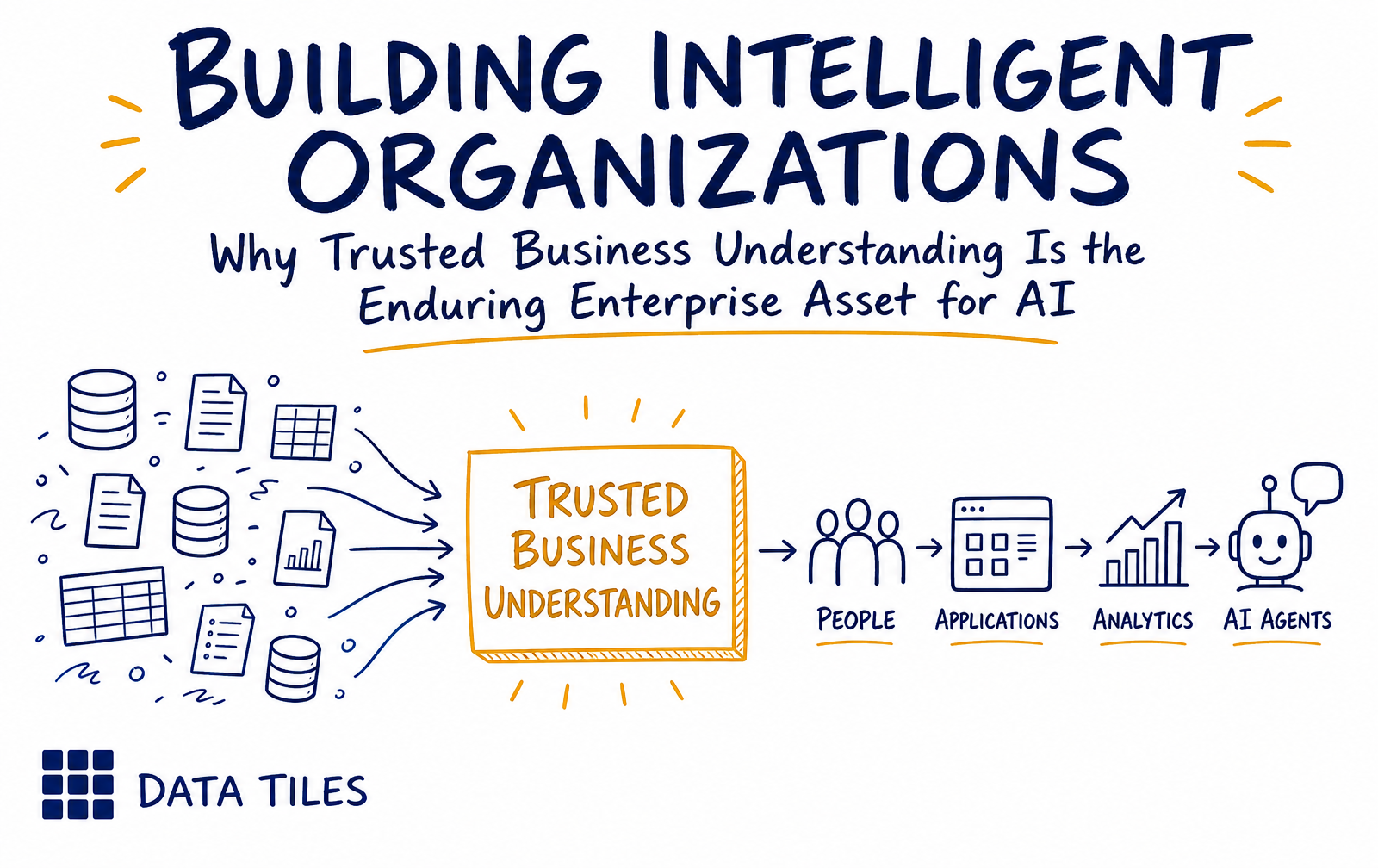
Building Intelligent Organizations
Why Trusted Business Understanding Is the Enduring Enterprise Asset for AI

From Intelligent Agents to Intelligent Organizations
The first era of enterprise artificial intelligence was about building intelligent agents. The next will be about building intelligent organizations.
Across government, financial services, healthcare, manufacturing and retail, AI has quietly crossed the line from experiment to operation. Agents summarize, classify, analyze, recommend and act. The technology works, and it works well enough that the interesting questions have moved elsewhere.
What executives are discovering is that the harder problem was never the intelligence of the machine. It is the clarity of the enterprise. Every successful deployment depends on something the model cannot supply: whether the organization can express, govern and share what its own information actually means. Artificial intelligence does not consume information. It consumes understanding.
That distinction is the subject of this essay. The argument is simple, and its consequences are not. The reusable unit of enterprise intelligence is not the AI agent. It is trusted business understanding, and it is becoming the most enduring asset an enterprise can own.
Enterprise AI Has Reached a Turning Point
Two years ago most enterprise AI conversations were about feasibility. Today they are about proliferation. Boards are no longer asking whether an agent can be built. They are asking how many the organization should run, who is accountable for them, and how quickly the next one can be delivered. Gartner now describes the resulting condition as AI agent sprawl, predicting that by 2028 the average global Fortune 500 enterprise could have more than 150,000 agents in use, up from fewer than 15 in 2025. That is a remarkable acceleration, but it also illustrates the scale of the management challenge emerging alongside it. Enterprises are learning to manufacture intelligence faster than they can supervise it. [1]
This is genuine progress, and it deserves to be recognized as such. Model quality has improved sharply. Tooling has matured. The cost of assembling a competent agent has collapsed to the point where capability that once required a research team can now be produced by a product team in weeks. In most large organizations, building AI is no longer the difficult part.
What remains difficult is everything the AI leans on. Ask an agent a question about revenue, risk exposure, customer churn or supply performance, and it immediately needs to know which definition of revenue applies, which customers are in scope, which policies restrict disclosure, and which source can be defended if the number is challenged. That knowledge exists. It sits in the heads of business experts, in local spreadsheets, in the unwritten reasoning behind a report someone built four years ago. It is almost never expressed in a form a system can consume.
So the bottleneck has moved, and it has moved in a direction most technology roadmaps did not anticipate. The constraint is no longer the intelligence of the model. It is the speed at which an enterprise can articulate itself. Most organizations can now build AI faster than they can explain themselves to it.
AI Consumes More Than Information
Enterprise technology has spent three decades operating on a comfortable assumption: that if information is accessible, it is usable. Warehouses, lakes, lakehouses, pipelines and integration layers were all built on that premise. Each generation made information easier to move and cheaper to store. None of them, on their own, made information easier to understand.
Artificial intelligence exposes that gap with unusual honesty. A model given access to a hundred tables will always produce an answer. It will be fluent, confident and structurally plausible. Whether it is correct depends entirely on whether the model understood what those tables meant, which business rules applied, who is accountable for the numbers, and whether that information was ever fit to be used for the question being asked. Gartner has been direct about the consequence: a lack of semantics is already contributing to inaccurate AI agents and wasted enterprise spending. [2]
This is what makes the current moment unlike previous data quality debates. A bad dashboard announces itself. Nobody trusts a chart that contradicts what they know. A bad agent does the opposite. It reassures. The organization does not receive an obviously wrong answer it can catch. It receives a confident answer it cannot verify, delivered at machine speed, into a decision that someone is about to make.
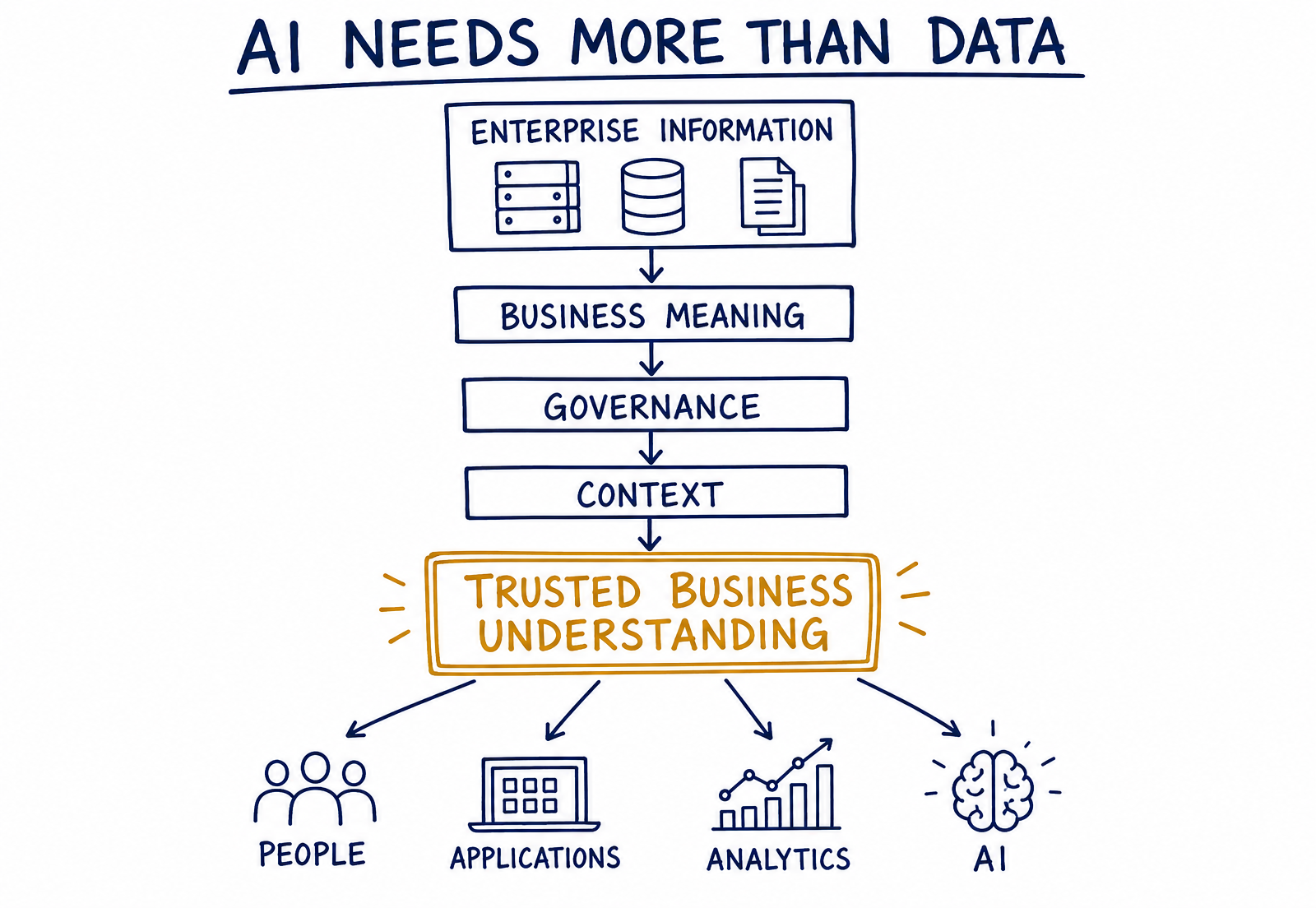
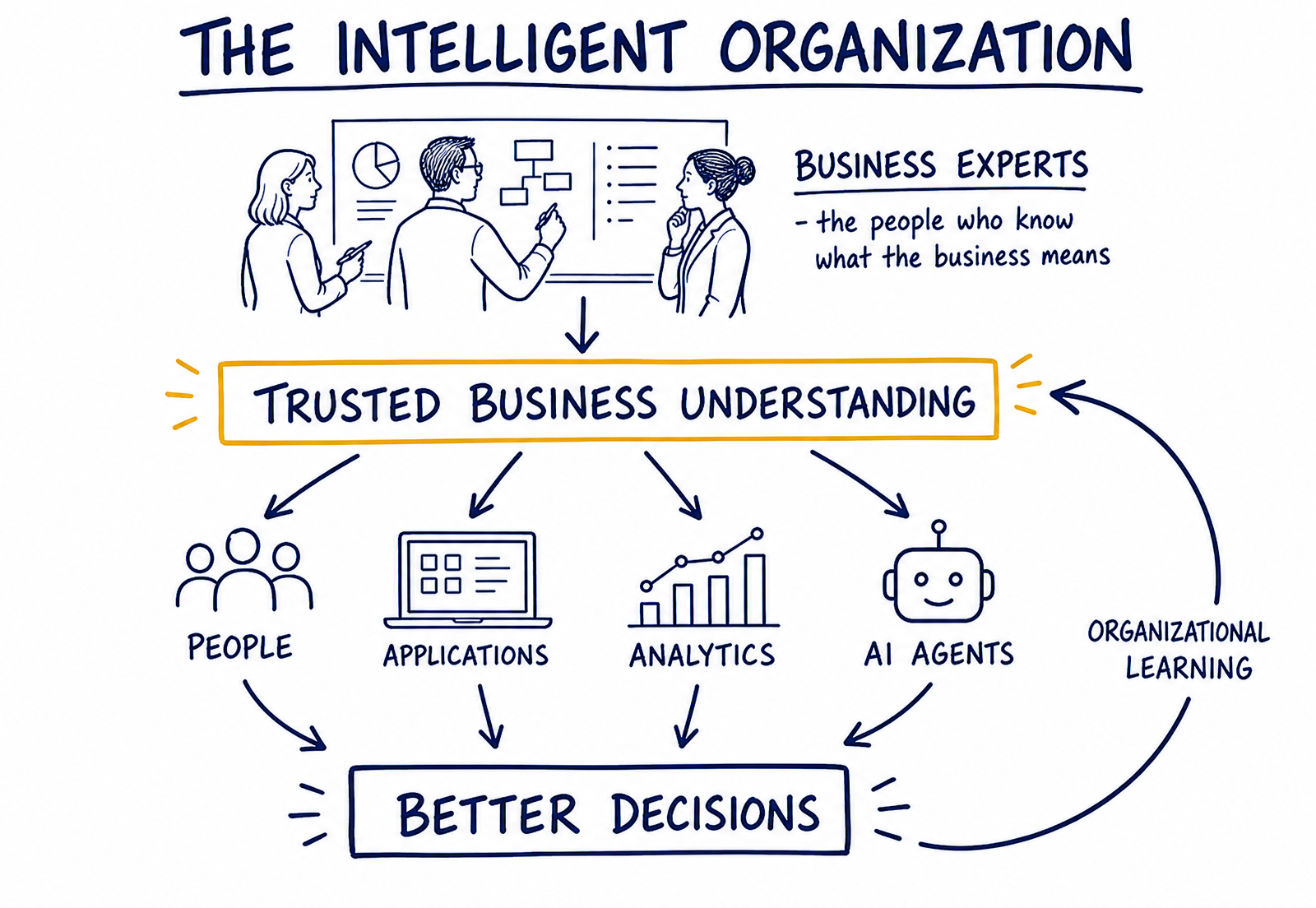
What AI actually consumes is business meaning, governance, context, semantics, ownership, lineage and demonstrated trust. Taken together, those elements form what I call trusted business understanding. It is the difference between information an organization holds and knowledge an organization can act on, and it is the only part of the stack that a model cannot generate on your behalf.
The industry is converging on this conclusion from multiple directions. Snowflake now describes Horizon Context as a governed context layer that turns metadata into business meaning so that AI agents, BI tools and applications can work from consistent definitions and relationships. [3] Microsoft describes Work IQ as an intelligence layer that builds a semantic understanding of the business and gives agents business context rather than raw data. [4] Google Cloud's Agentic Data Cloud similarly places governance, context and trusted enterprise data at the foundation of agentic systems, while Databricks is extending unified governance across data, applications and AI through Unity Catalog. [5][6] That convergence is worth noticing, because vendors rarely agree about anything. When they do, it usually means the market has found a constraint that no product can route around.
The Reusable Unit of Enterprise Intelligence
Every technology era has a reusable unit: the thing built once and leveraged many times. In the application era it was the service. In the cloud era it was the platform primitive. The reusable unit matters more than any individual project, because it determines where value accumulates and what survives once the projects are finished.
It is tempting to assume the reusable unit of the AI era is the agent. It is not. Agents are becoming the most disposable component in the enterprise stack. They are cheap to build, easy to replace and routinely retired the moment a better model, vendor or interface appears. An organization running two hundred agents without shared understanding has not built an asset. It has built two hundred private interpretations of itself, each one confident, none of them reconciled.
What endures beneath every agent is the understanding it depends on. The definition of an active customer. The policy that governs how a claim may be assessed. The lineage that proves a number can be defended to a regulator. That understanding outlives the model, the platform and the program that funded it. It is the only layer in the modern enterprise that compounds.
The commercial problem is that most organizations rebuild it continuously. Each report re-derives its own definitions. Each integration re-encodes business rules that already exist somewhere else. Each new AI initiative begins by asking the same business experts the same questions they answered eighteen months ago for a different project. Knowledge is created, consumed once and quietly discarded, and because the cost is distributed across every team, no one ever sees the invoice.
At the pace of quarterly reporting, that inefficiency was survivable. At the pace of AI it is structural. When an enterprise intends to run hundreds of intelligent capabilities against its own information, rebuilding understanding for each one is not waste. It is the ceiling.
"The reusable unit of enterprise intelligence is not the AI agent. It is trusted business understanding, and it is the only thing every future agent will inherit."
Building Intelligent Organizations
If understanding is the asset, the executive question changes shape. It is no longer how many agents to build. It is how the organization deliberately produces understanding at scale, in a form that both people and machines can consume.
This is the role of business-led data products. A data product is not a technical artifact wearing a friendlier name. It is the mechanism by which fragmented organizational knowledge becomes durable enterprise capability. The business experts who know what a term means, which policy applies and what good looks like define that understanding once. It is governed, versioned, owned and published. Everything downstream, whether a person, a dashboard, an application or an agent, consumes the same understanding instead of reconstructing it.
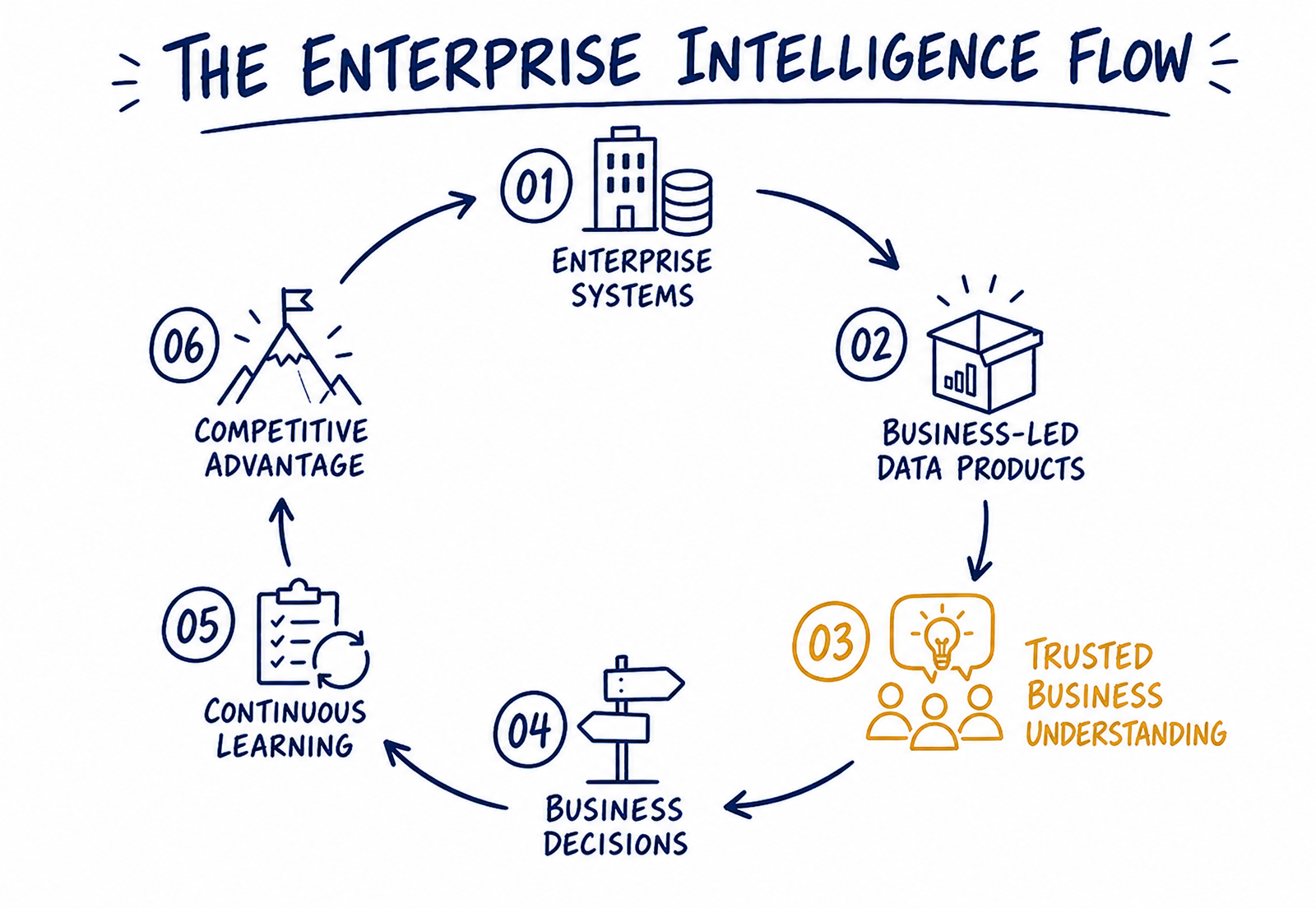
The economics are what make this strategic rather than architectural. When understanding is rebuilt each time, effort scales linearly with ambition and quality varies with whoever happened to be available. When understanding is captured as a reusable product, every new use case begins further forward than the last. The organization gets faster precisely because it has already done the thinking, and the thinking no longer leaves when the consultants do.
This also changes the character of governance. In an organization built on reusable understanding, governance stops being a checkpoint that delivery teams learn to route around and becomes the property that makes reuse safe. Ownership, policy and lineage travel with the understanding itself. Active governance means the more the organization reuses, the more governed it becomes, which is the exact inversion of how most enterprises experience control today.
Peter Senge's work on the learning organization argued more than three decades ago for the enduring importance of an organization's capacity to learn. [7] What has changed is that learning is no longer confined to people. When understanding is captured once and shared, the organization learns in a form its systems can also read. Institutional memory stops depending on who is still employed.
At Data Tiles we built Latttice as the practical implementation of this philosophy, a business activation layer that lets business people create trusted, governed data products without writing code, so that understanding can be produced at the speed AI now demands. But the philosophy outranks the platform. An organization that treats business understanding as an asset will outperform one that treats it as project overhead, whatever tools it eventually selects.
The Next Competitive Advantage
It is worth being precise about where advantage will not come from. It will not come from access to models, because access is becoming universal. It will not come from the number of agents deployed, because agents are becoming infrastructure. It will not come from being early, because being early to a capability everyone will hold is a position with a short shelf life.
Advantage will come from something considerably harder to acquire: an organization that understands itself better than its competitors understand themselves. That understanding is specific, accumulated and institutional. A competitor can license your model tomorrow morning. They cannot license your definitions, your policies, your lineage or the accumulated judgment behind them.
This is why intelligent organization is a description rather than a slogan. An intelligent organization is one where understanding is created by the people closest to the business, governed continuously, and reused by everyone and everything that makes decisions, so that each decision leaves the enterprise slightly more capable than it was that morning. Decision-driven enterprises are built this way, one reusable piece of understanding at a time.
There is a quieter implication for leadership. If understanding is the asset, then the executives who create the most enterprise value in this decade may not be the ones who sponsor the most AI. They will be the ones who insist that the business explain itself clearly, once, in a form the whole organization can inherit. That is unglamorous work. It is also the work that decides which organizations compound and which ones simply spend.
Every previous generation of enterprise technology rewarded organizations that accumulated more information. The AI era will reward organizations that accumulate better business understanding. Models will change, frameworks will be replaced, and today's platforms will look quaint within a decade. Trusted business understanding will still be there, because it was never a technology in the first place. It is the accumulated intelligence of the organization itself.
The opportunity in front of executives is not to deploy more AI. It is to build the understanding that makes AI worth deploying at all, and that will still be earning its keep long after the current generation of intelligence has been retired.
"The organizations that win this decade will not be the ones with the most intelligent AI. They will be the ones that became intelligent organizations while everyone else was buying agents."
Cameron Price, Founder & CEO, Data TilesCameron Price is the CEO and Founder of Data Tiles and the creator of Latttice, the AI-powered Data Product Workbench. With more than 30 years across data strategy, analytics, cloud, governance and enterprise transformation, Cameron writes on how organizations turn trusted business understanding into better decisions.
Connect with Cameron on LinkedInBuilding Intelligent Organizations
References
- Gartner. (2026). Gartner Identifies Six Steps to Manage AI Agent Sprawl. Gartner Newsroom, April 28, 2026. https://www.gartner.com/en/newsroom/press-releases/2026-04-28-gartner-identifies-six-steps-to-manage-artificial-intelligence-agent-sprawl
- Gartner. (2026). Gartner Says Lack of Semantics Causes Inaccurate AI Agents and Wasted Spending. Gartner Data & Analytics Summit, May 11, 2026. https://www.gartner.com/en/newsroom/press-releases/2026-05-11-gartner-data-and-analytics-summit-london-2026-day-1-highlights
- Snowflake. (2026). Snowflake Horizon Context: The Governed Context Layer for AI, BI and Apps. June 2, 2026. https://www.snowflake.com/en/blog/horizon-context-governed-context/
- Microsoft. (2026). Announcing the New Work IQ APIs. Microsoft 365 Blog, June 2, 2026. https://www.microsoft.com/en-us/microsoft-365/blog/2026/06/02/announcing-the-new-work-iq-apis/
- Google Cloud. (2026). What's New in the Agentic Data Cloud: Powering the System of Action. April 22, 2026. https://cloud.google.com/blog/products/data-analytics/whats-new-in-the-agentic-data-cloud
- Databricks. (2026). Data and AI Governance with Unity Catalog. Databricks. https://docs.databricks.com/aws/en/data-governance
- Senge, Peter M. (1990). The Fifth Discipline: The Art and Practice of the Learning Organization. Doubleday.
People also ask
Explore the connected concepts that anchor the Decision-Driven Enterprise.
Why competitive advantage in AI is built, not bought.
Read article →Why data products are becoming the new operating model for data.
Read article →Trusted, business-led data products decide enterprise AI success.
Read article →Leadership, decision latency and the business activation layer.
Read article →